_2014.jpg)
Botallack Mine
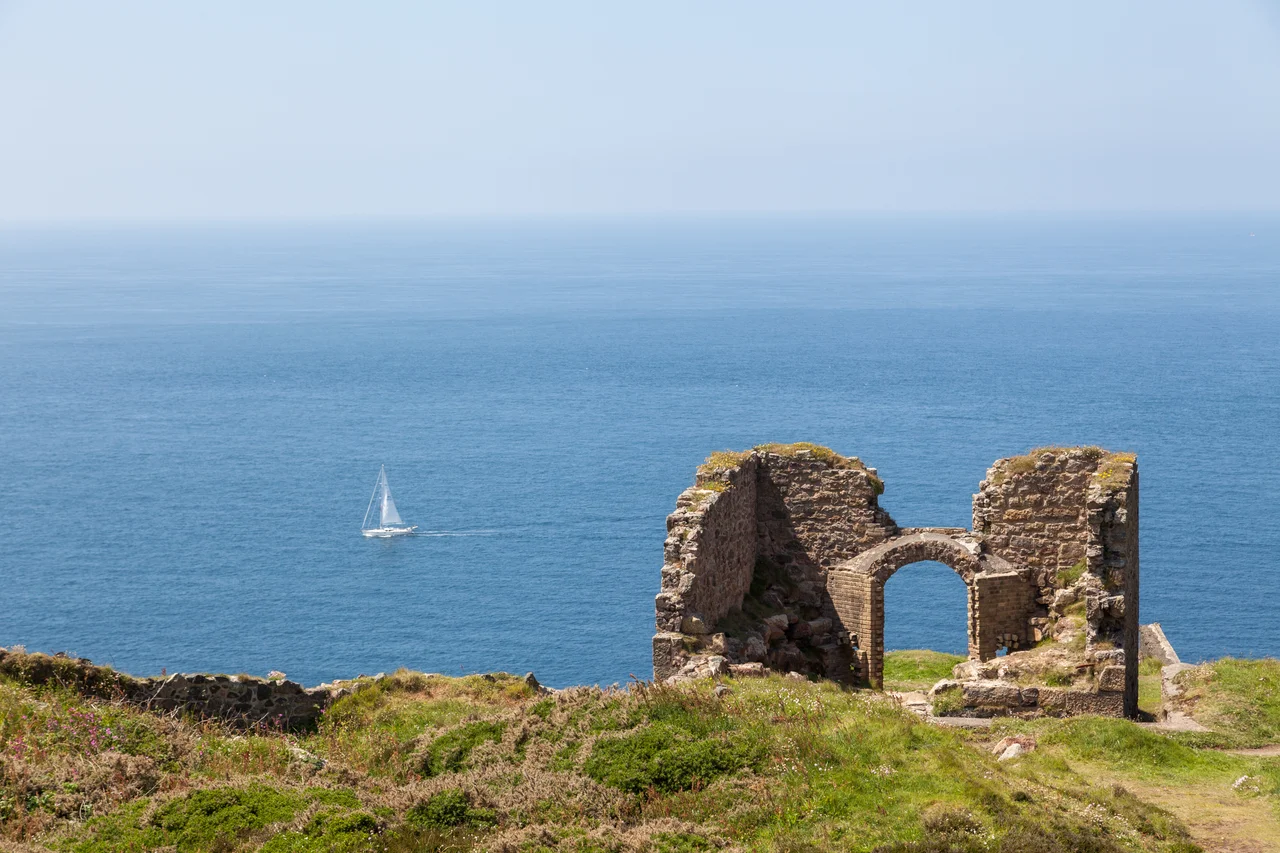
The miners at Botallack worked half a mile out under the Atlantic. They could hear the sea over their heads when the swells were big, boulders rolling across the rock above them like distant thunder. Down on the cliff edge, the two stone engine houses of the Crowns clung to a ledge above the breakers, their chimneys leaning slightly into the wind. The men climbed down to them on ladders fixed to the cliff face, then descended again, this time into the workings, until they were beneath the seabed itself. They came up at the end of the shift soaked in seawater and sweat, with the salt of two oceans on their skin.
Out Under the Sea
Botallack was a submarine mine. Its tunnels reached half a mile out under the Atlantic, following lodes of tin and copper that the Cornish geology had laid down in the granite hundreds of millions of years ago. Over the recorded life of the workings, miners pulled out around 14,500 tonnes of tin, 20,000 tonnes of copper, and 1,500 tonnes of arsenic. They moved an estimated 1.5 million tonnes of waste rock to get at it. The deepest engine shaft, Botallack itself, ran 220 fathoms down: roughly 1,320 feet. The Boscawen diagonal shaft slanted out under the seabed for some 500 fathoms — a perpendicular depth of 240 fathoms, with the workings extending 300 fathoms out horizontally beneath the seafloor. Inside those workings, water seeping through the rock above carried so much heat that men stripped to short trousers and worked by candle in temperatures that could exceed 100 degrees Fahrenheit.
The Lives of the Men
Two hundred and sixty-five workers were on the books in 1884, drawing wages totalling about 800 pounds a month. The figure includes the bal maidens, the women and girls who broke and dressed the ore on the surface, swinging hammers all day in the wind off the cliff. Underground, miners worked in pairs and threes on tributer contracts: they bid against each other for the right to work a particular section of lode, and they were paid by what they brought up. A good shift could mean prosperity. A bad month, especially when the price of tin dropped, could mean a family went hungry. The work killed slowly. Lung disease from rock dust, arsenic poisoning from the ore, accidents in the shafts; many miners did not reach their fortieth birthday. When the Cornish industry collapsed in the late nineteenth century, tens of thousands of these men carried their skills to copper and tin fields in Mexico, South Africa, Montana, and Australia, where the saying went that wherever there was a hole in the ground, you would find a Cousin Jack at the bottom.
The Royal Visit and the Auction
In 1865 the Prince and Princess of Wales, the future Edward VII and Alexandra of Denmark, came to Botallack and descended the diagonal shaft. They went down in mining gear, three hundred feet beneath the seabed, and emerged talking about the sound of the waves rolling overhead. The visit made the mine famous. Operators began charging tourists a guinea a head to descend, and Botallack became, for a few years, the closest thing nineteenth-century England had to an extreme attraction. The boom did not last. By October 1883 the entire sett, four pumping engines, three winding engines, two steam stamps, the lot, went up for auction as a going concern. The auctioneer told the room the mine only needed 20,000 to 25,000 pounds to be put back in working order. Nobody bid.
Poldark and the Heritage Site
The Crowns engine houses, perched on their cliff ledge, have become the most photographed Cornish mining image on earth. The BBC filmed Poldark here in the 1970s and again from 2015, using the Crowns to stand in for Wheal Leisure and Manor Farm as the fictional Nampara. Walk the South West Coast Path now and the engine houses rise out of the cliff face exactly as they did when steam billowed from their stacks and men descended in cages slung from rope. Since 2006 the whole sett has been part of the Cornwall and West Devon Mining Landscape, a UNESCO World Heritage Site. The mineral Botallackite, a green copper chloride hydroxide, has its type locality here, named for the rock where mineralogists first identified it. The Atlantic still rolls in, breaking against the ledge below the Crowns, and the houses still stand, empty now and full of wind.
From the Air
Located at 50.1333°N, 5.6833°W on the cliffs north of Botallack village, between St Just and Pendeen. Best viewed from 800-1,500 feet AGL along a coast-parallel track at the cliff line; the iconic Crowns engine houses sit on a ledge below the main cliff and are nearly invisible from inland but unmistakable from seaward. Nearest airport: Land's End (EGHC), 5 nautical miles south. Approach from the west over open ocean for the dramatic reveal as the cliffs and engine houses rise together. The coastline here is part of the UNESCO Cornwall and West Devon Mining Landscape; chimneys of half a dozen mines dot the skyline within a five-mile stretch.
Nearby Stories
- Bartholomew Ledges Wreck 1.8 km away
- Carn Brea Castle 4.6 km away
- Battle off Lizard Point 12 km away
- Carnewas and Bedruthan Steps 18 km away
- King Charles's Castle 25 km away
- MV Cita 34 km away
- 1979 Fastnet Race 47 km away
- Trevose Head Lighthouse 55 km away