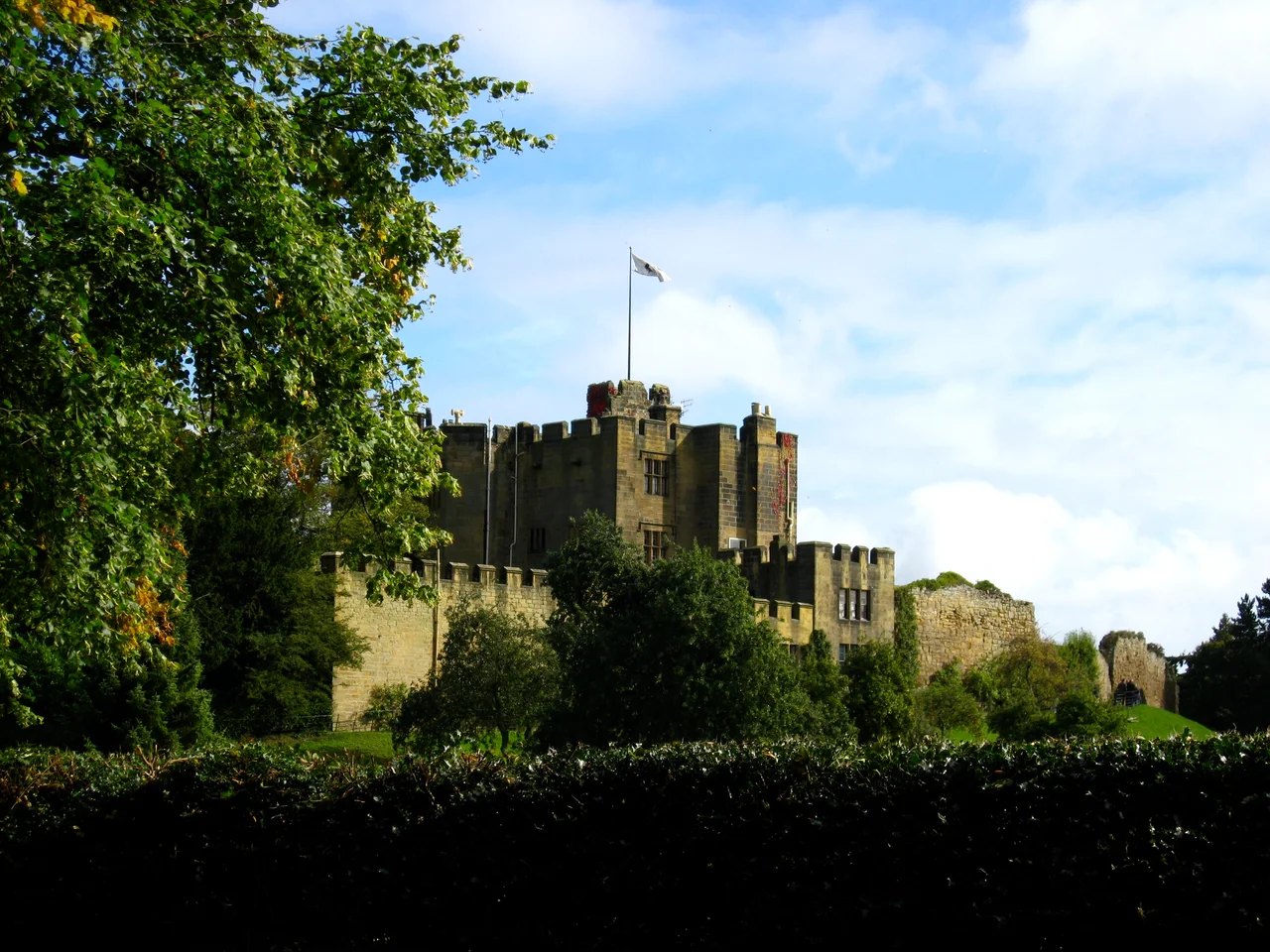

Bothal Castle
Bothal is simply the Old English word for a dwelling - a hall, a home. The men who first fortified the rise above the River Wansbeck did not need anything grander than that. Their castle has carried the name plainly ever since, through the Norman Conquest, through three royal grants, through marriages that wove it into some of the great families of England, and into the private ownership of the Cavendish-Bentinck Dukes of Portland, who still use it as a residence today. The river bends below it. Bothal village clusters at its foot. The visitor walking the public footpath from Ashington along the Wansbeck cannot enter the castle - but can see what the Earl of Shrewsbury's agents saw in 1583, when they wrote that it was a castle battled, and not unlike Nether Haddon where Master John Manners doth dwell.
From the Conquest to the Ogles
Bothal was fortified before the Norman Conquest, though what stood here then would have been a timber hall house rather than stone. In 1095, King William Rufus granted the estate to Guy I de Balliol - one of the Norman lords whose families would shape the politics of the Anglo-Scottish border for centuries. Guy's daughter Alice married William Bertram, Baron of Mitford, who probably built a more substantial hall house here. Several generations later, in 1343, Sir Robert Bertram was granted licence to crenellate - permission to turn his manor house into a true castle with an impressive gatehouse. The gate tower and fragments of the curtain wall from that 14th-century construction still survive. When Bertram's daughter Hellen married Sir Robert Ogle, who died around 1363, the castle passed to the Ogle family, who held it through some of the most turbulent years of the medieval border. Bothal is a Scheduled Ancient Monument and a Grade I listed building.
Inventories and Royal Visits
When Robert, Lord Ogle, died at Allerton Mauleverer in 1562, his executors compiled an inventory of furnishings at Bothal. The list reveals a Tudor castle interior of bed hangings, window cloths, and painted cloths - cheaper alternatives to tapestry that hung on the walls of even substantial households. The detail of those rooms is preserved nowhere else. In August 1583, Cuthbert Ogle, 7th Baron Ogle, negotiated a marriage between his daughter Jane and Edward Talbot, a son of George Talbot, 6th Earl of Shrewsbury. The Talbot family agents visited Bothal as part of the negotiations and wrote their description - calling it a castle battled, comparing it favourably to Nether Haddon in Derbyshire. By 1591, through the marriage of Catherine, Countess of Ogle, to Sir Charles Cavendish of Welbeck, Bothal passed into the Cavendish-Bentinck family - the line that would later become the Dukes of Portland. King James I visited on 5 May 1617 on his journey to Scotland, staying two nights as he travelled north.
Still a Home
Bothal escaped the fate of many medieval castles. It was not slighted in the English Civil War; it was not abandoned to ruin. The Cavendish-Bentinck family carried out major restoration work in the 19th century, returning the structure to a state of repair that most castles of its age never see. Today Bothal Castle is in excellent condition and remains a private residence of the family, also housing the Welbeck Estate Office. It is not open to the public. The village of Bothal that gives the castle its name - or perhaps takes its name from the castle, the historical sequence depending on which scholar you ask - sits at the river's edge below the castle walls. The walk up from Ashington along the Wansbeck through Riverside Park is a popular one, and the photogenic castle above the water is one of the most painted and photographed places in Northumberland. You cannot go inside. But you can see what generations of travellers have seen: a medieval gatehouse, a curtain wall, and a private family still living in a house their ancestors received from the marriage of a 16th-century Countess.
From the Air
Bothal Castle sits at 55.173 N, 1.625 W, on a rise above the River Wansbeck between Morpeth and Ashington. Newcastle International Airport (EGNT) is approximately 14 nm south-west. The castle and village lie in a wooded dene of the Wansbeck, with the river bending tightly below the castle walls - look for the distinctive gatehouse and curtain wall against the river. Ashington sits 2 nm east, Morpeth 4 nm west. Best viewed at 1,500-3,000 feet AGL on clear days; the wooded valley provides shelter and the castle is often partly screened by mature trees in summer.
Nearby Stories
- Alnmouth Lifeboat Station 2.6 km away
- Finchale Priory 4 km away
- Hadrian's Wall Path 8.5 km away
- Allenheads 8.7 km away
- Battle of Nesbit Moor (1355) 9.9 km away
- Saltburn Pier 29 km away
- Saltburn-by-the-Sea 59 km away
- Alexander L. Kielland (Platform) 286 km away