
Bothwell Castle
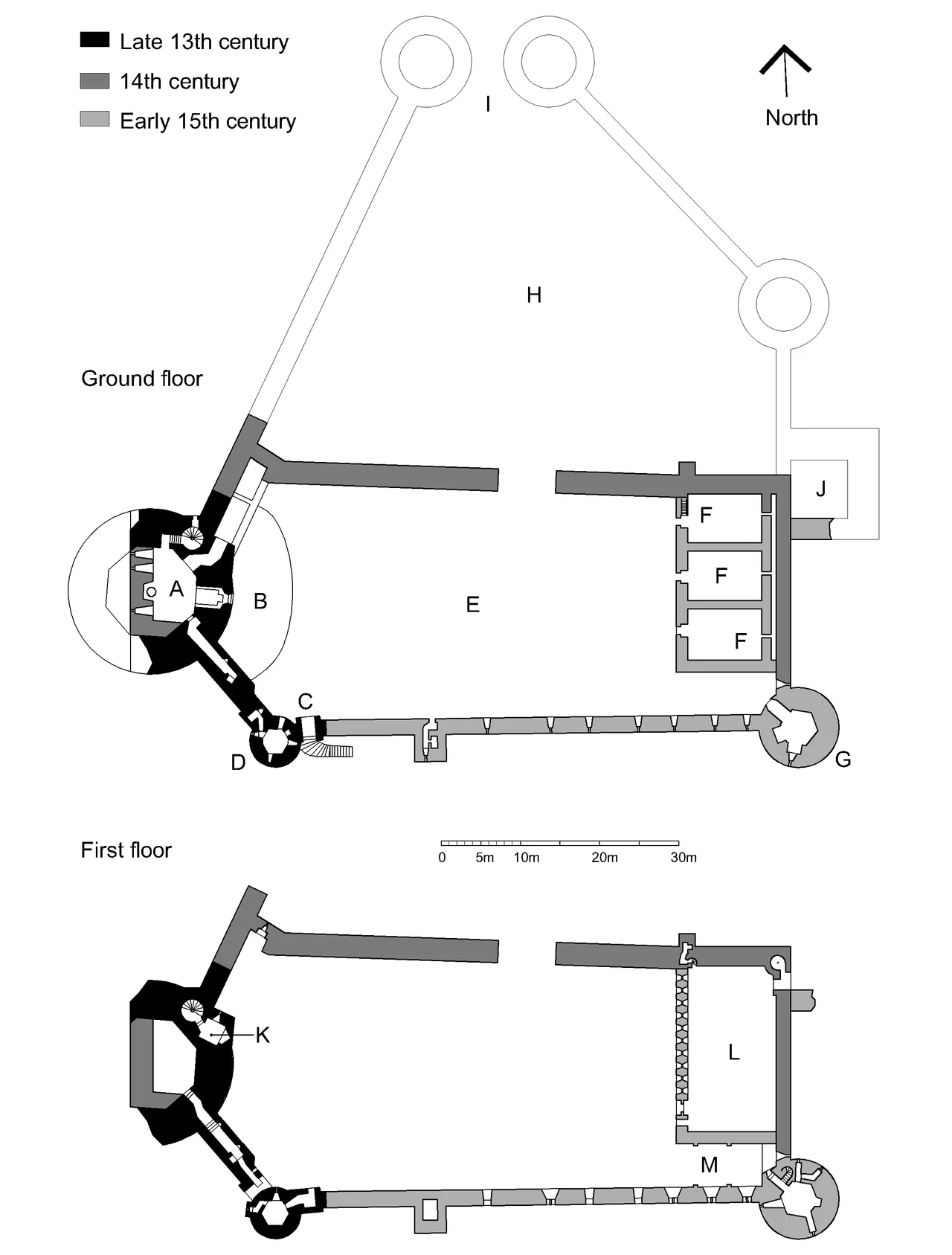
Walter of Moray meant Bothwell to be the grandest castle in Scotland. He started with the donjon - a cylindrical keep 82 feet high, 62 feet across, walls 15 feet thick - and planned curtain walls, towers, a great hall, all of it set on a bluff that bent the River Clyde into a defensive curve. Then in 1296, before the rest could be built, Edward I of England crossed the border. For the next 40 years Bothwell would change hands so many times that its own defenders kept demolishing it on the way out the door.
The Donjon That Outgrew the Castle
A donjon is a great cylindrical keep, the kind that French and English masons were perfecting in the 13th century at places like Coucy and Dirleton. Walter of Moray, who got the barony of Bothwell through his Norman ancestors and a series of advantageous marriages, wanted one of these on the bluff above the Clyde. By the time the Wars of Scottish Independence broke out in 1296, the donjon was finished but stood almost alone, ringed only by a prison tower and a short stretch of curtain wall. The rest existed mostly as foundations and a wooden palisade. The Scottish archaeologist William Douglas Simpson would later call what survives 'one of the foremost secular structures of the Middle Ages in Scotland.' Even half-built, it announced ambitions on a continental scale.
Four Decades of Sieges
Edward I's army took Bothwell almost immediately. The Scots got it back in 1298 after a 14-month siege - the English garrison held out that long. Edward returned in 1301 with 6,800 men and purpose-built siege engines, and the castle changed hands again. After Robert the Bruce won at Bannockburn in 1314, English nobles fleeing the battlefield sheltered at Bothwell; the constable, Sir Walter FitzGilbert, took one look at the situation and surrendered to the Scots. For switching sides he was rewarded with the barony of Cadzow, where his descendants became the Hamilton family - one of the most powerful in Scottish history. The Scots then slighted the castle, tearing down their own walls so the English could not garrison it again. In 1336 Edward III rebuilt it. In 1337 Sir Andrew Murray, the rightful owner, took it back with siege engines and pulled the west half of the donjon down into the Clyde to make sure of it. Half the great cylinder lies in the riverbed still.
The Douglas Centuries
By 1362 the wars were over and Bothwell had passed by marriage to Archibald Douglas - 'the Grim' - who became Lord of Galloway and Earl of Douglas. He repaired the donjon and completed the curtain walls his predecessors had only ever planned. His son, Archibald the 4th Earl, added the Great Hall and chapel by 1424, finally giving Bothwell the rectangular courtyard with corner towers that William of Moray had drawn up two centuries earlier. Then in 1455 the Black Douglases were forfeited - the price of getting too powerful in a Scotland whose kings were learning the same lesson as their French cousins. Bothwell passed from Crichton to Ramsay to Hepburn to Angus through a series of crown grants, exchanges and quiet feuds. James IV stopped by in 1503 and 1504. The Earls of Forfar inherited it and built a new mansion nearby in the 17th century, robbing the north-east tower for stone. That mansion in turn was demolished in 1926 - undermined, literally, by coal mining beneath the estate.
What You See From the Air
In 1935 the 13th Earl of Home handed Bothwell over to the state. Historic Environment Scotland has cared for the scheduled monument ever since. The castle closed to visitors in 2020 over safety concerns about the stonework - centuries of weather, war and mining subsidence catching up at last - and reopened in April 2024 with some access restrictions still in place. From the air the ruin still reads clearly: the rectangular courtyard with the broken stump of the great donjon at the west end, the long curtain walls running east to where the Great Hall meets the chapel, the wooded bluff dropping sharply to the Clyde on the south. The river makes the same defensive bend it always did. Half a donjon sits where it fell in 1337, waiting for somebody to fish it out.
From the Air
Bothwell Castle sits at 55.81N, 4.10W, on a wooded bluff above the south bank of the River Clyde, about 10 nm southeast of Glasgow city centre. The castle lies between the villages of Bothwell and Uddingston. From the air, look for the dramatic bend in the Clyde just east of where the M74 motorway crosses; the castle is on the inside of the southern curve, the woods of the Clyde Walkway leading to it. Glasgow International (EGPF) is 13 nm northwest, Glasgow Prestwick (EGPK) 26 nm southwest, Edinburgh (EGPH) 36 nm east. Recommended viewing altitude 3,000 to 6,000 feet to make out the rectangular ruin against the river bend.
Nearby Stories
- HMS Gannet 3.6 km away
- Luss 5.3 km away
- Oliver Castle 6.8 km away
- Battle of Bannockburn 6.9 km away
- Beith 7.9 km away
- Pentland Hills 7.9 km away
- Lochleven Castle 16 km away
- Cumnock 17 km away