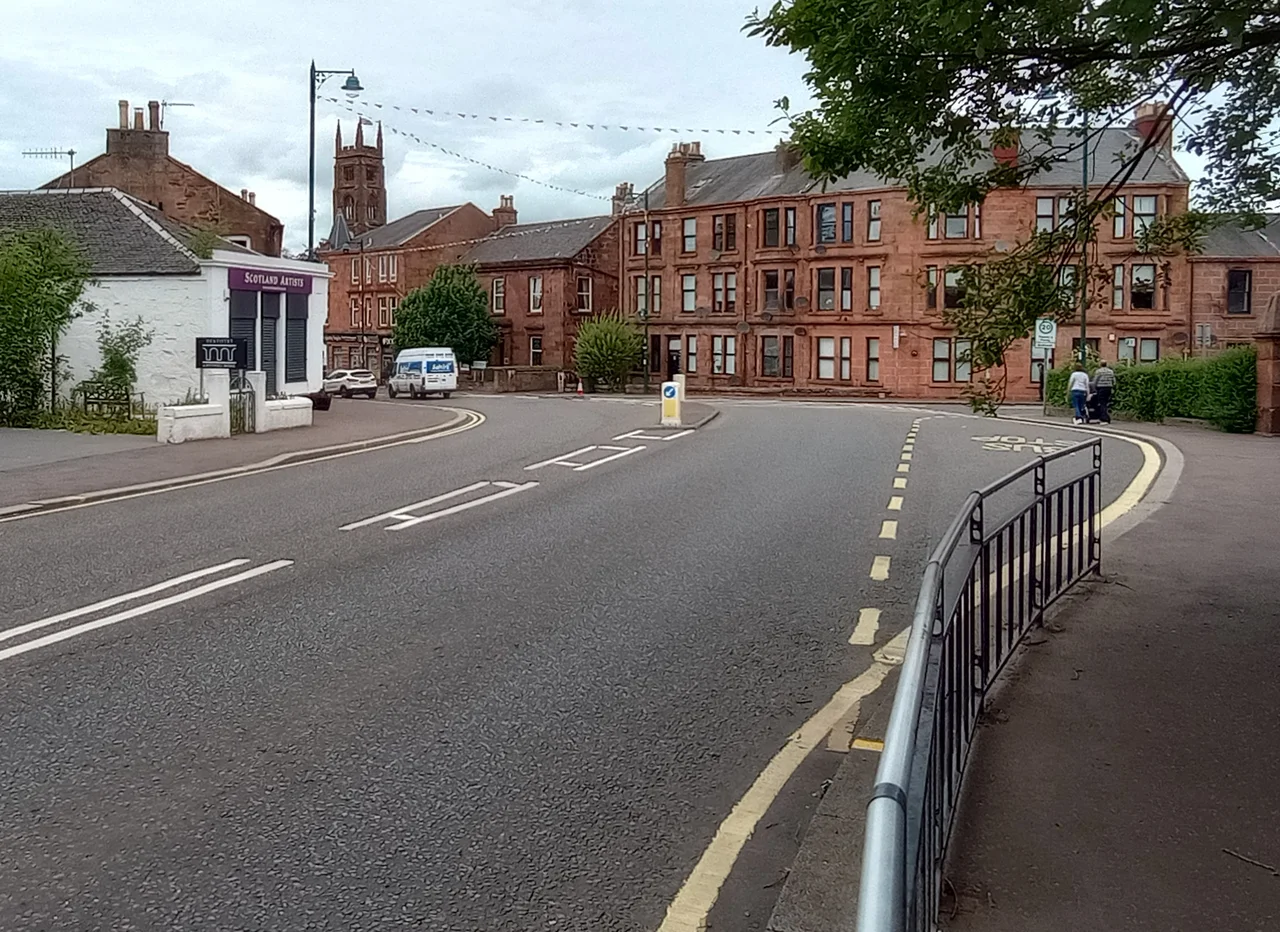

Bothwell
Earls Gate, in Bothwell, was named Greater Glasgow's most expensive street in 2019. Average price tag: £1,125,000. By 2021 the same row of houses was named the most expensive street in the entire West of Scotland. From its bay windows you can look down on the broken donjon of Bothwell Castle, the river bend Walter of Moray fortified seven centuries ago. It is a strange kind of continuity: a thirteenth-century stronghold whose grounds now line the property pages of the Glasgow papers, in a village that began as a mining row and is now a celebrity commuter belt.
From Pithead to Premiership
Bothwell sits on the north bank of the Clyde, nine miles east-southeast of Glasgow centre. For centuries it was a mining village - one of the seams of black coal that fed the iron furnaces of Coatbridge and the shipyards of the Clyde. Long before the mines, in June 1679, the Battle of Bothwell Bridge ended a Covenanter rising on the river crossing just south of the village. After the mines closed the cottages remained and the trains kept running into Glasgow. By the late 20th century Bothwell had reinvented itself as a commuter dormitory for footballers, lawyers and television presenters. Henrik Larsson, the great Swedish striker, kept a house here while he played for Celtic. Gordon Strachan, Leigh Griffiths, Archie MacPherson - the Main Street pubs collect the names like a who's-who of Scottish football.
A Choir from 1398
Bothwell's parish church was restored at the end of the 19th century, but its choir is older - the surviving choir of a Gothic church built in 1398. In the manse beside it, Joanna Baillie was born in 1762, a poet and playwright who would go on to be one of the most performed dramatists of her generation; a memorial inside the church honours her. The streets around the church are Victorian sandstone, the colour of weak tea, with the kind of slate roofs that mark Lanarkshire towns out from anywhere else. Newer estates run westward toward Bothwell Castle Golf Club, opened in 1923 by the Earl of Home and looped through the old castle grounds. Earls Gate is up there, the row of detached mansions with their views over the Clyde.
Scarecrows on the Main Street
In 2010 a community group called Brighter Bothwell launched what became the Bothwell Community Scarecrow Festival. Every September the Main Street fills with scarecrows - made by local businesses, by schoolchildren, by households who tape their efforts to garden walls. Boyd Tunnock, of the famous Lanarkshire caramel wafer dynasty, lent classic cars to the 2013 Festival of Transport. Proceeds go to the Yorkhill Children's foundation. Brighter Bothwell has won the small-town category in the Beautiful Scotland competition, and pushed the village up to Silver Gilt standard - the kind of award nobody outside the world of British civic horticulture quite knows how to value, but which villages compete for fiercely all the same.
The Bothwell Bank
Bothwell's bluff above the Clyde takes the river in a wide, bold sweep that Scottish ballads have been calling 'the Bothwell bank' for as long as anyone has been writing them down. A footbridge crosses the river to Blantyre on the south side, leading directly to the David Livingstone Centre - making Bothwell, almost by accident, a waypoint on one of the great pilgrim routes of Scottish biography. The Clyde Walkway runs through the woods to Bothwell Castle on one side and downriver toward Glasgow on the other. In 1949 the village even had a brief speedway career, the Bothwell Bulls thundering around a track built on old railway land in the castle estate before the whole operation decamped to Chapelhall.
From the Air
Bothwell lies at 55.80N, 4.07W, on the north bank of the Clyde 9 nm southeast of Glasgow. The village sits between Uddingston to the northwest and Hamilton to the south, just off the M74 motorway. From the air, look for the bend in the Clyde where it loops around Bothwell Castle's wooded bluff, with the village immediately to the north on flatter ground. Bothwell Castle Golf Club is a recognisable green oval west of the village. Glasgow International (EGPF) is 12 nm northwest; Glasgow Prestwick (EGPK) 25 nm southwest; Edinburgh (EGPH) 35 nm east. Best viewed from 3,000 to 6,000 feet.
Nearby Stories
- HMS Gannet 3.6 km away
- Luss 5.3 km away
- Oliver Castle 6.8 km away
- Battle of Bannockburn 6.9 km away
- Beith 7.9 km away
- Pentland Hills 7.9 km away
- Lochleven Castle 16 km away
- Cumnock 17 km away