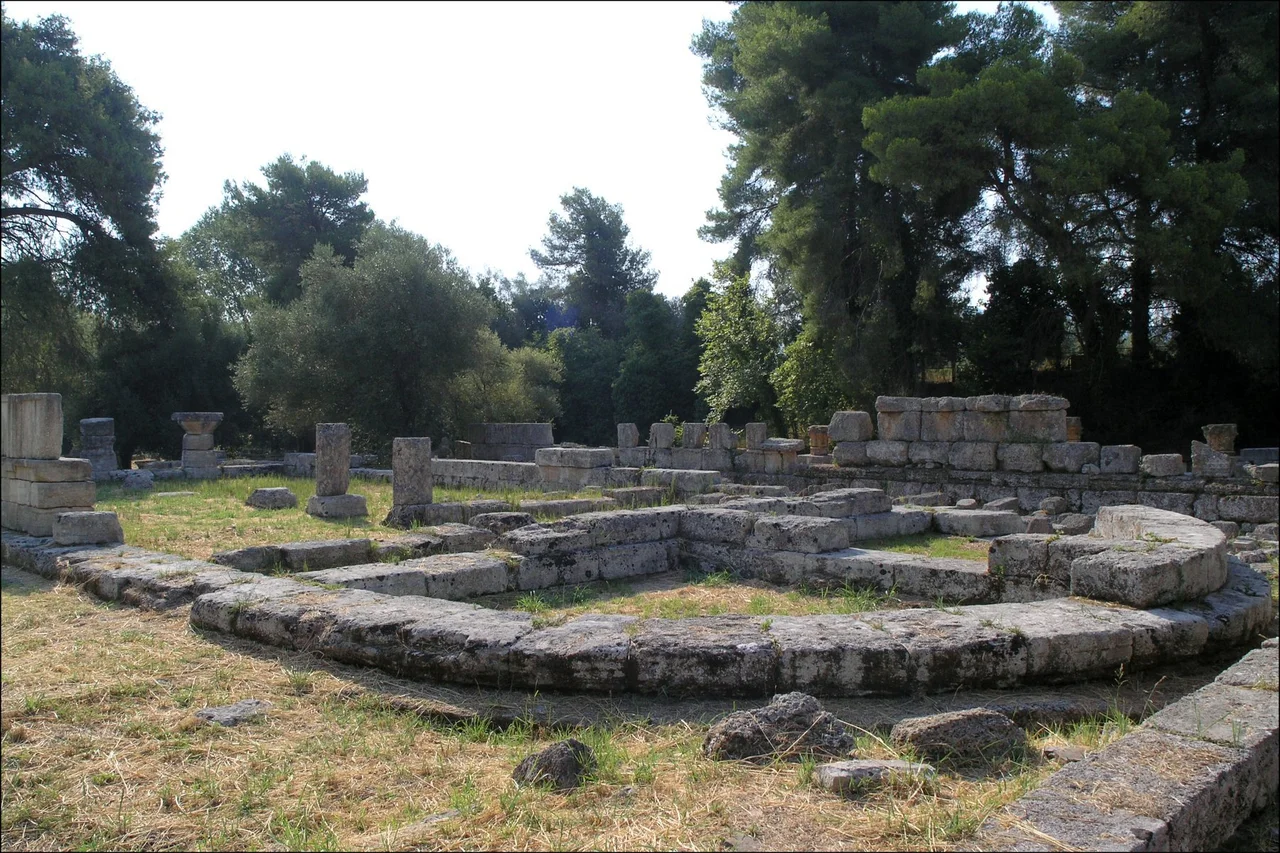

Bouleuterion of Ancient Olympia
Before any athlete could compete at Olympia, he had to stand before Zeus. Not the enormous chryselephantine colossus in his great temple — that came later — but a grimmer, older effigy: Zeus Horkeios, Zeus of the Oaths, positioned inside the Bouleuterion with one hand raised and a thunderbolt ready. Every competitor, and his father and his brothers too, took the oath here: that they had trained for ten months, that they would play fair, that they would not cheat the Games. The penalty for lying to this particular god was swift and known. The Bouleuterion was where the Olympic promise was made — and where its weight was meant to be felt.
The Architecture of Authority
The Bouleuterion complex sits within the Altis, the sacred enclosure of Olympia, immediately south of the great Temple of Zeus. It was not built in a single campaign but grew over roughly two centuries, from the sixth century BC through the fourth, with further Roman-era adjustments added later. The result is an unusual arrangement: two apsidal buildings on the west side — that is, buildings with semicircular ends — joined to a square hall and an Ionic portico facing east. The apsidal form is older, more archaic, predating the confident rectangular planning of the classical period. You can read the building's biography in its footprint: a city-state institution that accumulated meaning as the Games grew in prestige, adding rooms and colonnades as the bureaucratic demands of a panhellenic festival multiplied.
The Seat of the Elean Senate
The Bouleuterion served as the administrative heart of the ancient Olympics. The Elean Senate — the governing body of Elis, the region and state that controlled Olympia — met here to manage the Games. In practical terms, this meant registering athletes, adjudicating their eligibility, assigning places in the draw for heats and bouts, and levying fines for rule violations. Athletes could be expelled for bribery; the fine was used to commission bronze statues of Zeus — the Zanes — which lined the path to the stadium as a very public reminder of what happened to cheats. The Bouleuterion was both administrative office and courtroom, mundane and sacred at once.
The Oath and Its Witness
At the center of the building's ritual function stood the altar and statue of Zeus Horkeios. Unlike the idealized, serene Zeus of later classical art, the Horkeios figure was described in ancient sources as deliberately fearsome — a god depicted holding thunderbolts in both hands, as if poised to strike. Athletes, trainers, and the male relatives who accompanied them gathered before this image to swear. The oath was specific and solemn: not merely a general promise of fairness, but a declaration that they had completed their ten months of prescribed training and had committed no act that would pollute the Games. The ritual combined legal contract with religious terror. Breaking the oath was not just cheating — it was sacrilege.
What the Ruins Tell Us
The Bouleuterion today is one of the older and less immediately imposing structures on the Olympia site. Its remains are low — foundation courses and the ghost of floor plans — but their significance is legible once you know what happened here. The building's proximity to the Temple of Zeus was deliberate: the oath was taken in the shadow of the god's greatest house, lending it additional gravity. Roman-period modifications show the site remained active for centuries. Elis maintained its grip on the sanctuary and its Games through most of antiquity, and the Bouleuterion served the administration of that authority until the emperor Theodosius I banned the Games in 394 AD.
A Covenant in Stone
To stand among the Bouleuterion's foundations is to stand where athletes of the ancient world came to bind themselves — to their sport, to their gods, to the ideal of honest competition. The statue of Zeus Horkeios is long gone. The apsidal halls are reduced to outlines in the soil. But the act performed here — the public promise before a divine witness, the staking of one's honor against the possibility of divine punishment — proved durable enough to echo across twenty-five centuries. Every modern athlete who pledges fair play at an opening ceremony is, however distantly, repeating something that began in this particular room, before that particular statue, at the edge of the sacred plain of Olympia.
From the Air
The Bouleuterion sits at approximately 37.637°N, 21.631°E within the Altis at ancient Olympia in the western Peloponnese. Approach from the northwest following the Alpheios River valley for good orientation. The ancient site is best appreciated from 2,000–3,000 feet above ground level, where the rectangular enclosure of the Altis and the surrounding gymnasium and stadium areas become legible as a coherent whole. The nearest airport with regular traffic is LGRX (Araxos Airport), approximately 55 km to the northeast near Patras. Visibility in the Peloponnese interior is generally excellent in summer, with the Alpheios and Kladeos river courses serving as natural navigation references.
Nearby Stories
- Santameri Castle 4.6 km away
- Aristarchos 2.3 m Telescope 4.8 km away
- Lepreum 9.1 km away
- Arcadia (region) 13 km away
- Peloponnese 14 km away
- St. Mark's Roman Catholic Church 20 km away
- Strofades 22 km away
- County Palatine of Cephalonia and Zakynthos 39 km away