
Boxley Abbey
The figure on the cross moved. Its eyes rolled. Its lips parted to speak. For centuries before the Reformation, pilgrims came to Boxley Abbey to see the Rood of Grace - a wooden crucifix with moveable parts that the Cistercian monks of Boxley used in their devotional displays. In February 1538, Thomas Cromwell's commissioner Geoffrey Chamber arrived with orders. He examined the rood. He found, exactly as he expected, the wires and levers that animated the figure. He took the rood down. It was displayed in Maidstone market to show the fraud. Then it was sent to London and broken to pieces in front of St Paul's Cathedral, accompanied by a mocking sermon from the Bishop of Rochester. The Reformation had found its emblematic exposure. Whether what was exposed was actually fraud is another question entirely.
Flemish Mercenaries and Cistercian Monks
Boxley Abbey was founded around 1146 by William of Ypres, the leader of King Stephen's Flemish mercenaries during the Anarchy. The choice of founder was unusual - most English abbeys were endowed by Anglo-Norman magnates with deep local roots - but William had been granted lands in Kent in exchange for his military service to Stephen, and the foundation of an abbey was both an act of piety and a way of converting battlefield wealth into spiritual capital. The monks came from Clairvaux Abbey in France, the mother house of the Cistercian reform under Bernard of Clairvaux himself. They settled at the foot of the North Downs, in the parish of Boxley near Maidstone, and built their abbey to the strict Cistercian template: white-robed monks following the Rule of St Benedict in its purest form, austere architecture, manual labour combined with prayer.
Thomas Becket and Richard the Lionheart
The abbey acquired political significance quickly. In 1171, the then abbot of Boxley was one of those responsible for the burial of Archbishop Thomas Becket, murdered in Canterbury Cathedral the year before. Becket's burial was a political act in itself, the Church making clear its position on the murder of one of its primates by knights acting on a king's wish. Twenty-two years later, in 1193, the abbots of Boxley and Robertsbridge undertook one of the more remarkable diplomatic missions of the Middle Ages. King Richard I had vanished on his way home from the Third Crusade. His brother John was angling for the throne. The two Cistercian abbots travelled across the continent searching for him. They found him in Bavaria, imprisoned by Duke Leopold of Austria. Their information helped negotiate the ransom that eventually brought the Lionheart home.
The Rood of Grace
Whatever the Rood of Grace was, it was old. The carved wooden crucifix with its moveable parts probably dated from the twelfth century, around the time of the abbey's foundation. Diarmaid MacCulloch, the historian of Cromwell and the Reformation, has pointed out that moveable parts in religious statuary were not unusual in the twelfth century, and were not necessarily fraudulent. They were theatrical aids to devotion, allowing congregations to experience the Passion of Christ as a moving spectacle. Theatrical historian Leanne Groeneveld has argued the rood was understood by its audience as a puppet - a religious performance, not a deception. The monks knew it moved by wires. Their congregations probably knew too. Geoffrey Chamber's discovery of the levers was less an exposure of fraud than an exposure of what everyone had always understood. The supposed finger of the Apostle Andrew, also displayed at Boxley, was pawned to a local merchant for eleven pounds when pilgrim donations stopped flowing.
Henry's Hammer
The dissolution of Boxley Abbey came in early 1538. The abbey was surrendered to the king on terms - the lesser monasteries had already been dissolved by act of Parliament in 1536, and the larger houses were being picked off one by one. The Rood of Grace and the relic of St Andrew's finger gave Cromwell a useful propaganda piece. The destruction of the rood at St Paul's, accompanied by Bishop John Hilsey's mocking sermon, was performed for maximum effect. It made the case that the medieval religious system had been propped up by deception, that the monks had been confidence tricksters, that the Reformation was clearing away centuries of fraud. The argument was simpler than the reality. Henry got what he wanted: the abbey's lands, its buildings, its endowments. The site was granted in 1540 to Sir Thomas Wyatt the Elder, the poet, whose family seat at Allington Castle was a few miles away.
Bones in the Wall
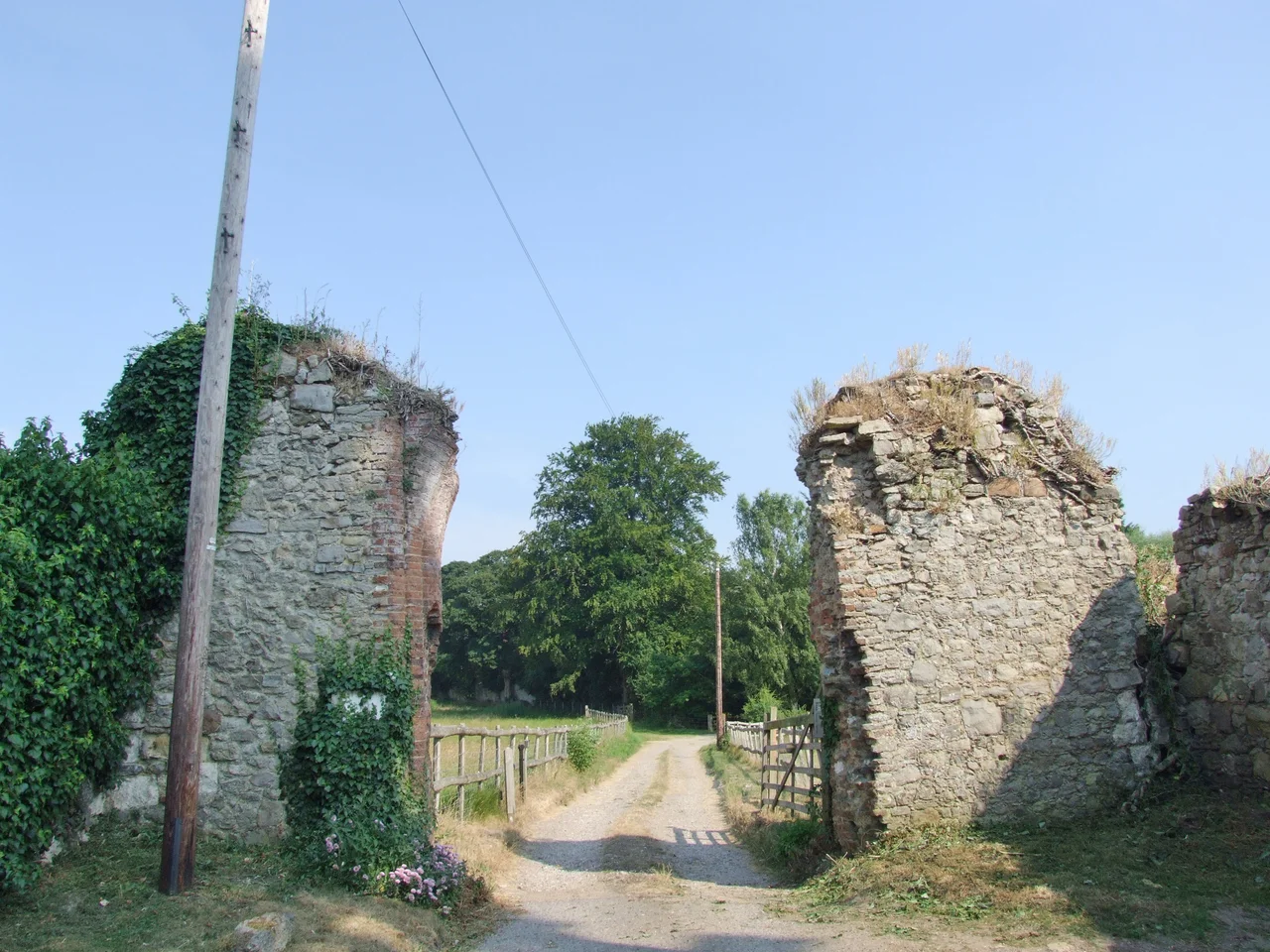
After the dissolution, the abbey's west range and abbot's house were converted into a country residence. The church was demolished, though a doorway in the south aisle still survives. The thirteenth-century stone barn that had served as the abbey's hospitium - the guest house where pilgrims slept - still stands as Boxley Abbey Barn, a Grade I listed building roofed and preserved. Boxley Abbey House, mostly nineteenth-century, incorporates fragments of the medieval west range within its walls. The precinct is a scheduled monument, ringed by the ruins of its medieval wall and entered through a ruined gatehouse. The site is private. The parish church of St Mary and All Saints in Boxley village was associated with the abbey from the beginning. The former chapel of St Andrew - quite probably the original home of the apostle's finger - was converted to a house at the Dissolution and is now (2024) being restored by the SPAB as their Old House Project. The white monks are long gone. Their building stones hold up other people's walls.
From the Air
Located at 51.30 degrees N, 0.52 degrees E, in Sandling at the foot of the North Downs, just northeast of the M20-A229 Sandling Interchange and north of Maidstone in Kent. The ruined precinct walls and surviving Boxley Abbey Barn appear as a distinct heritage feature in the rural strip between the M20 and the chalk escarpment of the North Downs. Nearest airports: London Biggin Hill (EGKB) twenty miles northwest, London Gatwick (EGKK) twenty-nine miles west-southwest. Best viewed at 1,500-3,000 feet on clear days.
Nearby Stories
- Blackwall Tunnel 0.2 km away
- London Gateway 2.6 km away
- Canterbury Castle 4.2 km away
- Battle Abbey 7.4 km away
- Plymouth Brethren 9.9 km away
- The Carrington Event: The Solar Storm That Could Happen Again 12 km away
- Clacton Pier 32 km away
- 2008 Channel Tunnel fire 42 km away