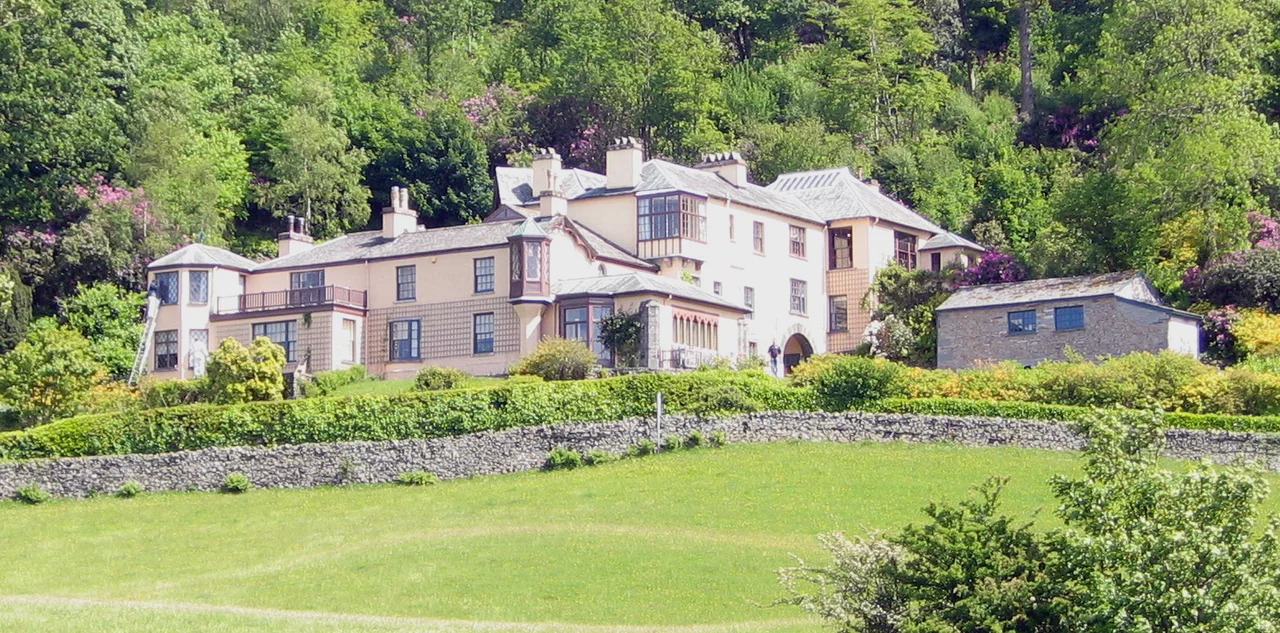

Brantwood
John Ruskin had never seen the house when he bought it in 1871. He committed to Brantwood - a modest pile of grey stone on the steep wooded eastern shore of Coniston Water - on the recommendation of his friend George William Kitchin, who was then living there. Kitchin and Ruskin had met as young men at Oxford. So when Ruskin paid 1,500 pounds, sight unseen, he was buying not just a building but a friend's enthusiasm. He moved in the following year and stayed nearly thirty. The name itself was a clue: 'brant' is Old Norse for steep, and Brantwood sits exactly where its name says it should.
An Essential Viewing Point
Long before any building stood on it, this hillside above Coniston Water was on the maps of early Lake District travellers as 'an essential viewing point.' The original Brantwood was thrown up at the end of the 18th century by Thomas Woodville - just six or eight rooms - and was extended around 1833. By the mid-19th century the resident was Josiah Hudson, father of the Anglican priest and pioneering mountaineer Charles Hudson. In 1852 the wood engraver, poet, illustrator, and social reformer William James Linton lived here, buying the house the next year. While Linton was in London between 1858 and 1864 he let the place to Gerald Massey, poet and Egyptologist. In 1867 Linton emigrated to America. Brantwood passed to Kitchin, and from Kitchin, indirectly, to Ruskin.
Ruskin Arrives, and Rebuilds
Before moving in, Ruskin commissioned repairs: a turret on the southwest corner, a lodge for his valet's family, improvements to the garden. Once installed he filled the house with art. The drawing room held paintings by Gainsborough, Turner, and members of the Pre-Raphaelite Brotherhood, along with cabinets of minerals, pottery, and seashells he had been collecting for decades. Above the shell-cabinet hung his own drawing of the north porch of St Mark's, Venice. The wallpaper was a copy of his own design. For a short period he ran tutorial seminars in the house, meeting students three times a week on three different subjects: Art, Literature, and Sociology. A former pupil, Richard Hosken, served as his evening assistant when Ruskin himself was away.
A Household of Severns and Visitors
Ruskin did not live at Brantwood alone. He was joined by his cousin Joan Agnew, her husband the artist Arthur Severn, and their growing family. A new dining room was built at the south end of the house in 1878, with seven lancet windows looking across the lake to the Coniston Fells. A second storey was added around 1890 to give the Severns more space, and a studio was built at the back for Arthur Severn's work. Frequent visitors included W. G. Collingwood - painter, archaeologist, and translator of Nordic sagas - who lived nearby and would become Ruskin's first biographer. The garden, meanwhile, became one of Ruskin's laboratories. He used it to experiment with cultivation and drainage. Steep winding paths still climb through it.
From Family Home to National Trust
Ruskin died at Brantwood in 1900. In his will he asked that the house should be opened for thirty days each year so visitors could see his collection. The Severns did not honour the wish, and over the following decades they sold many of the better paintings. After Arthur Severn's death in 1931 the remaining contents were sold at auction. Emily Warren - the last of Ruskin's pupils - led a campaign to turn Brantwood into a museum. The house was finally saved for the nation by John Howard Whitehouse, founder of Bembridge School and of the Birmingham Ruskin Society, who bought it and established the Brantwood Trust in 1951. The Trust still runs the property today, a registered charity caring for both the house and 250 acres of grounds.
Lithophones and Lakeside Light
Visitors today see five rooms inside the Grade-II*-listed house. The drawing room still contains Ruskin's secretaire, bookcase, and shell-cabinet. Next door is the study where he worked, with a painting by Samuel Prout. The 1878 dining room looks across the water to the Coniston Old Man. The old dining room contains some of Ruskin's earliest drawings. In the turret above is his bedroom. Out in the grounds there are four more listed buildings - lodge, former stable, coach house, ice house. In the Linton Building stands one of Brantwood's strangest objects: a lithophone called The Musical Stones, a percussion instrument made of carefully tuned slate that visitors are invited to play. The estate runs across 250 acres of lakeshore, pasture, oak woods, and moorland - the whole thing arranged, as Ruskin would have wanted, around the view.
From the Air
Brantwood sits at 54.3535N, 3.0592W on the steep eastern shore of Coniston Water in the southwestern Lake District. Coniston Water is the long thin lake immediately west of Windermere, about 5.5 miles long. The house occupies a wooded slope; from altitude look for the small jetty on the lakeshore below it and the Coniston village at the head of the lake to the north. The Coniston Old Man rises sharply just west. Nearest airports are Carlisle Lake District (EGNC) about 35 nm north, Walney Island (EGNL) 18 nm southwest, and Blackpool (EGNH) 45 nm south. Recommended viewing altitude 3,000-4,000 ft AGL; fells push above 2,500 ft to the west.
Nearby Stories
- Morecambe Bay 4.1 km away
- Caldbeck 8 km away
- Pendragon Castle 8.1 km away
- Egremont Castle 8.5 km away
- Upper Teesdale 13 km away
- Solway Firth 13 km away
- Malham Cove 21 km away
- Santon Railway Station 70 km away