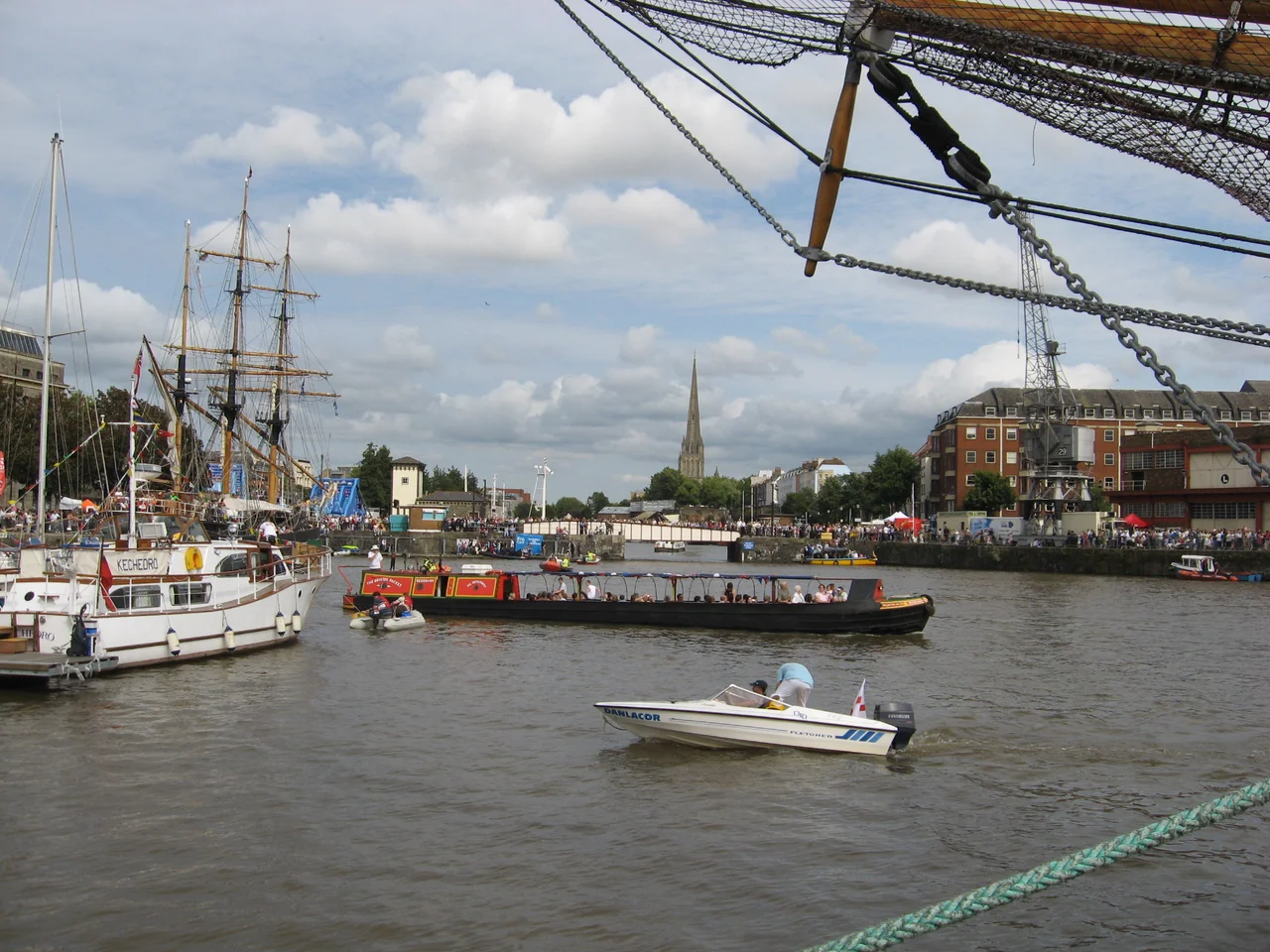

Bristol Harbour
On 7 June 2020, during a Black Lives Matter protest, demonstrators pulled the bronze statue of Edward Colston off its plinth in Bristol city centre, jumped on it, daubed it in red paint, rolled it through the streets, and threw it into Bristol Harbour. Colston had made his fortune as a deputy governor of the Royal African Company. He had personally overseen the transport of an estimated 84,000 African men, women and children into slavery, of whom perhaps 19,000 died on the voyage. The harbour where his statue sank had been built on the wealth that traffic generated. The water that closed over him had carried his ships.
The Floating Harbour
Bristol grew up on the banks of the rivers Avon and Frome, with one of the largest tidal ranges in the world. At low tide ships sat in the mud. The phrase shipshape and Bristol fashion came from the local practice of building hulls strong enough to take their own weight when grounded. By 1802, ships had grown too large for that to work. The engineer William Jessop proposed damming the Avon at Hotwells and digging a two-mile bypass channel, known forever after as the New Cut, to carry the tide around the city. Inside the dam, the river became a permanent lake at high-water level, the Floating Harbour, holding ships afloat continuously. The scheme cost 530,000 pounds, an enormous sum, and was approved by Parliament. Construction began in May 1804. The harbour opened on 1 May 1809.
Cabot, tobacco, and the slave trade
Bristol had been a great Atlantic port for centuries before the Floating Harbour. By 1420 Bristol ships sailed regularly to Iceland, and some historians believe Bristol sailors had reached North America before Columbus. John Cabot left from Bristol in 1497 on the Matthew and made the first documented English landfall in the Americas, sponsored by the Society of Merchant Venturers. By 1670 the port held 6,000 tons of shipping, half of it given over to tobacco. By the late 17th century, much of the rest was given over to the transatlantic slave trade. Bristol's merchants invested in slave voyages, built ships fitted for the Middle Passage, and grew enormously wealthy from a traffic in human beings. The city's elegant Georgian terraces were paid for, in large part, with the proceeds of slavery. Edward Colston was the most famous beneficiary, but he was far from alone.
Brunel's ships, Brunel's docks
By the 1830s Isambard Kingdom Brunel was the engineer of choice for ambitious Bristol projects. He upgraded Jessop's locks, rebuilt parts of the harbour and designed two of the most important ships ever launched from it. The SS Great Western, built at William Patterson's yard inside the Floating Harbour in 1838, became the first purpose-built transatlantic steamship. In 1843 the same yard launched the SS Great Britain, the first iron-hulled, screw-propeller-driven ocean liner. The Great Britain still floats in Bristol Harbour today, restored and visible from the south bank. Around her sit the surviving fabric of the working port: the octagonal red-brick chimney of the Underfall Yard hydraulic engine house, built in 1888, the A Bond Tobacco Warehouse of 1905, the B Bond Warehouse of 1908, the first building in Britain to use Edmond Coignet's reinforced concrete system.
Reckoning with the past, slowly
Trade moved out as ships grew larger. The Royal Edward Dock at Avonmouth opened in 1908, and the deepwater Royal Portbury Dock in 1972, making the city centre docks redundant for freight. The last Bristol shipbuilder, Charles Hill & Sons, closed in 1977 after delivering the beer tanker Miranda Guinness. The empty warehouses slowly became something else. The Arnolfini gallery occupies a 19th-century tea warehouse. The Watershed media centre occupies another. M Shed museum tells the city's story from the converted Bristol Industrial Museum building. Every summer the Bristol Harbour Festival draws 200,000 visitors to the quaysides for tall ships, music and street performance. The harbour is, by most measures, one of the most successfully regenerated postindustrial waterfronts in Britain. The reckoning with what built it is more recent. Colston's statue was retrieved from the harbour mud, displayed lying down and graffitied at M Shed, and the city continues to argue about how to tell the whole story honestly.
From the Air
Coordinates 51.45 N, 2.60 W. Bristol Harbour occupies the former course of the River Avon through central Bristol, with the bypass New Cut running parallel to its south. From altitude the harbour reads as a wide, sinuous lake winding through the city, anchored at its western end by the Cumberland Basin locks and overlooked by Clifton Suspension Bridge crossing the Avon Gorge. The deepwater terminals at Avonmouth and Portbury lie 7 nm downstream at the river mouth. Nearest airports: Bristol (EGGD) is 6 nm south-west; Filton (EGTG, now closed to fixed-wing but still a useful landmark) is 4 nm north; Cardiff (EGFF) is 25 nm west across the Severn Estuary. Best viewing is afternoon, when the SS Great Britain's masts catch the western light.
Nearby Stories
- Cosmeston Medieval Village 1.4 km away
- Glastonbury Festival 3.5 km away
- Tintern Abbey 3.6 km away
- Quantock Hills 4.8 km away
- Ebbw Vale Steelworks 10 km away
- New Wardour Castle 12 km away
- Windmill Hill, Avebury 16 km away
- Cotswolds 18 km away