
Bristol Museum & Art Gallery
In June 2009 a secret exhibition opened in Bristol. No press release, no advance billing, just an extra 70 works of art slipped into the existing galleries of Bristol Museum & Art Gallery. Animatronic chicken nuggets pecking in a cage. A penguin on a snow-cone. A burned-out ice cream van. Banksy versus Bristol Museum, his largest show ever, drew enormous queues to the museum's grand Edwardian entrance the moment word leaked. The museum had pulled off the impossible: a Banksy exhibition that not even the curators' partners knew was coming.
An Edwardian gift
The museum's origins lie in 1823, when the Bristol Institution for the Advancement of Science and Art opened in a neoclassical building at the bottom of Park Street, designed by Sir Charles Robert Cockerell, the same architect who later completed the Fitzwilliam Museum in Cambridge and St George's Hall in Liverpool. It merged in 1871 with the Bristol Library Society, moved into a new Venetian Gothic building at the top of Park Street in 1872, and would still be there if the tobacco baron Sir William Henry Wills, later Lord Winterstoke, had not offered 10,000 pounds in 1899 to build a city art gallery on the adjoining site. The new building, designed by Frederick Wills in full Edwardian Baroque, opened in February 1905. Sir Hubert von Herkomer gave the inaugural address. It is now Grade II* listed.
The bomb that gutted the museum
On the night of 24-25 November 1940, during the Bristol Blitz, a bomb hit the old Venetian Gothic museum building. The fire that followed destroyed about 17,000 of its natural history specimens, a loss that took the collection generations to rebuild. The 1930 art gallery extension was also hit but the building survived with blast damage. The art gallery partially reopened in February 1941, in the middle of the war, sharing space with what remained of the museum. The two institutions were formally separated in 1945, with the lower floor reverting to the museum and the upper floors to the gallery. The shell of the old museum, except its undamaged lecture theatre, was sold in 1947 to the University of Bristol and rebuilt as university dining rooms, today known as Brown's Restaurant.
What's inside
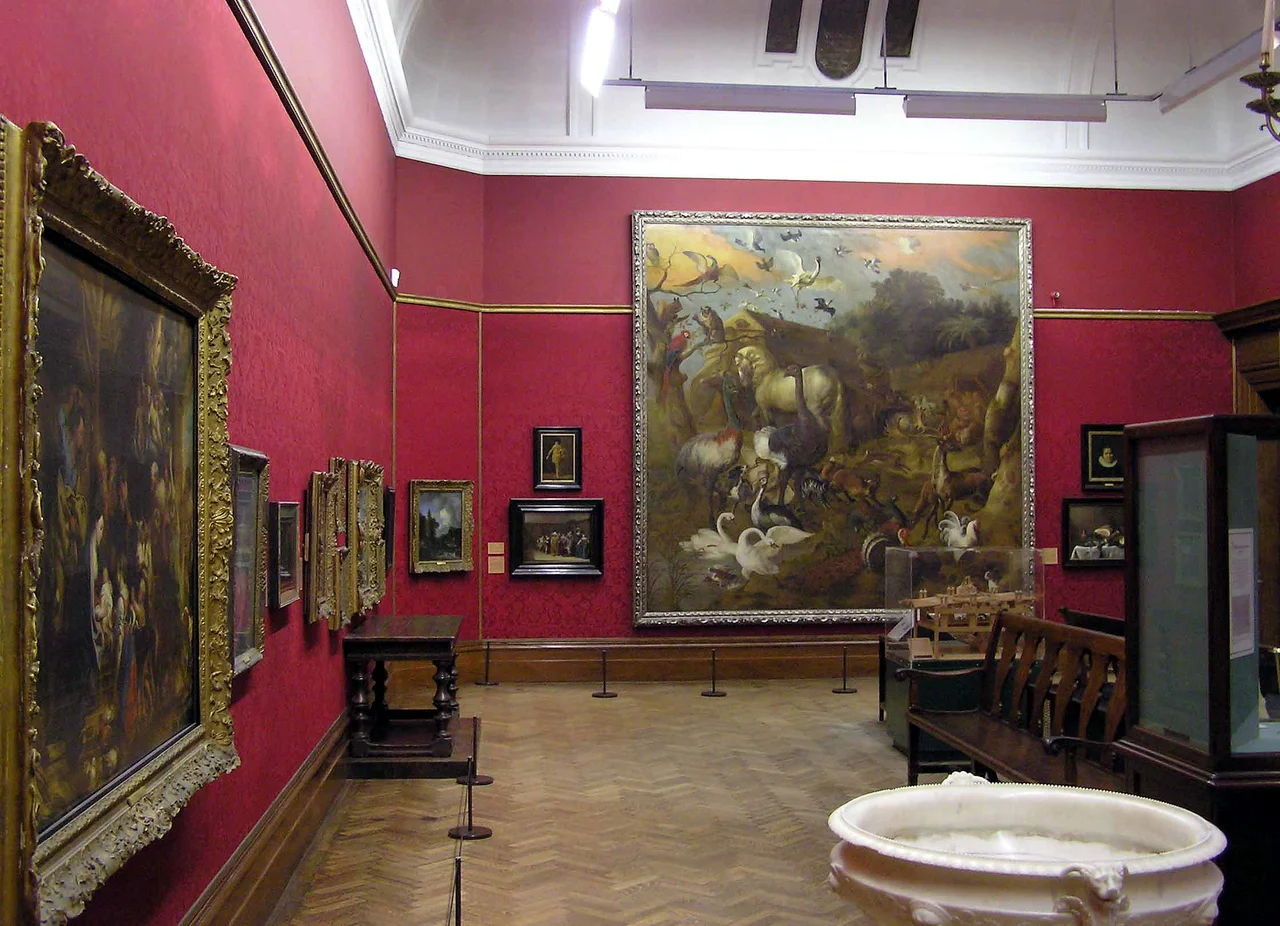
A replica Bristol Boxkite biplane hangs from the main hall ceiling, built in 1963 for the film Those Magnificent Men in Their Flying Machines. Below it sprawl the museum's designated collections, granted special national status for outstanding importance: geology, Eastern art, and Bristol history including English delftware. The Egyptology gallery holds mummies, the Assyrian Reliefs, and a stela from the high official Meni acquired through the Egypt Exploration Society. The Schiller Collection, bequeathed by Frederick Maximilian Schiller, includes Tang and Song dynasty white, light-blue and green-glazed wares, qingbai ceramics from a thousand years before the museum was built. The art galleries hold Old Masters, the French School, the British Collection and the Bristol School, including Francis Danby's 1822 View of the Avon Gorge and Rolinda Sharples's 1818 Cloakroom, Clifton Assembly Rooms.
Theft, reckoning, regeneration
In 2012 the museum received the entire 50,000-piece collection of the closed British Empire and Commonwealth Museum, instantly making it one of the most important holdings of colonial-era material in Britain. The collection arrived with its own ethical baggage. Some of those objects were taken without consent from communities across Africa, Asia and the Pacific, and curators are still working through provenance, repatriation requests and how to present the material honestly. In September 2025 the question became acute when more than 600 items from the British Empire and Commonwealth collections were stolen from a storage building. Four unidentified individuals were named as persons of interest. Investigations continue. The museum, run by Bristol City Council with no entrance fee, is supported by Arts Council England with 1.36 million pounds a year through 2026. The Friends of Bristol Art Gallery, founded in 1947, have added more than 300 works to the collection. The museum stays open. Every visitor walks past the Boxkite, past the mummies, past the Banksy memories, into a building still negotiating what it means to be a Victorian-Edwardian museum in the 21st century.
From the Air
Coordinates 51.4561 N, 2.6053 W. Bristol Museum & Art Gallery sits at the top of Park Street in Clifton, about half a mile west of the city centre and a short walk from the University of Bristol's Wills Memorial Building tower, which is the most prominent landmark of this part of the city. From altitude, look for the Wills tower's vertical Gothic silhouette, with the museum's flatter Edwardian roofline immediately to the north. Bristol Harbour lies a mile south-east. Nearest airports: Bristol (EGGD) is 7 nm south-west; Cardiff (EGFF) is 27 nm west across the Severn Estuary.
Nearby Stories
- Cosmeston Medieval Village 1.4 km away
- Glastonbury Festival 3.5 km away
- Tintern Abbey 3.6 km away
- Quantock Hills 4.8 km away
- Ebbw Vale Steelworks 10 km away
- New Wardour Castle 12 km away
- Windmill Hill, Avebury 16 km away
- Cotswolds 18 km away