
Bristol Old Vic
In 1766, fifty Bristol citizens each handed over fifty pounds and received in return a numbered silver token. The token entitled the bearer to unlimited free entry to a new theatre being built behind a row of medieval houses on King Street. Two special golden tokens went to a cabinet maker named Edward Crump and his wife Ann, in recognition of the immense effort they had put into convincing the landowners. On 30 May 1766 the theatre opened. David Garrick, the most famous actor of the age, sent down a prologue and epilogue from Drury Lane. The Theatre Royal, Bristol has been operating continuously ever since.
The most beautiful theatre in England
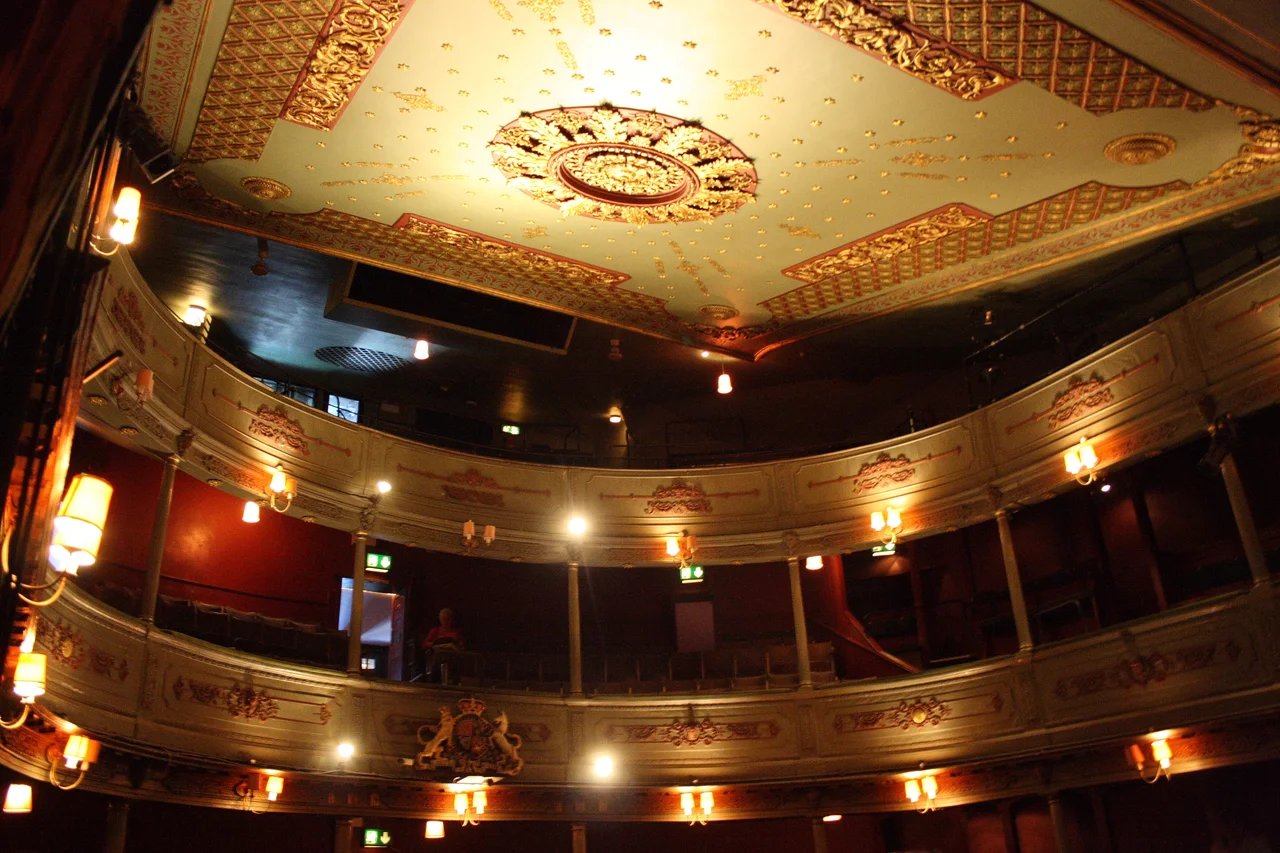
Daniel Day-Lewis, who trained here, called it the most beautiful theatre in England. The Theatre Royal occupies a roughly rectangular site called Rackhay Yard, accessed through narrow passageways cut beneath the medieval King Street houses. The architect of record was the Bristol mason Thomas Paty, but the actual design came from James Saunders, David Garrick's carpenter at Drury Lane, who had also drawn up the theatre at Richmond, Surrey the previous year. The result is a debased Palladian façade with four Corinthian columns and an interior that wraps the audience around the stage on three sides, intimate enough to feel domestic, classical enough to feel grand. The Coopers' Hall next door, built 1743-1744, was joined to the theatre as a new foyer between 1970 and 1972. Together they form a single Grade I listed building.
Evading the law
When the theatre opened, English law made it nearly impossible to run an unlicensed playhouse outside London. The Licensing Act of 1737 restricted spoken drama to the patent theatres at Drury Lane and Covent Garden. So the Bristol proprietors did what every provincial theatre did. They billed their performances as a concert with a specimen of rhetorick, on the theory that a musical event with a few speeches was not a play. The fiction was a thin one and was eventually abandoned, although a production in the neighbouring Coopers' Hall in 1773 did fall foul of the law. Legal protection finally arrived when royal letters patent were granted by Act of Parliament. The building became a true patent theatre, took the name Theatre Royal, and could put on Shakespeare without pretending it was a recital.
The Old Vic comes to Bristol
By 1942 the building was decaying and its owners had put it up for sale. The fear was that Bristol's theatre would be lost. A public appeal raised funds and a new trust bought the building. In 1943 it was taken over by the London Old Vic and a new company, the Bristol Old Vic, was founded in 1946 as a regional offshoot. The artistic director was Hugh Hunt. Early members of the company included a young Peter O'Toole, who made his first appearance here in Major Barbara in 1956, along with John Neville, Timothy West, Dorothy Tutin and Barbara Leigh-Hunt. In 1954 the company gave the world premiere of Julian Slade and Dorothy Reynolds's musical Salad Days, which transferred to the West End and became the longest-running musical on the London stage at that time. The royalties from Salad Days bought the two Victorian villas in Clifton that became the home of the Bristol Old Vic Theatre School, opened in 1946 by Laurence Olivier.
Ghosts, fires, refurbishment
In 2007 the trustees made the controversial decision to close the theatre for major refurbishment. Many in the profession feared the building would never reopen as a working theatre. A new board led by Dick Penny appointed Tom Morris from the Royal National Theatre as artistic director in 2009, and the Arts Council put in 5.3 million pounds towards a 19 million pound rebuild that ran from 2016 to 2018. The result kept the Georgian auditorium intact while opening up a new foyer onto King Street, exposing the old theatre walls that had been hidden behind 1970s cladding. Two graduates of the Theatre School each year now receive the Peter O'Toole Prize, a six-month contract, renamed after the actor's death in 2013. The school's alumni include the Academy Award winners Daniel Day-Lewis and Jeremy Irons. The theatre's reputed ghost, according to legend, belongs to the actress Sarah M'Cready. Visitors who have heard nothing else about the building have heard about her. On 30 May 2016 the Theatre Royal celebrated its 250th continuous birthday, the longest unbroken run in the English-speaking theatrical world.
From the Air
Coordinates 51.452 N, 2.594 W. The Bristol Old Vic stands on King Street in central Bristol, a short walk from the Floating Harbour and Bristol Bridge. From altitude the theatre is hard to pick out among the dense city-centre rooflines, but King Street runs east-west between Welsh Back on the harbour and Queen Square just to the south. Look for Queen Square's open green four-acre grid and follow King Street west from its north-west corner. Bristol Cathedral lies 0.5 nm west; Bristol Temple Meads station 0.8 nm south-east. Nearest airports: Bristol (EGGD) is 6 nm south-west; Cardiff (EGFF) is 25 nm west.
Nearby Stories
- Cosmeston Medieval Village 1.4 km away
- Glastonbury Festival 3.5 km away
- Tintern Abbey 3.6 km away
- Quantock Hills 4.8 km away
- Ebbw Vale Steelworks 10 km away
- New Wardour Castle 12 km away
- Windmill Hill, Avebury 16 km away
- Cotswolds 18 km away