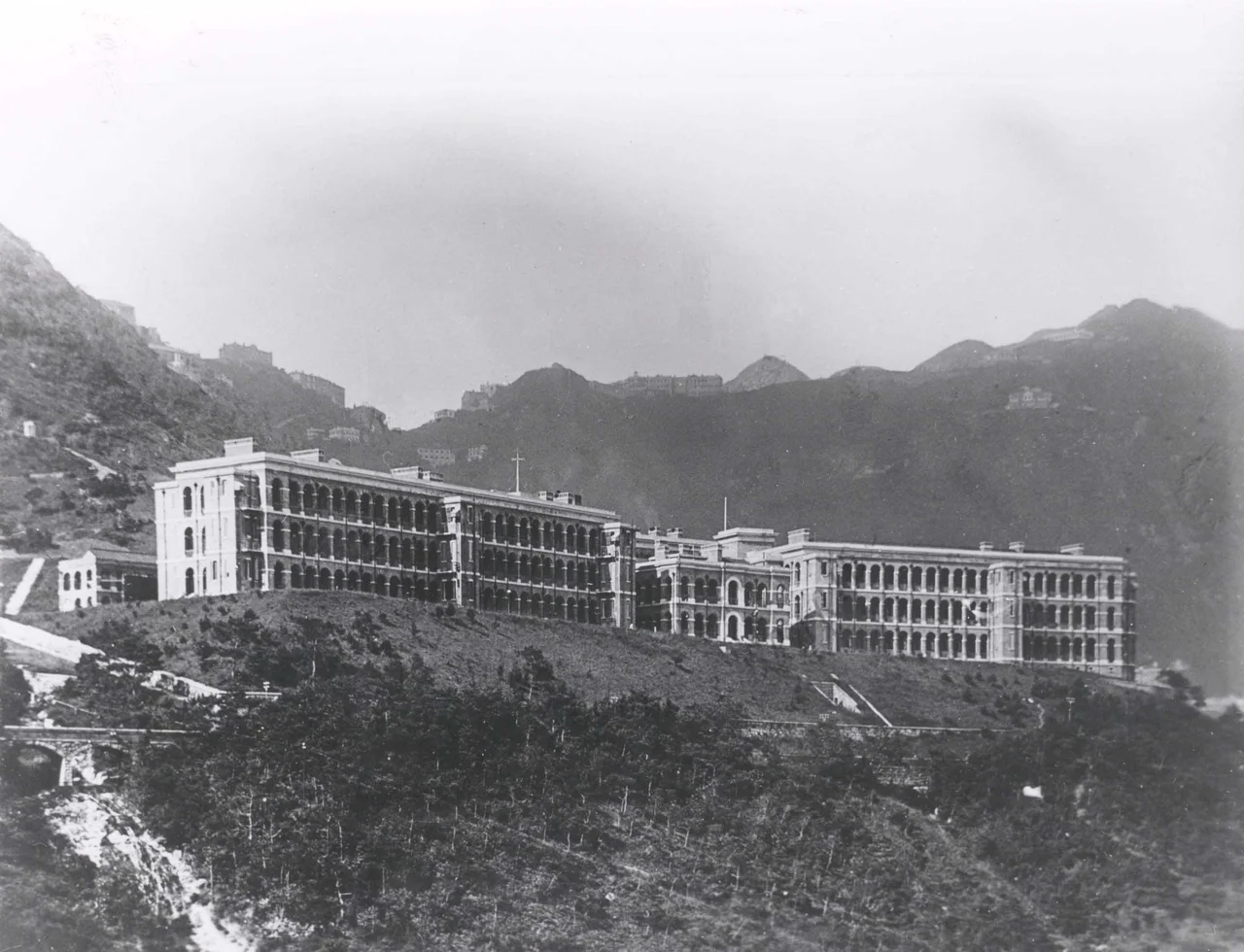

British Military Hospital, Hong Kong
It opened on 1 July 1907 — a pair of three-storey red-brick blocks on Borrett Road in the Mid-Levels, with commanding views across Victoria Harbour that no civilian address in Hong Kong could match. The British Military Hospital was built between 1903 and 1906, officially a 150-bed facility for the garrison. It would outlast the garrison by decades, housing schoolchildren and theatre companies long after the last soldier left. But in December 1941, the hospital witnessed something neither its architects nor its administrators had planned for: it became a place where prisoners of war were cared for under Japanese occupation, its wards serving a conquered army in a conquered colony.
A Garrison's Refuge on the Hillside
The Bowen Road Hospital, as it was commonly known, sat in the Mid-Levels of Hong Kong Island — a neighborhood of colonial institutions and expatriate residences terraced into the hillside above the harbour. Its 150 beds were specifically for British garrison personnel, and the facility's design reflected the era's confidence in British permanence: solid red brick, administrative central block, wards spreading outward from it, and those long harbour views that made the site feel more like a colonial residence than a medical facility. For the first three decades of its operation, the hospital served the peacetime needs of the garrison — injuries, tropical illnesses, the routine medical demands of soldiers stationed in a subtropical colony thousands of miles from home. Then December 1941 arrived.
Under Occupation
When the Battle of Hong Kong ended on Christmas Day 1941, the British garrison surrendered to Japanese forces. The Bowen Road Hospital did not close. A portion of it was repurposed for the care of prisoners of war — British and Allied soldiers who now belonged to a conquered force held by a Japanese colonial administration. The hospital that had been a symbol of British institutional permanence became, for nearly four years, part of the apparatus of occupation. Doctors and nurses treated patients who were simultaneously captives. The moral geometry of that situation — caring for the wounded in a hospital that was no longer theirs to control — belongs to the larger story of what happened to Hong Kong between 1941 and 1945, when the colony's population fell from 1.6 million to 750,000 as people fled.
After the Soldiers Left
The hospital continued in military service until 1967, when the British garrison relocated it to a new 15-storey building on Wylie Road in the King's Park area, near the Queen Elizabeth Hospital in Kowloon. The Bowen Road campus was turned over to the colonial government. What followed was a sequence of tenancies that says something about the scarcity of usable space in Hong Kong: the Island School occupied the buildings from 1967 to 1972 on a five-year lease; the German Swiss International School was there from 1973 to 1975. By the 1980s, the Chinese International School was using former hospital buildings on the adjacent Borrett Road site. The Canadian International School occupied the west wing from 1994 to 1999. The 10 Borrett Road address became the first home of the West Island School from 1991 to 1994. Each institution moved on when something better became available, but the buildings remained.
Grade I Heritage, Reinvented Again
In 1986, a Mid-Levels planning exercise zoned the Bowen Road site for open space — a future that would have meant demolition. The buildings survived that threat. In May 2001, the Town Planning Board re-zoned the site to 'government, community and institutional use' on the recommendation of the Planning Department and the Antiquities and Monuments Office. That designation allowed the buildings to be preserved rather than cleared. In 2009, the Main Block and the Annex Block of the Old British Military Hospital were formally designated Grade I historic buildings — the highest tier in Hong Kong's heritage protection system. Today the complex houses the Carmel School, the Chung Ying Theatre Company, a kindergarten, and an early education centre. The red-brick walls that once looked out over a garrison's sick ward now contain classrooms, rehearsal spaces, and playgrounds. The harbour view remains.
From the Air
The British Military Hospital site sits on the Mid-Levels of Hong Kong Island at approximately 22.31°N, 114.18°E — above the dense urban grid of Central, on the slope rising toward Victoria Peak. At 3,000–4,000 feet, the Mid-Levels terracing is visible on Hong Kong Island's northern face, with the harbour and Kowloon Peninsula beyond. Primary airport is VHHH (Hong Kong International Airport) on Lantau Island, approximately 25 km west-northwest. The building's red-brick profile may not be distinguishable from the air, but the neighbourhood's distinctive hillside architecture and Victoria Harbour backdrop orient any approach from the north.
Nearby Stories
- Lok Ma Chau Loop 2.3 km away
- Portas do Cerco 2.3 km away
- Kweilin Incident 17 km away
- Wanshan Archipelago Campaign 34 km away
- Nanxiong Formation 115 km away
- Battle of Nanpeng Island 148 km away
- Heyuan 169 km away
- Cape Maobitou 632 km away