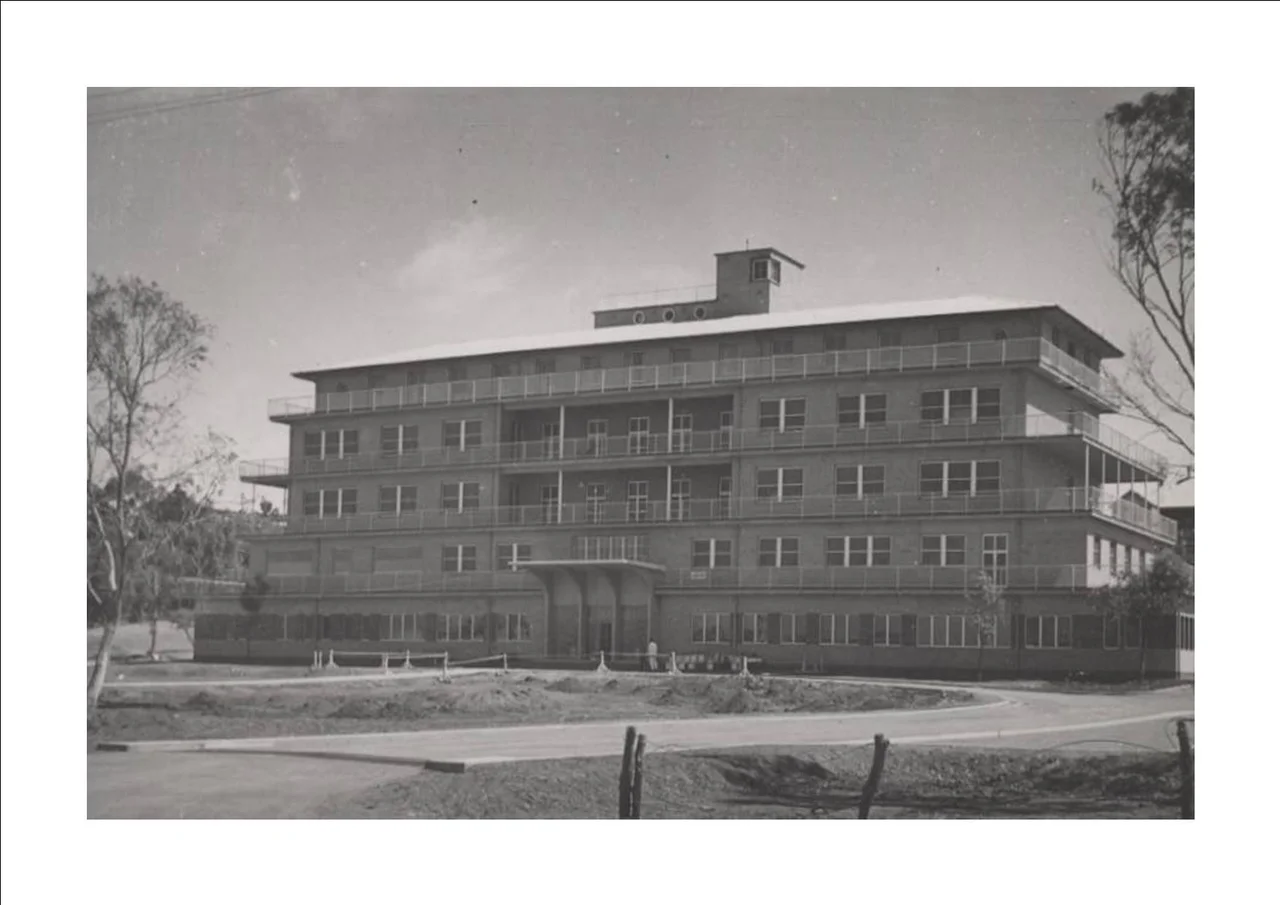

Broken Hill Hospital
In 1886 the booming silver town of Broken Hill had no doctor and no hospital, while tiny Silverton up the road had three medical practitioners. The contrast says everything about how fast and how raw the place had grown. People lived in tents and iron humpies on a treeless plain, and the things that killed them came in a grim catalogue: diphtheria, typhoid, dysentery, pneumonia, lead poisoning from the very ore that made the town rich. Children died at a frightful rate. When the miners' association finally pressed the mining company to act, the answer was a simple shed of timber and iron, six beds, a morgue, and two outhouses. From that bare beginning grew the hospital that has cared for the far west of New South Wales ever since.
From a Shed to a Civic Promise
The temporary structure lasted barely a year. Broken Hill's first proper hospital opened on 16 May 1887, built on the site where the town jail now stands, for the modest sum of 260 pounds. It was quickly outgrown. In September 1888 a new contract was let to build in Thomas Street, on the ground the hospital still occupies, and on 26 June 1889 the building was officially opened by Sir Henry Parkes, the towering colonial statesman often called the father of Australian federation. The mine money that built the town helped build its hospital too. The directors of the mining company gave 500 pounds, and the mine owner George McCulloch gave 700, a sum that earned his name on the surgical ward, the McCulloch Ward, in thanks. In a city where the company shaped nearly everything, the hospital was both charity and necessity.
Chin Up, Girls
Among the nurses who trained at Broken Hill was a young woman named Vivian Bullwinkel, and her story reaches far beyond the outback. In February 1942, serving as an army nurse, she was aboard the SS Vyner Brooke when Japanese aircraft sank it near Bangka Island. Bullwinkel and twenty-one other Australian nurses reached the beach, where Japanese soldiers ordered them to walk into the sea and machine-gunned them from behind. Their matron, Irene Drummond, called out 'Chin up, girls' as they waded into the surf. Bullwinkel, shot through the body, feigned death and became the sole survivor, later testifying at a war crimes trial and devoting her life to nursing. Drummond was killed. In 1949 a memorial park was opened in the hospital grounds in her honour, binding this remote hospital to one of the most harrowing chapters of the war.
Rebuilt for a New Century
By the late twentieth century the old buildings had served their time. In May 1997 plans for a wholly new hospital were announced; the old structure came down in December 1999, and in March 2000 the NSW health minister opened a 32-million-dollar replacement. The modern facility carries the weight of a remote city's needs in a single building: eighty multifunctional acute beds spanning medicine, surgery, obstetrics, coronary and intensive care, paediatrics, palliative care, and mental health, alongside a day-procedure unit, a rehabilitation centre, and emergency services. For a community hundreds of kilometres from any larger hospital, this is not one facility among many. It is the facility, the place where the far west is born, mended, and farewelled.
A Long Watch in the Desert
In July 2012 the health service marked 125 years of continuous care, and the following February a new sub-acute mental health unit opened, answering a need that remoteness makes especially acute. In 2013 the hospital began training medical interns again for the first time in decades, a quiet but telling sign of investment in a place that has always struggled to attract and keep medical staff. Like any institution under strain, it has had hard chapters too, including a 2015 inquiry into bullying allegations raised by nursing staff. But the longer arc is one of endurance. For more than a century and a quarter, in a city built on a mountain of ore in the middle of an arid continent, the hospital has kept its watch, never the largest in the country, but for the people it serves, the most important one there is.
From the Air
Broken Hill Hospital stands at roughly 31.95 degrees south, 141.45 degrees east, in central Broken Hill, New South Wales, just west of the Line of Lode ridge that bisects the city. The terrain is flat arid plain near 300 metres elevation; from the air the prominent mine ridge with its memorial structures, the regular grid of the city streets, and the green of the hospital's memorial grounds help locate it. Broken Hill Airport (ICAO YBHI, elevation 959 ft) lies about 5 kilometres southeast and is the nearest aerodrome and the regional base of the Royal Flying Doctor Service, for whom this hospital is a key destination. Visibility is generally excellent in the dry interior but can drop fast in dust storms. Recommended viewing altitude 2,000 to 3,500 ft AGL over the central city.
Nearby Stories
- Mount Gipps Station 5.4 km away
- Radium Hill 33 km away
- Honeymoon Uranium Mine 35 km away
- Menindee, New South Wales 44 km away
- Mutawintji National Park 64 km away
- Kinchega Woolshed 70 km away
- Kinchega National Park 86 km away
- Mount Chambers Gorge 178 km away