.jpg)
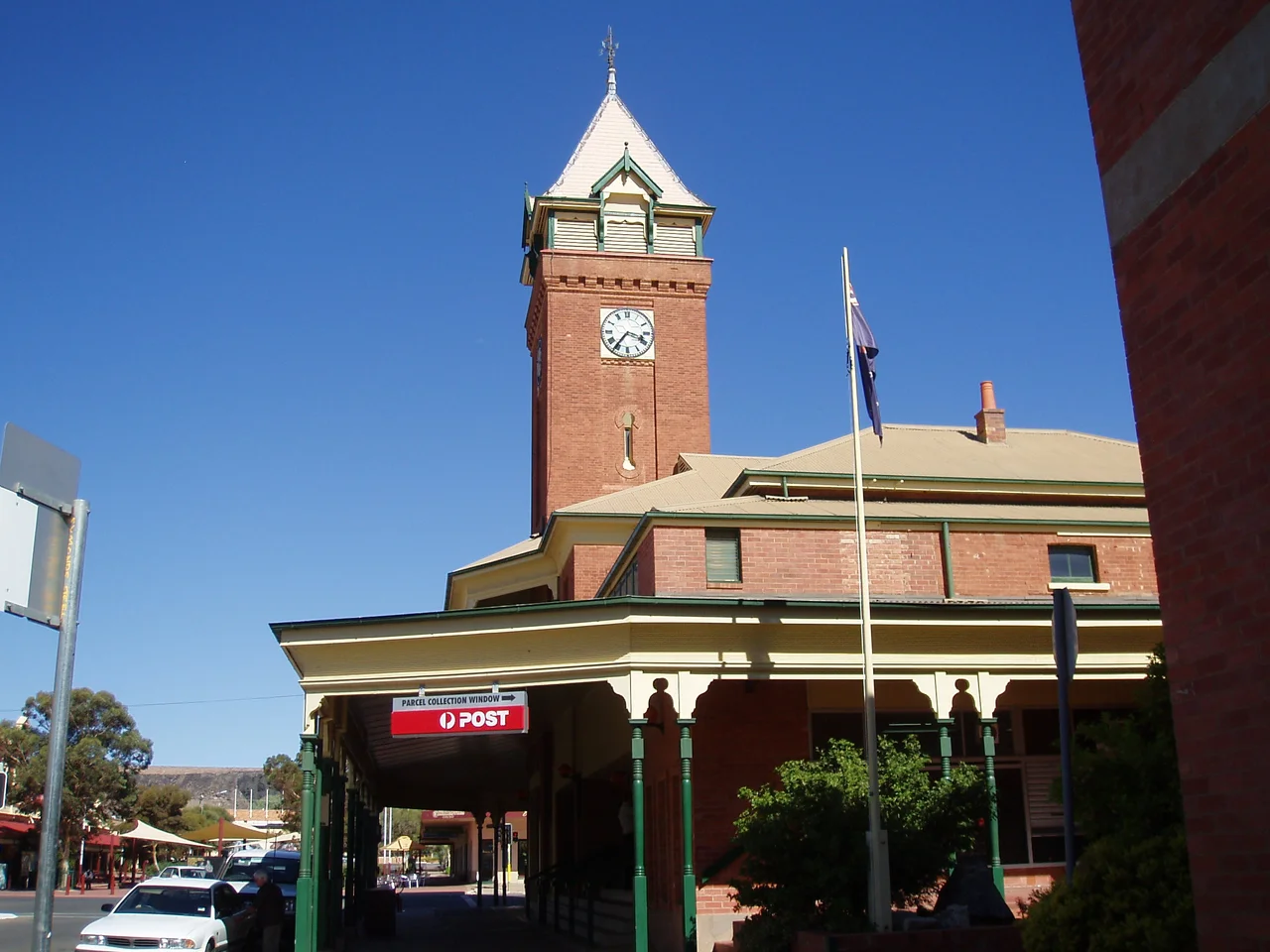
Broken Hill Post Office
For three years the bureaucrats in Sydney refused to build it. A grand post office in Broken Hill seemed a reckless bet, and the men who approved public works had watched too many outback mining camps swell and then vanish the instant the ore ran thin. Why pour money into a town that might be a ghost by the time the mortar dried? But by 1888 the silver under Broken Hill was proving too rich to doubt, and the Colonial Architect's Office finally relented. What rose at the corner of Argent and Chloride Streets was not the cautious building of a camp hedging its bets. It was a statement: an 86-foot clock and bell tower, square and heavy, climbing out of the flat red country as if daring the desert to outlast it.
A Town That Insisted
The need came before the building. When silver ore turned up in the tailings of Charles Rasp's shaft in 1885, Broken Hill grew at the speed only a mineral rush can produce. By the end of 1886 the population had passed three thousand, and the makeshift mail counter wedged into Walter Sully's general store could not cope. The town's first postal worker, Marie Wilson, ran that early service from a small room attached to the store, making her the first government official ever appointed in Broken Hill. The local Progress Committee pestered the Postmaster General's Department relentlessly. They wanted a real post office, a building that announced permanence, and they would not stop asking until they got one.
Barnet's Last Frontier
The design came from the office of James Barnet, the Colonial Architect whose buildings shaped public New South Wales for a generation. Between 1865 and 1890 his office was responsible for some 169 post and telegraph offices, and Barnet liked to give country towns distinct designs rather than a single repeated pattern. John Dobbie of Balmain won the tender at £6,475, with one demanding condition: finish it in twelve months. The office opened for business on 9 May 1892. Its interior fittings were cut from cedar, from the entrance doors to the mail counters to the stairways, and the postmaster lived on the premises, as did a postal assistant in a second residence built into the structure. In 1900 a young building grew again when Walter Liberty Vernon, Barnet's successor, added a telegraph office onto the Argent Street frontage.
The Tower and the Clocks
The tower is the building's argument made visible. Square and slate-capped, with four clock faces and a bell room behind louvred vents, it dominates the streetscape and anchors a precinct of civic buildings that the town raised in the same confident years: the elaborate Second Empire courthouse, the Arts and Crafts technical college. The clocks themselves arrived a decade after the building, installed in 1902. Remarkably, the original clock and bell mechanisms still survive in place, now nudged along by an electric motor. Walk the verandah today, under paired turned-timber posts painted green, and you are standing in the spot generations of Broken Hill residents came to send word out to the wider world, when a letter or a telegram was the only thread connecting this isolated city to the coast more than a thousand kilometres east.
What the Building Remembers
Time has worked on the place. The postmaster's residence was demolished in 1973 to make way for a telephone exchange, the rear was rebuilt, and the interior has been altered many times over. Yet the exterior remains remarkably intact, and the building still does the quiet work it was made for. Heritage assessors call it a rare and early example of the Federation Free Classical style touched with Arts and Crafts influence, and they note something harder to measure: its hold on the town's sense of itself. It was listed on the New South Wales State Heritage Register in 2000 and added to the Commonwealth Heritage List in 2011. For more than a century it has been the place where Broken Hill spoke to the rest of the country, and the tower still keeps watch over the city that refused to be temporary.
From the Air
The Broken Hill Post Office sits at 31.958 degrees S, 141.465 degrees E, at the corner of Argent and Chloride Streets in the central civic precinct, elevation roughly 315 m. From the air, look for the square slate-capped clock tower rising above the low grid of central Broken Hill; it stands close to the courthouse and town hall and reads as the tallest historic vertical in the city core. Broken Hill Airport (ICAO YBHI) lies about 5 km south-southwest. Adelaide (YPAD) is roughly 500 km southwest and Mildura (YMIA) about 300 km south. The surrounding country is flat semi-arid plain, so the city grid and the rust-red mullock heaps of the Line of Lode just to the south are the dominant navigational features. Best viewed at low to medium altitude in the region's typically clear, dry air; Broken Hill averages over 150 clear days a year.
Nearby Stories
- Mount Gipps Station 5.4 km away
- Radium Hill 33 km away
- Honeymoon Uranium Mine 35 km away
- Menindee, New South Wales 44 km away
- Mutawintji National Park 64 km away
- Kinchega Woolshed 70 km away
- Kinchega National Park 86 km away
- Mount Chambers Gorge 178 km away