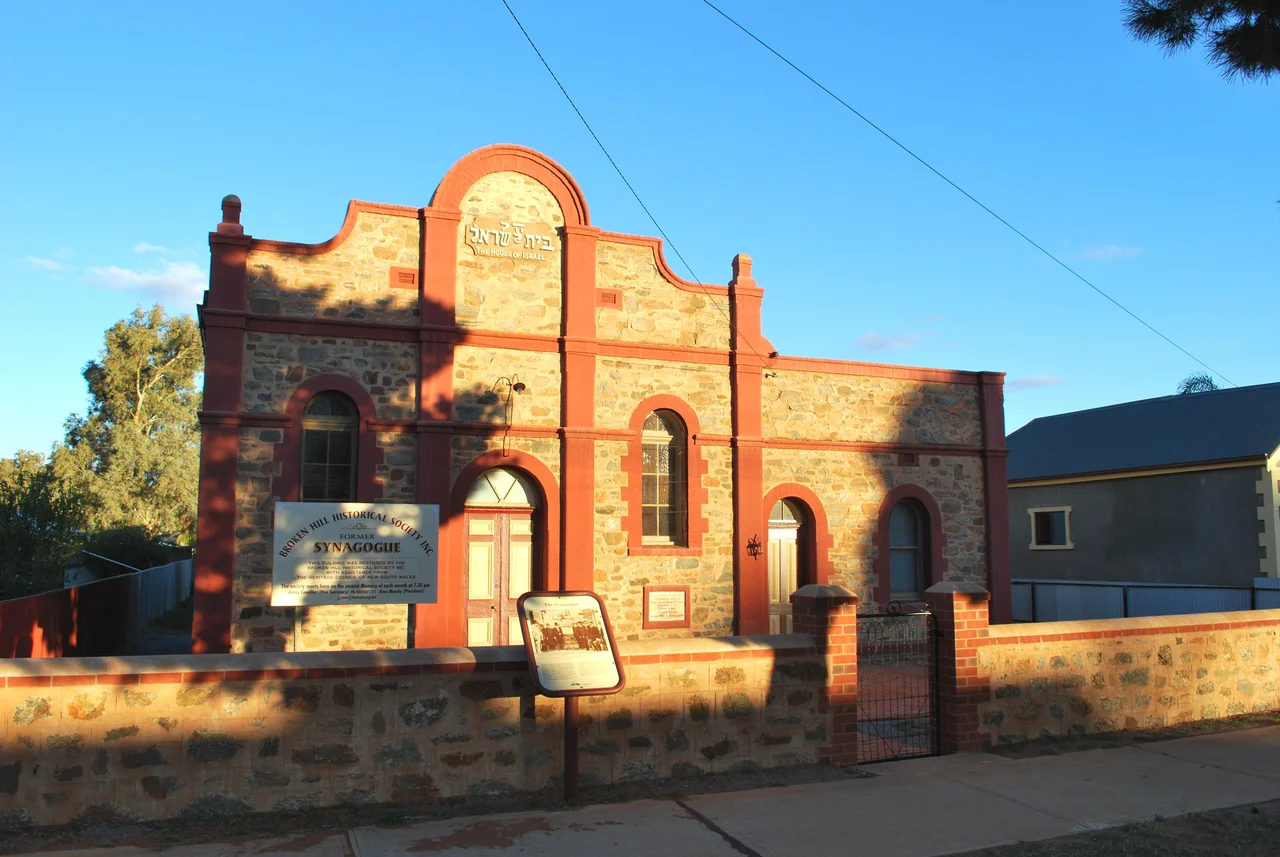

Broken Hill Synagogue
Before there was a synagogue, there was a cemetery. The Jewish community of Broken Hill consecrated its burial ground on 17 May 1891, marking the boundaries of belonging in the hard red earth years before it had a building in which to pray. The families who settled this remote silver town came mostly from Lithuania and Ukraine, carrying with them the orthodox practice of nineteenth-century Russian Jewry, and for a decade they worshipped in the local Masonic Hall while they slowly raised the funds for something of their own. The synagogue on Wolfram Street, when it finally came, was one of only three purpose-built synagogues in all of rural New South Wales, and it stood as proof that Jewish life could take root even here, in the dust at the edge of the continent.
A Congregation Takes Shape
A meeting in 1900 set the plan in motion: form a proper congregation, and build a house of worship. The money did not come easily. The first appeals failed, and it was not until later in the decade that the community gathered enough to buy a site, which it secured in July 1907. The foundation stone was laid on 30 November 1910, and the synagogue was consecrated a few months later, on 26 February 1911. For a small community in an isolated mining city, the achievement was considerable. These were shopkeepers, traders, and working families who had crossed the world and then crossed a desert, and they had built a place where the rhythms of the Sabbath and the high holy days could be kept in full, the same as in the towns their parents had left behind.
The Slow Fading
Communities like this one depended on numbers, and Broken Hill's numbers thinned. As families moved toward the coastal cities over the decades, the congregation shrank. By 1961 only about fifteen identifiable Jews remained in Broken Hill, too few to sustain a synagogue. The building closed its doors in 1962. The Sefer Torah scrolls, the handwritten parchment that is the sacred heart of any synagogue, were carried away to the Yeshiva in the Melbourne suburb of St Kilda, where a living community could keep them in use. The building that had once held a congregation's hopes was, by then, described as derelict. It passed into private hands and became, of all ordinary things, a house.
Saved and Reopened
The story might have ended there, with a forgotten building slowly returning to the desert. Instead, the Broken Hill Historical Society bought the synagogue in 1990 and set about restoring it. Today it houses the Synagogue of the Outback Museum, which preserves the memory of the Jewish families who once gathered here and tells visitors how they lived and worshipped in this unlikely place. The museum keeps faith with people who might otherwise have vanished entirely from the record, the way so many small outback communities do. Walk inside now and you are not in a dead building but in a deliberate act of remembrance, a town's decision that these lives mattered and would not be allowed to disappear.
Why It Endures
The synagogue was added to the New South Wales State Heritage Register on 2 April 1999, recognised for what it represents as much as for what it is. Australia's outback is rarely imagined as a place of Jewish history, and that is precisely why this modest building on Wolfram Street matters. It is a record of migration and faith carried to one of the most remote inhabited corners of the earth, of a community that arrived, took root, flourished briefly, and slowly dispersed, leaving behind walls that still speak. In a town built on silver and defined by the muscle of its miners and unions, the synagogue is a quieter kind of monument: to belief, to belonging, and to the human determination to make a home wherever life leads.
From the Air
The Broken Hill Synagogue stands at 31.957 degrees S, 141.459 degrees E, at 165 Wolfram Street in the central grid of Broken Hill, elevation roughly 315 m. From the air it is a modest single building within the orderly streets of the city centre, a few blocks west of the landmark Post Office clock tower, which makes the better visual anchor. Broken Hill Airport (ICAO YBHI) lies about 5 km south-southwest; Adelaide (YPAD) is roughly 500 km southwest and Mildura (YMIA) about 300 km south. The surrounding terrain is flat semi-arid plain, with the rust-red mullock heaps of the Line of Lode rising just south of the city as the strongest navigational reference. Best viewed at low altitude in the area's typically clear, dry desert air.
Nearby Stories
- Mount Gipps Station 5.4 km away
- Radium Hill 33 km away
- Honeymoon Uranium Mine 35 km away
- Menindee, New South Wales 44 km away
- Mutawintji National Park 64 km away
- Kinchega Woolshed 70 km away
- Kinchega National Park 86 km away
- Mount Chambers Gorge 178 km away