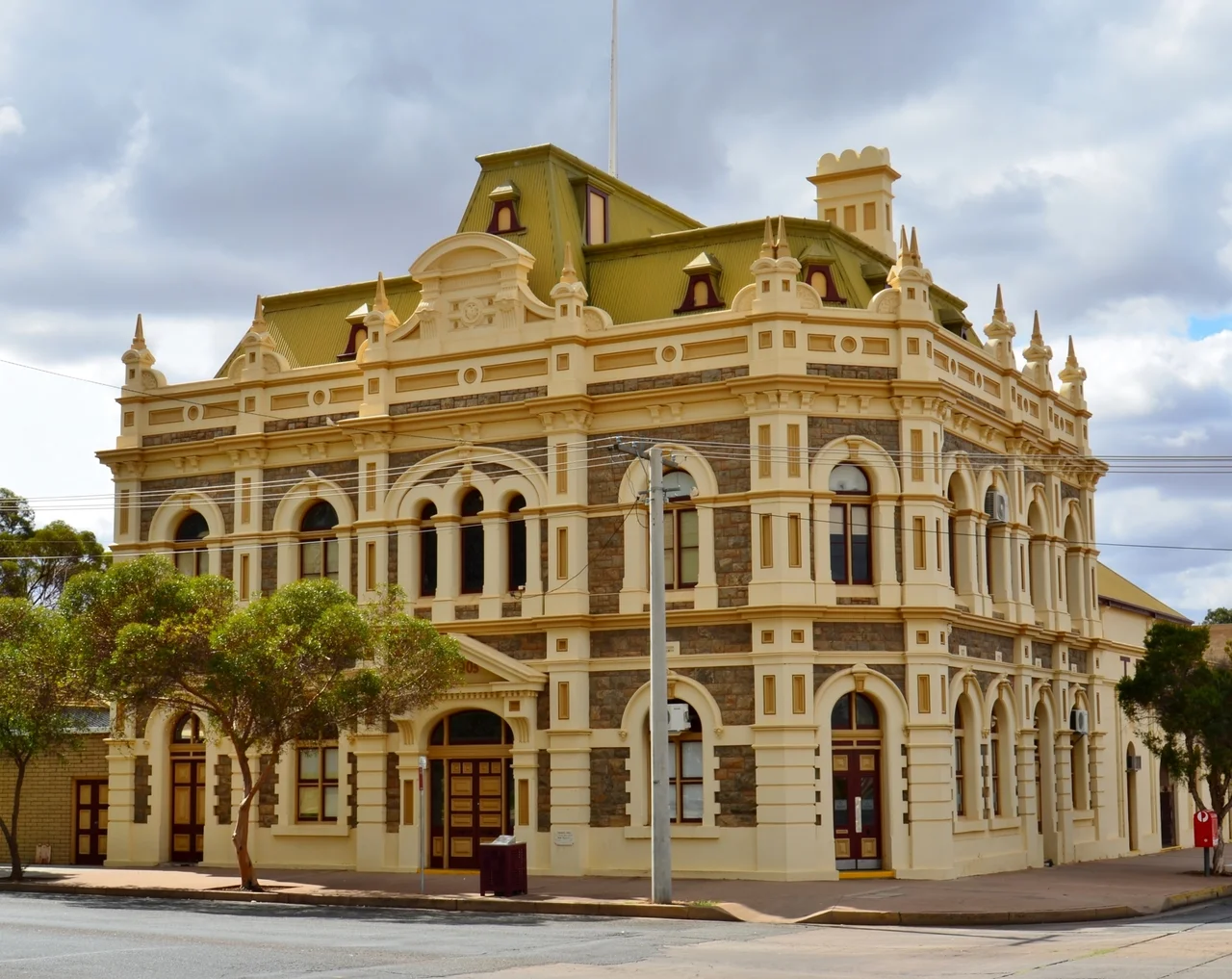

Broken Hill Trades Hall
Look up inside the Broken Hill Trades Hall and you will find a vast ceiling painted in shades of green in an intricate geometric pattern, the kind of flourish a town gives to a building it intends to revere. Down in the streets and the mines below, the men who paid for that ceiling fought some of the fiercest industrial battles in Australian history. Broken Hill did not just have unions; for the better part of a century it was governed by them, a place where the labour movement was not a faction but the establishment. This stone hall on Sulphide Street, built between 1898 and 1905, was the headquarters of that power, and it remains one of the few prominent Victorian buildings in the city left little changed since the day it opened.
Built by the Workers, For the Workers
The hall was raised by the unions themselves, an act of collective will as much as construction. Local architect Tom Jackson designed it and acted as clerk of works, and the building went up in stages as money was scraped together. The first chairman of the Trades Hall trustees, Jabez Wright, oversaw the early years, and the building debt was cleared by 1901, after which every dollar raised went toward finishing the hall. Fellow unions chipped in from across the colonies; in 1898 the secretary of the South Australian branch of the Australian Workers' Union staged a tug-of-war competition in the Crystal Theatre to help fund the work. By the time the second section was added, the hall held meeting rooms, the office of the Amalgamated Miners' Association, a banqueting room with a dance floor, and a bandroom on the top floor.
The Great Disputes
The struggle of working people for fair pay and safe conditions runs through everything in Broken Hill, and the great disputes of 1892, 1909, and 1919 to 1920 are remembered here and far beyond. They were brutal contests. The 1892 strike ended in defeat so total that union membership collapsed from roughly six thousand to three hundred within a few years. But the movement did not break. It rebuilt, and it grew teeth. Out of the bitter 1919 dispute came, in 1923, the Barrier Industrial Council, an alliance of eighteen trade unions that would become one of the most powerful forces in the politics of the city for decades, regulating not just wages but the very rhythm of life in Broken Hill.
Tom Mann on the Rotunda
Through these years the hall and the town drew the leading agitators of the age. The unions ran their own newspaper, the Barrier Daily Truth, founded in 1898, and a Social Democratic Club from 1903. In 1902 the British socialist and former miner Tom Mann came to Broken Hill and addressed a great crowd from the rotunda of the Hillside Reserve, laying out the goals of socialism with a force that left the local leaders electrified. They remembered him. When a savage dispute with BHP flared in 1908, the combined unions invited Mann back as an organiser to help fight it. Workers' heroes like Mann and the firebrand Percy Brookfield are memorialised all over Broken Hill, woven into the town's idea of itself.
A Living Headquarters
Most halls like this become museums of a vanished cause. This one did not. The Broken Hill Trades Hall still works for a living: it continues to house the Barrier Industrial Council, the Broken Hill Town Employees' Union, and the local office of the mining and energy division of one of the country's big modern unions. Inside, a collection has accumulated like sediment, the physical memory of a movement, with union badges, banners, the great flags of the Amalgamated Miners' Association, and picket maps drawn during the 1909 lockout. Listed on the New South Wales State Heritage Register in 1999, the hall is not a monument to something finished but a stronghold still standing, its painted green ceiling looking down on a fight that never entirely ended.
From the Air
The Broken Hill Trades Hall sits at roughly 31.958 degrees S, 141.463 degrees E, at 34 Sulphide Street in central Broken Hill, elevation about 315 m. Sulphide Street runs through the heart of the old city and toward the rail corridor, and the nearby Post Office clock tower a few blocks east is the most reliable visual anchor from the air. Broken Hill Airport (ICAO YBHI) lies about 5 km south-southwest; Adelaide (YPAD) is around 500 km southwest and Mildura (YMIA) about 300 km south. The surrounding land is flat semi-arid plain, with the rust-red mullock heaps and headframes of the Line of Lode rising immediately south of the city centre as the dominant landmark. Best viewed at low to medium altitude in the region's usual clear, dry conditions.
Nearby Stories
- Mount Gipps Station 5.4 km away
- Radium Hill 33 km away
- Honeymoon Uranium Mine 35 km away
- Menindee, New South Wales 44 km away
- Mutawintji National Park 64 km away
- Kinchega Woolshed 70 km away
- Kinchega National Park 86 km away
- Mount Chambers Gorge 178 km away