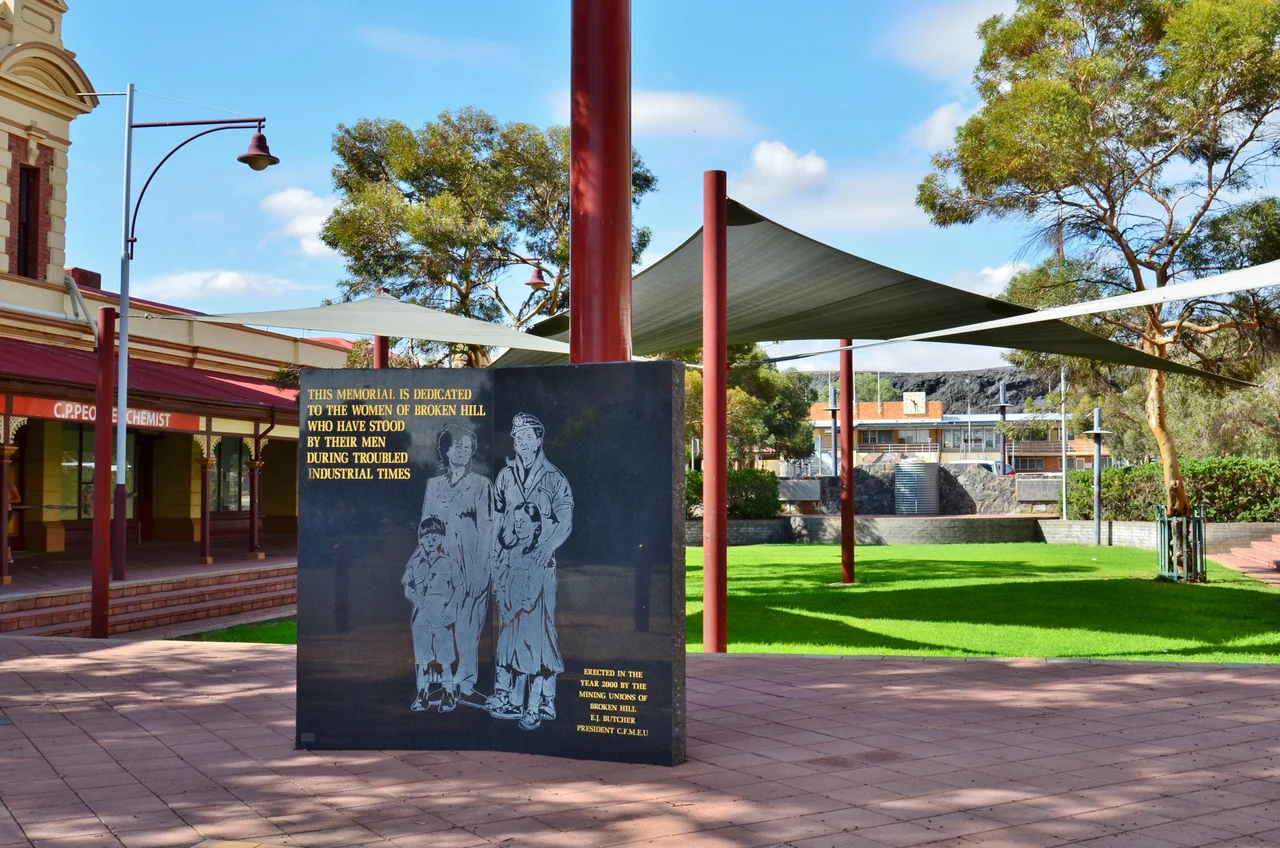

Broken Hill Women's Memorial
The men went down the mines and the men walked the picket lines, and the histories tend to remember the men. But in Broken Hill, when the great strikes dragged on for months and the wages stopped, it was the women who kept the families fed and the resistance unbroken. They organised the funds, sustained the morale, and stood on the lines themselves. Some formed the Women's Brigade, and their tactics were not gentle: they picketed the mine gates, marshalled protest marches and rallies, and tarred and feathered the strikebreakers, the non-union men they called scabs, who tried to slip through to take the jobs of striking miners. The black granite memorial in the Town Square exists because Broken Hill finally decided that this work deserved a monument of its own.
The Unpaid Front Line
Across every great dispute, the pattern held. In 1892, in 1919, and again in 1986, the women of Broken Hill organised the support that made long strikes survivable: raising money, distributing it, keeping spirits up through the toughest stretches when a single mining family's income simply stopped. This was not a supporting role in any small sense. A strike is a siege, and a siege is won or lost on whether the people behind the lines can endure. The women endured, and they made endurance possible for everyone else. Theirs was the labour that does not show up in the production figures or the union ledgers, but without it the famous battles of Broken Hill would have been lost before they began.
A Surplus Becomes a Monument
The memorial began with leftover money and a good decision. During an industrial dispute at the mine in 1986, the women of the town once again raised funds to sustain the strikers. When the dispute ended, a thousand dollars remained in the women's fund. Rather than simply divide it, they resolved to use it to build a memorial to themselves and to the generations of women who had done this work before them. The miners' union supplied the balance of the cost. It is a fitting origin for a monument to people whose contribution was always practical and collective: it was paid for, in the end, by the same kind of pooled effort it was built to honour.
Granite and Words
The memorial is made of two pieces of black granite, cut and set by Zanon Memorials, carrying an image of a family and two passages of text. It was unveiled on 30 March 2001 by Martin Ferguson, then a federal opposition frontbencher with the Labor Party. The president of the miners' union, Eddie Butcher, dedicated it with words that fixed the meaning plainly: the women, he said, were the unsung heroes who stood by their men through the toughest and darkest hours of mining history, the backbone of Broken Hill's society, who truly deserved the recognition the monument would give them. In a town crowded with memorials to fallen miners and martyred union leaders, this one names a quieter, steadier kind of heroism.
Standing in the Square
There is something deliberate about the memorial's location in the Town Square, at the civic centre of the city rather than out at the mines. It places the women where the public business of Broken Hill happens, an everyday reminder rather than a remote shrine. The monument tells a truth that mining towns the world over have been slow to acknowledge: that the survival of a community under pressure depends on far more than the men at the rock face. Broken Hill's identity was forged in struggle, and this small black monument insists that the struggle had two fronts. The women held one of them, often without recognition, and the granite now makes sure they are not forgotten.
From the Air
The Broken Hill Women's Memorial stands at roughly 31.958 degrees S, 141.466 degrees E, in the Town Square within the central civic precinct of Broken Hill, elevation about 315 m. It is a small monument, not itself visible from altitude; navigate instead to the nearby Post Office clock tower, the tallest historic structure in the city core, with the memorial in the adjacent square. Broken Hill Airport (ICAO YBHI) lies about 5 km south-southwest; Adelaide (YPAD) is around 500 km southwest and Mildura (YMIA) about 300 km south. The surrounding terrain is flat semi-arid plain, and the rust-red mullock heaps of the Line of Lode just south of the city centre are the dominant navigational feature. Best appreciated on the ground; from the air, view the central grid at low altitude in the area's typically clear, dry conditions.
Nearby Stories
- Mount Gipps Station 5.4 km away
- Radium Hill 33 km away
- Honeymoon Uranium Mine 35 km away
- Menindee, New South Wales 44 km away
- Mutawintji National Park 64 km away
- Kinchega Woolshed 70 km away
- Kinchega National Park 86 km away
- Mount Chambers Gorge 178 km away