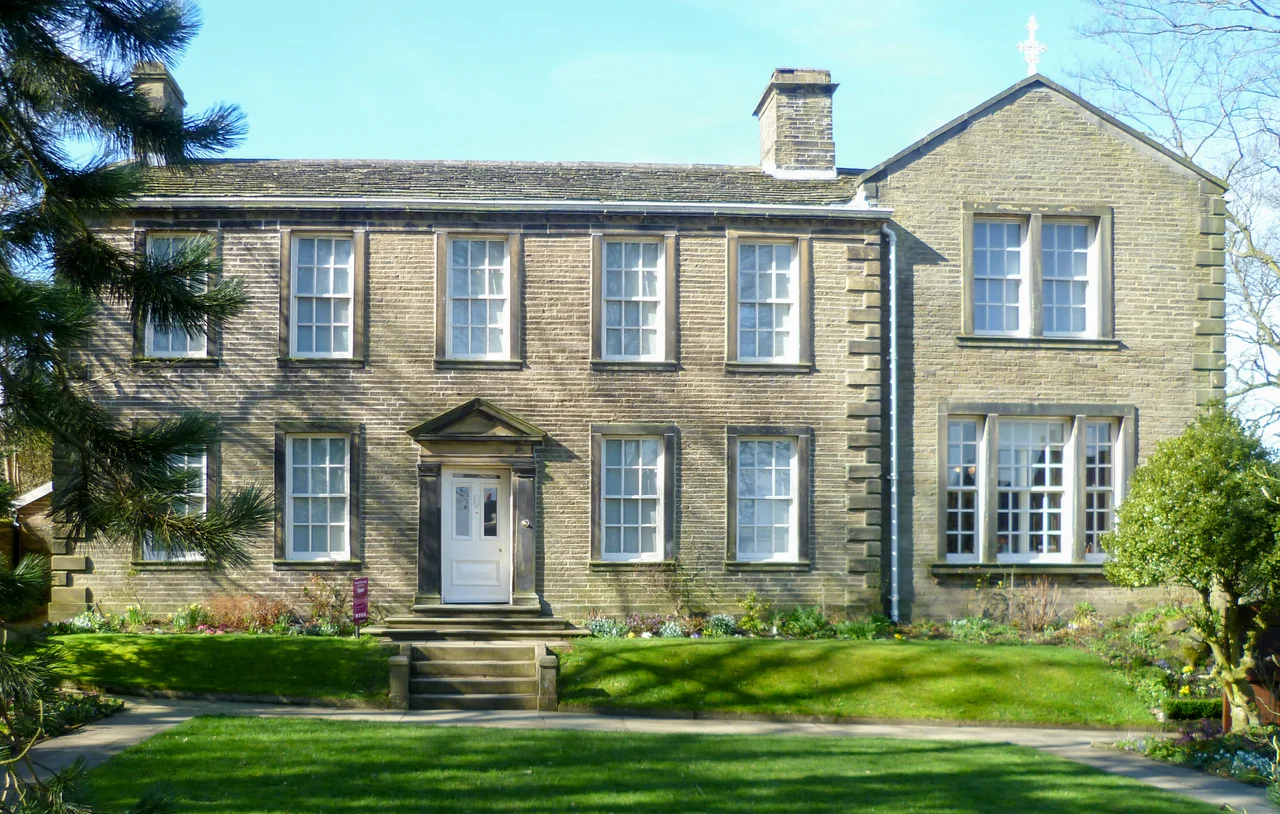

Bronte Parsonage Museum
The front door of the parsonage opens straight onto a graveyard. Step out, and you are among Haworth's stacked black headstones; turn back, and you can see the small window of the dining room where Charlotte Bronte paced at night, working out a sentence in her head. The house at the top of the hill was built in 1778 for the parson of the moorland village, but it is remembered because of what three sisters did inside it between roughly 1845 and 1849. The Bronte Parsonage Museum preserves not a monument but a workplace, with the working surfaces left almost exactly where they were when the writers laid down their pens.
A Family Moves In
Patrick Bronte was appointed perpetual curate of St Michael and All Angels' Church in 1820 and arrived at the parsonage with his Cornish wife Maria and six small children. Within a year and a half, Maria was dead of cancer, and her sister Elizabeth Branwell left Penzance and the gulls of the Cornish coast for the harsh upland climate of Haworth to keep the household together. Two more daughters, Maria and Elizabeth, would die in childhood at the parsonage in 1825, after illness at the Clergy Daughters' School at Cowan Bridge. By 1826 the surviving children were Charlotte, Branwell, Emily, and Anne. They grew up with grief, but also with a library full of magazines and books their father carried home, and an empty moor stretching out behind the back garden wall.
The Pasteboard Books
Some of the most extraordinary objects in the museum are small enough to fit in a palm. As children, the Bronte siblings stitched together tiny books out of scrap paper and wrote them in a hand deliberately so minute that adult eyes could not read it without a magnifying glass. They invented countries called Angria and Gondal, populated by soldiers and queens and political intrigues. The miniature books are the seedbed for everything that followed. By 1846 Charlotte, Emily, and Anne were using money from Aunt Branwell's legacy to print a joint volume of poetry under the male-sounding pseudonyms Currer, Ellis, and Acton Bell. The book sold two copies. They kept writing.
Three Novels in a Year
Jane Eyre was published on 19 October 1847. By December that same year Wuthering Heights and Agnes Grey had appeared as a three-volume set from another London publisher. Within fourteen months, three sisters living quietly in a moorland parsonage had put three of the most discussed novels of the century into the world, all under invented names. Then the family began to collapse. Their brother Branwell, who had slid into alcoholism and laudanum dependence, died of tuberculosis on 24 September 1848. Emily, refusing medical help, died three months later on 19 December. Anne died at Scarborough on 28 May 1849, taken there in the hope that sea air would do what nothing else could. Charlotte was left to finish Shirley and Villette in a house grown silent around her, and to marry her father's curate Arthur Bell Nicholls in 1854 before dying herself in the early stages of pregnancy in March 1855.
How the House Was Saved
When Patrick Bronte outlived all of his children and finally died in 1861 at the age of 84, the parsonage's contents were auctioned, and friends, servants, and souvenir hunters carried off keepsakes and letters across England. The Bronte Society was founded at a public meeting in Bradford in 1893 to gather back what could be gathered. The first museum opened above the Yorkshire Penny Bank in Haworth in 1895 and drew about 10,000 visitors in its opening year. In 1928 Sir James Roberts, the Yorkshire wool magnate who also owned Saltaire downstream, bought the parsonage itself for 3,000 pounds and gave it to the Society. The American collector Henry Bonnell of Philadelphia bequeathed his Bronte holdings the same year. Charlotte's mahogany writing desk, scattered for over a century in private hands, came home in 2011 when an anonymous donor returned it after buying it at auction for 20,000 pounds.
From the Air
Haworth Parsonage sits at 53.831 N, 1.957 W on the western edge of the village, perched on the lip of the Worth Valley at about 800 ft elevation. Recommended viewing altitude 2,500 to 4,000 ft AGL; the church tower of St Michael and All Angels is the visual anchor, with the dark moorland of Penistone Hill rising behind. Nearest airports are Leeds Bradford (EGNM) about 12 nm east and Manchester (EGCC) about 27 nm south-west. The Pennine micro-climate brings frequent low cloud, mist, and rapid weather changes.
Nearby Stories
- Battle of Seacroft Moor 3 km away
- RAF Topcliffe 7.4 km away
- Pretoria Pit Disaster 8.7 km away
- Lundhill Colliery Explosion 11 km away
- Forest of Bowland 12 km away
- Coverham Abbey 16 km away
- Macclesfield Canal 18 km away
- Leighton Hall, Lancashire 21 km away