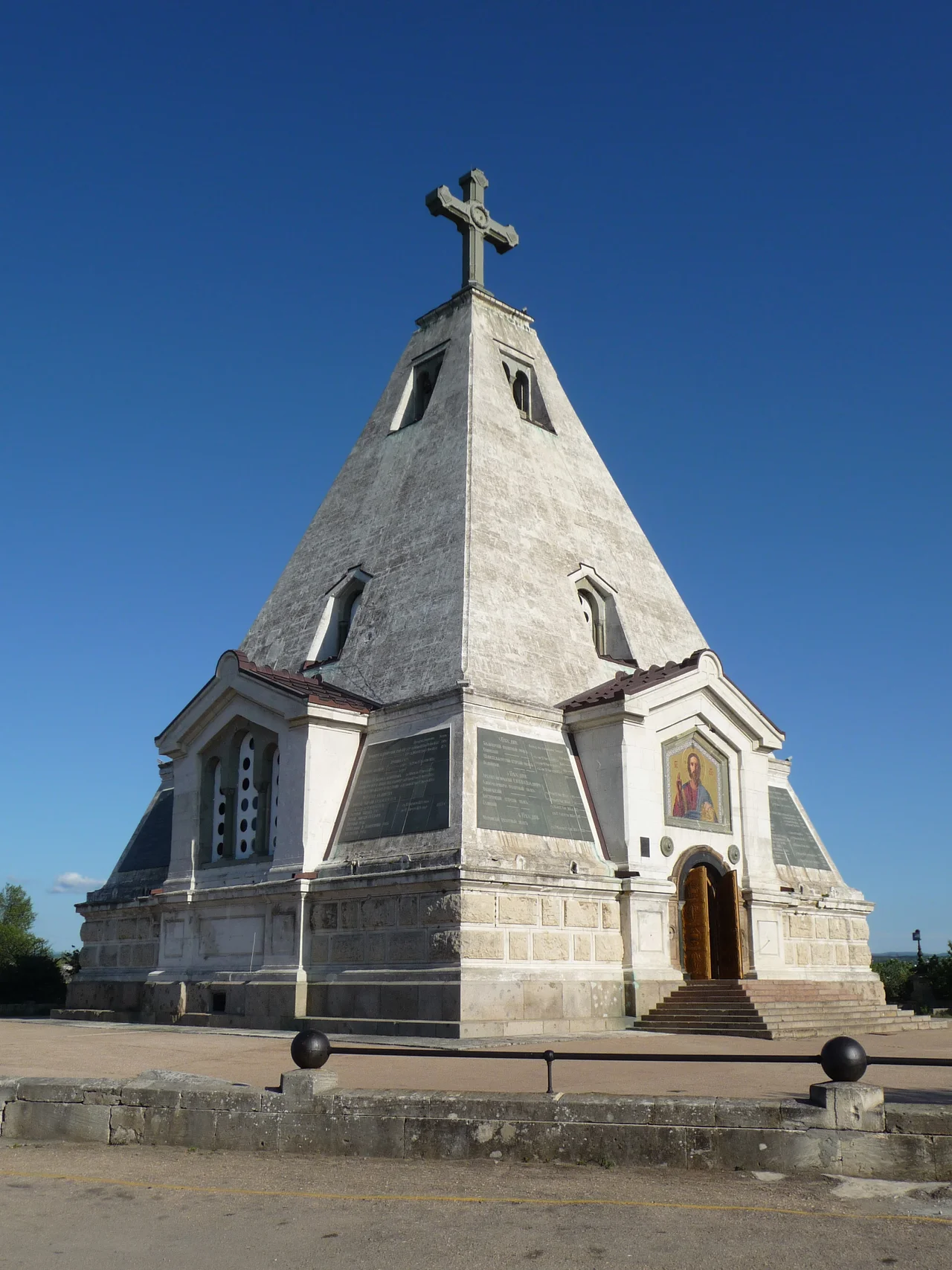

Brotherhood Cemetery
The names are everywhere. Step inside the pyramidal Saint Nicholas church on the hill north of Sevastopol and the walls close around you in stone tablets - the names of Russian officers who died defending the city. Step outside, and the pattern continues across the exterior walls: every regiment, every unit, the dates they fought and how many of them did not come home. This is the Brotherhood Cemetery, and it holds a number that is difficult to hold in the mind at all. Somewhere beneath this hill lie between 100,000 and 127,000 people - so many that the individual grave gives way almost entirely to the collective, and the cemetery becomes less a place of headstones than a single, vast act of remembrance.
A Hill for the Fallen
The cemetery was born of desperation in 1854, during the first great siege of Sevastopol in the Crimean War. As the allied armies bombarded the city month after month, the dead accumulated faster than anyone had planned for. Admiral Vladimir Kornilov, one of the city's defenders, ordered three burial grounds opened near the northern fort. The casualties were so severe that the three were soon merged into one. What resulted was not a tidy garden of individual graves but something closer to a mass grave on a monumental scale: 472 collective plots, each holding fifty, a hundred, or more bodies, alongside 130 individual graves reserved for officers. The arithmetic is grim, but it is honest - it reflects exactly how the men died, in numbers too large for the ordinary rituals of grief.
The Church of Names
In 1870, atop the crown of the hill, an Orthodox church rose in the unusual shape of a pyramid, its silhouette unlike any ordinary belfry. Inside, its walls were faced with plates bearing the names of the officers killed in the siege. Outside, more plates recorded every regiment and military unit that defended the city, each with its own tally of the lost. Among those buried on the hill are some of the defense's most famous commanders - the engineer Eduard Ivanovich Totleben, who designed the earthworks that held the city so long; General Stepan Khrulyov; and Mikhail Dmitrievich Gorchakov. But the church does not exist to honor the celebrated few. It exists to insist, name by name and unit by unit, that the tens of thousands beneath it were individuals, not a statistic.
War Returns to the Hill
The dead were not left in peace. When the Second World War reached Sevastopol during the second siege of 1941 to 1942, the cemetery hill was pressed back into service - this time as a command post for the fourth defense sector of the Soviet troops holding the city. The high ground that had received the fallen of one war became a battlefield in another. The hill was heavily bombarded and fought over between the Red Army and German forces, and both the church and the cemetery were partly destroyed. A place built to mark the end of one generation's suffering was drawn directly into the next, its stones scarred by a conflict fought ninety years after the first.
Layers of Loss
After the fighting ended, the cemetery grew again, absorbing the graves of Soviet soldiers killed in the Second World War - and, in 1955, the dead from the sinking of the battleship Novorossiysk, which exploded and capsized in Sevastopol's harbor with heavy loss of life. And so the hill holds not one war but the accumulated grief of a full century, layered generation upon generation in the same soil. To visit is to stand on ground that has received the fallen again and again, beneath a church whose every surface is a roll call of the dead. The name Brotherhood Cemetery is not sentimental. It is exact: this is where the brothers of a city, across a hundred years, were laid down together.
From the Air
The cemetery sits at approximately 44.64 degrees north, 33.56 degrees east, on a hill on the northern side of Sevastopol Bay. From altitude in clear weather the distinctive pyramid-roofed Saint Nicholas church marks the hilltop, with the great harbor of Sevastopol immediately to the south. The nearest airport is Sevastopol's Belbek (ICAO UKFB); Simferopol International (UKFF) lies inland to the north.
Nearby Stories
- 1988 Black Sea Bumping Incident 5.4 km away
- Battle of the Alma 7.5 km away
- Yalta 8 km away
- Russian Battleship Ekaterina II 10 km away
- Akmesdzhyt Friday Mosque 12 km away
- Soviet Hospital Ship Armenia 15 km away
- KaZantip 52 km away
- Januarius MacGahan 338 km away