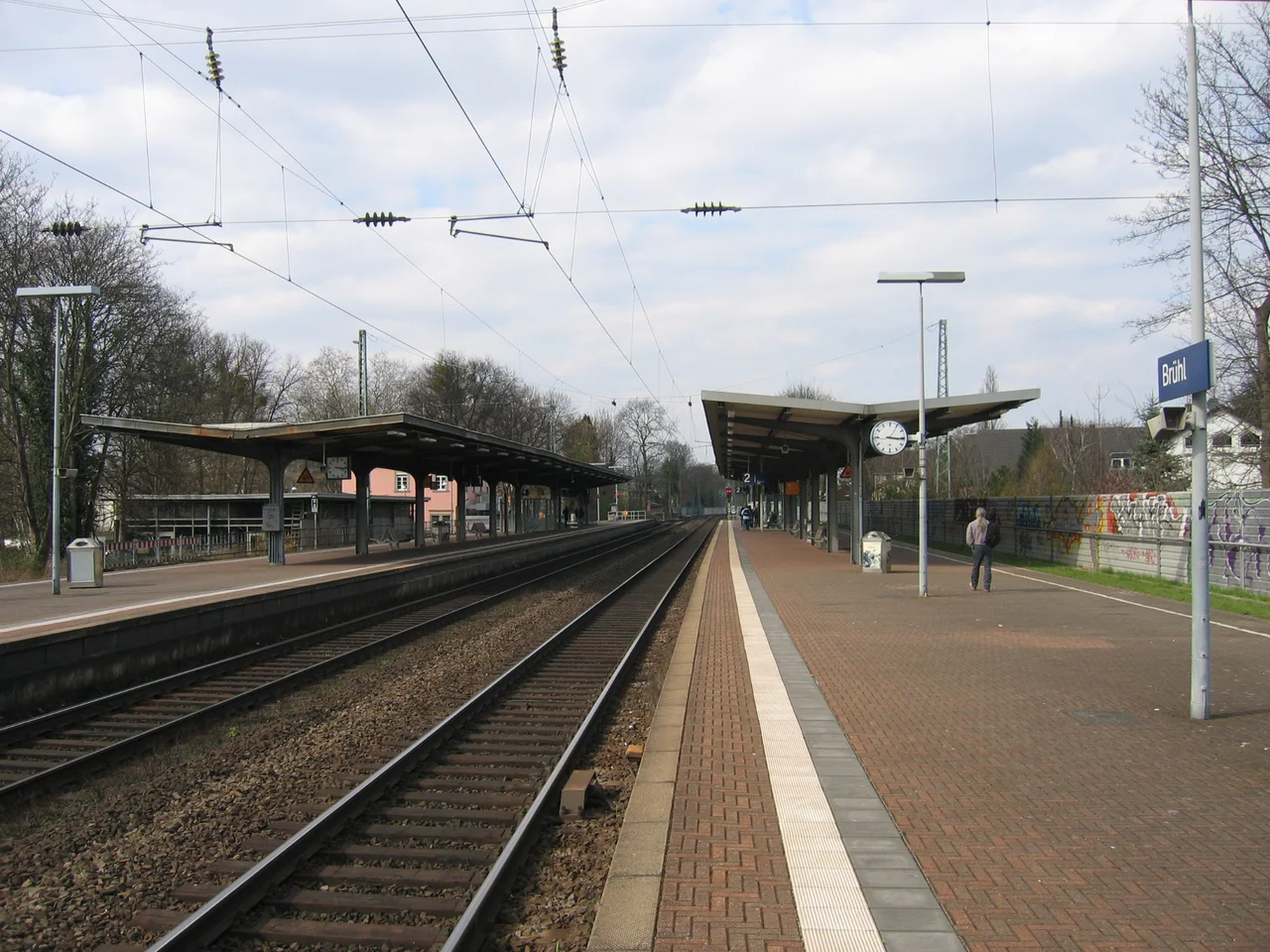

Brühl Train Derailment
It was a few minutes after midnight on a Sunday morning in February. Two hundred and one passengers were already asleep in their compartments aboard the D 203 Schweiz-Express, a night train that left Amsterdam each evening and reached Basel each dawn. Outside Cologne, the train slowed to a crawl for engineering work, then accelerated. The driver believed he was clear. He was not. Three kilometers ahead, the line he was on funneled into a 40 km/h crossover switch at the small station of Brühl. The locomotive met that switch at 122 km/h. Nine of the passengers asleep behind it would not see the morning.
A Construction Zone in the Dark
The West Rhine Railway between Cologne and Bonn is one of Germany's busiest mainlines - 160 km/h tracks carrying both freight and international expresses. On the night of 5-6 February 2000, the southbound track was closed near the Brühl freight yard for routine maintenance. Trains heading south were diverted onto the northbound track at Hürth Kalscheuren, ran wrong-line through Brühl, and rejoined their own rails further south. To do this safely, they had to take a low-speed crossover at the Brühl passenger station - a switch designed for 40 km/h, not for the line speed of the surrounding track. Sixty-eight trains had passed through that crossover without incident that night. The drivers' event recorders showed none exceeding 48 km/h through the station. Then came D 203.
Twelve Seconds of Confusion
The investigation report later reconstructed the driver's view in painful detail. He had received a written bulletin describing the closure. He had seen the substitute signal at Brühl, which mandates a 40 km/h limit. He slowed to 40 as required and crawled through the construction site. Then, clear of the work, he began to accelerate - first to 90, the figure printed in one column of his bulletin for the regular southbound track, then beyond it. He may have believed that signal applied to him once he had passed the work zone. It did not. The 40 km/h limit held all the way to the crossover. The bulletin itself, investigators found, had been written ambiguously and had even swapped the names of the freight station and the passenger station. There was no radio contact between the train and the station director. The judge later called it an Augenblicksversagen - an instant lapse. The German word is gentler than the English; it acknowledges that a competent person can be undone by a single missed beat.
The Locomotive and the House
When the wheels hit the switch at three times the design speed, the laws of physics offered no negotiation. The locomotive jumped the rails, slid down the embankment, and came to rest inside the wall of a house beside the tracks. The first coaches followed it. Others slewed sideways across the platform, slamming into the iron supports of the platform roof. Of the 201 people on board, nine died and 149 were injured. The dead were travelers - going on holiday, going home, going to work in another country. The Schweiz-Express had been a quiet way to cross Europe overnight; you boarded in one country and stepped off in another, and the kilometers passed while you slept. For nine families, that ordinary act of trust became the last act.
The Investigation's Hard Truth
Four people were charged with negligent manslaughter: the driver, the editor of the operations bulletin, and two construction-planning staff. The station director was not charged. After twenty-three days of trial, all four cases were dropped with fines between 7,000 and 20,000 marks - the court accepting that no single person had been criminally negligent. The investigators were less forgiving of the system. Their report pointed out, on page 19, that 69 trains routed through such a low-speed crossover would have justified installing an inductive train-protection system - the kind of equipment that automatically applies the brakes when a driver misjudges a signal. The cost would have been modest compared to the construction project. It was not installed. The recommendations focused on writing clearer bulletins, requiring radio confirmation between drivers and stations during diversions, and treating substitute signals with the suspicion they deserve. Many of those changes were made. The dead remained dead.
What the Town Remembers
Brühl is a pleasant Rhineland town of around 45,000, better known for its UNESCO-listed Augustusburg Palace and the Phantasialand amusement park than for the night of 6 February 2000. The station has been rebuilt; the crossover has been removed and the signaling modernized. Trains rush through where the D 203 came to rest. Nine names belong to that small siding now, even though no monument marks the spot. The lesson investigators wrote into the report was deceptively plain: when two pieces of written information conflict, choose the safer interpretation. It is the kind of rule that sounds obvious until the night you have read it a hundred times and your eyes have begun to skim, and the next switch is closer than you think.
From the Air
Brühl station sits at 50.8297 N, 6.9125 E, between Cologne and Bonn on the west bank of the Rhine. From the air the West Rhine Railway is a clear ribbon running north-south just east of the town center; the long thin sliver of Brühl's Schlosspark and the baroque Augustusburg Palace are the unmistakable landmarks immediately west of the line. Cologne Bonn Airport (EDDK / CGN) is 10 km east-northeast, with approaches that often overfly this stretch of railway. Best viewing in clear weather from 3,000 to 6,000 ft on the CGN downwind.
Nearby Stories
- Diamond Interchange: How a Simple Idea Reshapes Towns Like Julich 2.8 km away
- Dusseldorf-Unterbach 6.1 km away
- Baumwollspinnerei Ermen & Engels 11 km away
- RAF Bruggen 15 km away
- Hagen Open-air Museum 21 km away
- Belgium 130 km away
- Marcinelle Mining Disaster 173 km away
- Zwingenberg Castle 178 km away