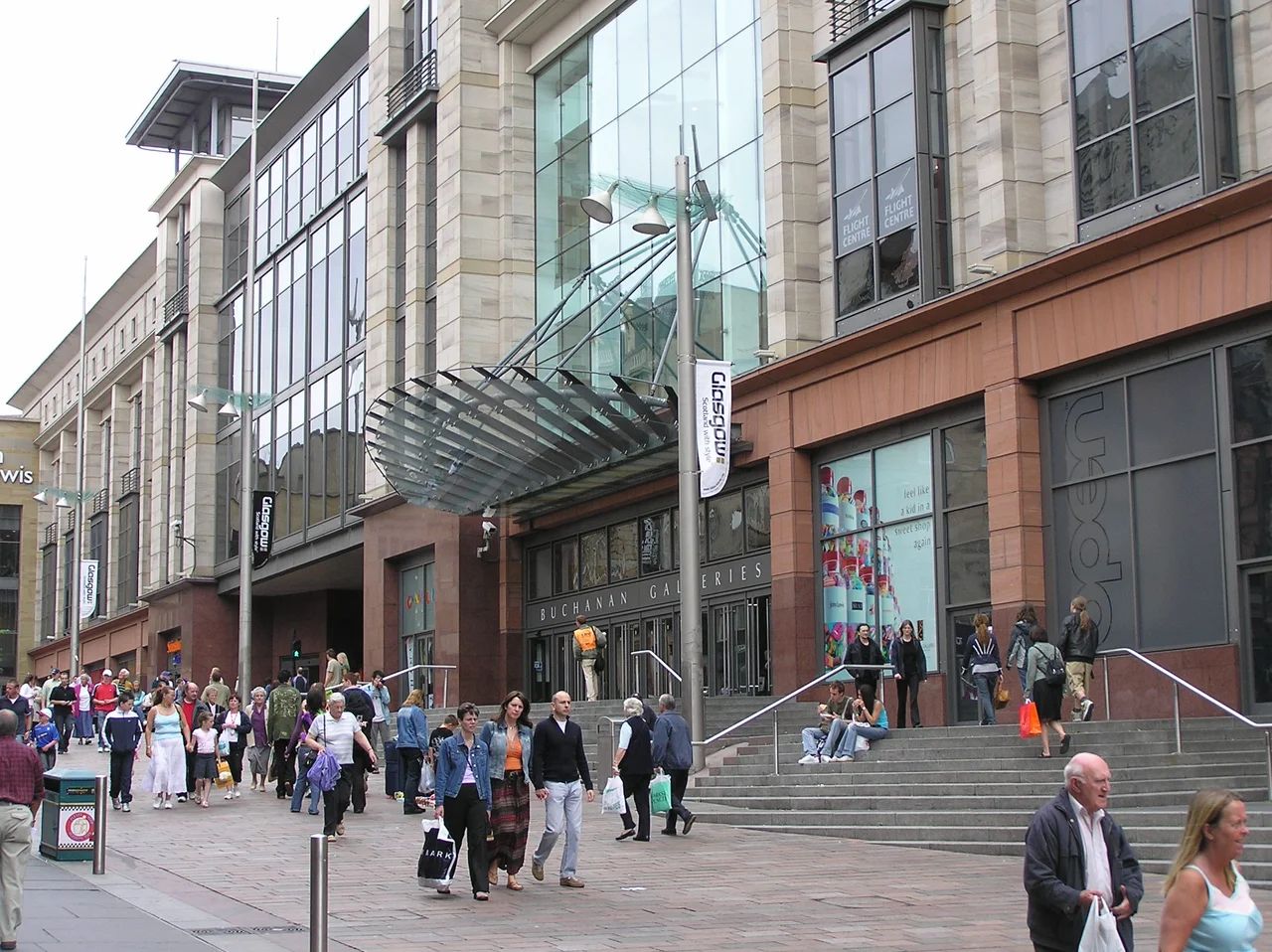

Buchanan Street
Andrew Buchanan, who never saw the street that carries his name, made his money in a way the modern shoppers walking it would find difficult. He was a Glasgow Tobacco Lord and a plantation owner, his fortune built on enslaved labor in Virginia. When he died in 1759, his tobacco empire passed to his son James; when the American Revolution arrived in 1776, the family lost the plantations. The land they had hoped to keep in country estate was carved into streets to pay debts. The first feu was laid out in 1777 on Buchanan ground, and the street took the family name. Today it is the second-busiest shopping thoroughfare in Britain, behind only Oxford Street in London.
A Street Built on Loss
Glasgow grew rich on tobacco in the eighteenth century, and the Buchanans were among the richest. The American Revolution ended that wealth almost overnight, and the response of Glasgow's tobacco families was characteristically practical: lose one empire, build another. The Buchanans pivoted into textiles and industry, and sold off land. The first Palladian villas went up along Buchanan Street in the 1790s, with terraced townhouses following. By the early nineteenth century the New Town of Blythswood was climbing the hill to the west, planned by William Harley up to Blythswood Square. Banks, hotels, the Western Club, the Athenaeum that would one day become the Royal Scottish Academy of Music and Drama, all gathered along the line of the street. The city was reinventing itself, and Buchanan Street was a major axis of that reinvention.
Railways and Pedestrians
Buchanan Street acquired a railway station in 1849, the first city-centre terminal in Glasgow, owned in turn by the Caledonian Railway, the London Midland and Scottish, and finally British Railways. It closed in 1966, and Glasgow Caledonian University now stands on its footprint. Glasgow Queen Street station, immediately to the east, still serves the lines to Edinburgh, Helensburgh, Oban, and Fort William. Underground, the Glasgow Subway loops through Buchanan Street station and continues to St Enoch at the foot of the hill. In 1977 the city pedestrianised the street between Bath Street and Argyle Street, and Buchanan Bus Station opened nearby. The biggest change came in 1999, when the entire street was relaid in high-quality granite under blue neon lighting. The result combined Victorian sandstone facades with crisp modern paving, and in 2008 it took the Academy of Urbanism's Great Street Award, beating O'Connell Street in Dublin and Regent Street in London.
The Squares Off the Spine
Walk Buchanan Street and the squares open off it like rooms off a corridor. At the foot, where the street meets Argyle Street and St Enoch Square, the Argyll Arcade opened in 1827 with sixty-three shops and is now the oldest Victorian shopping arcade in Britain. Princes Square hides behind a facade nearby. Across the street stands the iconic House of Fraser flagship, of a chain that started in Glasgow and once owned Harrods of London. Midway up, Royal Exchange Square opens through to Queen Street; its centerpiece, the old Royal Exchange, now houses the Gallery of Modern Art. Buchanan Street is also joined here by Nelson Mandela Place, renamed in protest by the Labour-led council because the South African Consulate stood there. Glasgow had in fact awarded Mandela the Freedom of the City in 1981 — the first city in the world to do so, nine years before his release — and in October 1993, after his release, Mandela came to Glasgow in person to receive the honour. At the top of the street stands the Glasgow Royal Concert Hall, opened in 1990, home to the Royal Scottish National Orchestra, and the only statue on Buchanan Street, of Donald Dewar, Scotland's first First Minister, unveiled by Tony Blair in May 2002.
Buskers, Granite, Rain
Rents on Buchanan Street can run as much as 250 pounds per square foot, making it the sixth most expensive retail street in the United Kingdom; the five above it are all in London. None of that explains why the street feels the way it does. The stretch between Argyle Street and St Vincent Street is the unofficial busking corridor, a sound check that runs from morning to night, a fiddler giving way to a piper giving way to a band of teenagers with a mic stand and an amp. The granite paving keeps a wet shine on grey days. Tall Victorian frontages of pale and red sandstone close the street into a clean stone canyon. To stand at the top of Buchanan Street on a Saturday and look down the long slope toward Argyle Street, with the buskers strumming and the shopping bags swinging, is to see one of those city moments in which a place is exactly, unapologetically itself.
From the Air
Buchanan Street runs roughly north to south across central Glasgow at 55.86 N, 4.25 W, easily picked out from the air by the pale stone of the Glasgow Royal Concert Hall at its north end and the dark glass of St Enoch Square at its south end. Glasgow Central railway station sits one block south. Glasgow International (EGPF) lies 6 nm west; Glasgow Prestwick (EGPK) 28 nm to the southwest. From 1,500 to 2,500 feet AGL on a westerly approach to EGPF, the M8 cuts past the city centre and the Buchanan corridor reads as a bright pedestrianised stripe between the older tenement blocks.
Nearby Stories
- Mauchline 3.6 km away
- Shotts 4.2 km away
- HMS Ulysses (1917) 7.7 km away
- Rothesay Castle 8.8 km away
- Inchcailloch 10 km away
- Strachur 14 km away
- Battle of Dollar 16 km away
- Crawford Castle 16 km away