.jpg)
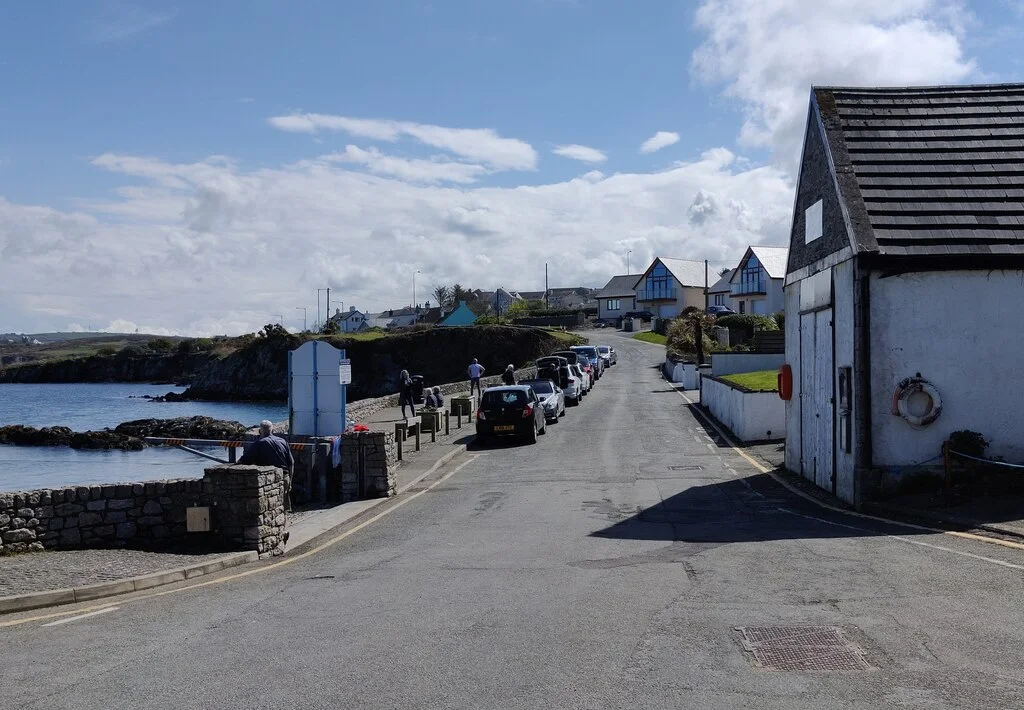
Bull Bay Lifeboat Station
Dense fog, calm water, and the 530 passengers and crew of a transatlantic liner aground on rocks under the cliffs. That was the morning of 9 March 1877 for the Bull Bay lifeboat crew. The SS Dakota, a Liverpool steamer bound for New York, had blundered onto the rocks near East Mouse and stuck fast. The lifeboat Eleanor was launched into the still water and reached her quickly. Twenty people came off in the lifeboat itself; she then stood by while local fishing boats ferried the rest ashore. No lives were lost. The ship broke in two the next day. The wreck of the Dakota was Bull Bay's most famous service in 58 years of saving lives along one of the most dangerous coasts in Britain.
Why Here
The decision to put a lifeboat at Bull Bay was made by the RNLI in 1867 with a blunt assessment: 'an additional life-boat would be useful on that rocky coast, there being a large passing trade, and a long gap between the two life-boat establishments at' Cemlyn and Penmon. The cliffs and rocks between Amlwch and Cemaes had eaten ships for generations. The Marquess of Anglesey granted the land for the boathouse, the boat was paid for by a £400 gift from Miss Holt of Anglesey, and the first lifeboat - a 32-foot self-righting boat with ten oars - arrived in March 1868. She was named Eleanor at the donor's request, and launched from a small sandy cove that gave shelter even when the rest of the coast was unworkable.
Four Boats and Many Names
Lifeboats were almost always paid for by individual donors and named after their benefactors, families, or causes. Bull Bay had four boats in succession. Eleanor served sixteen years. Curling came in 1884, paid for by Miss Curling of Camberwell. A new Curling replaced her in 1889. The final boat was James Cullen, funded from a £900 bequest by Miss Marianne Cullen of Nottingham, who had also paid for twelve almshouses in Carrington - a Victorian woman quietly converting her estate into housing for the poor and rescue for sailors. James Cullen arrived in 1904, housed in a new boathouse with a slipway built over the shore on steel piles at a cost of £2,000.
The War and the Cambank
On 20 February 1915, the Cardiff cargo steamer Cambank was torpedoed off Point Lynas by the German submarine U-30. Four of her crew of 25 were lost when the torpedo struck. The remaining 21 abandoned ship in one of the lifeboats, where Bull Bay's James Cullen found them and brought them home. The First World War had moved the danger from rocks and storms to mines and torpedoes, and lifeboat crews along the British coast spent four years answering distress signals from ships that had simply been blown apart. Bull Bay's records show 41 launches across the station's lifetime; the Cambank rescue was among the most clearly war-related.
Closure and Continuation
The RNLI committee of management met on 22 April 1926 and decided to close Bull Bay. Two world-class motor lifeboats - one at Holyhead, one at Moelfre - could now cover the same coast with far greater range and reliability than a rowing-and-sailing boat could ever achieve. The station that had launched 41 times and saved 63 lives was wound up. The slipway boathouse remained, and is today the Bull Bay Community Boathouse - a sailing and rowing club that keeps the lifeboat tradition alive in a smaller way. The Trireme Ynys Mon Rowing Club is based here. The cove that once sheltered the Eleanor still shelters wooden boats; the rescue work moved a few miles down the coast to Moelfre, where it continues.
From the Air
Bull Bay (Porth Llechog) at 53.42°N, 4.37°W, on the north Anglesey coast, two miles west of Amlwch. From the air the bay shows as a small notch in otherwise sheer coastline, with the rust-coloured slopes of Parys Mountain visible inland to the south. The treacherous offshore rocks - West Mouse, Middle Mouse, East Mouse - sit between two and four nautical miles offshore. Nearest airports: Anglesey/Valley (EGOV) 14 nm west-southwest, Caernarfon (EGCK) 20 nm south. The Skerries lighthouse, four miles northwest, marks the worst of the offshore hazards.
Nearby Stories
- Llandudno Lifeboat Station 3.8 km away
- Glynllifon 6.1 km away
- German submarine U-1024 9.4 km away
- Irish Sea Bridge 11 km away
- Ysbyty Ifan 12 km away
- Irish Sea 18 km away
- Celtic Array 18 km away
- Birkdale Palace Hotel 56 km away