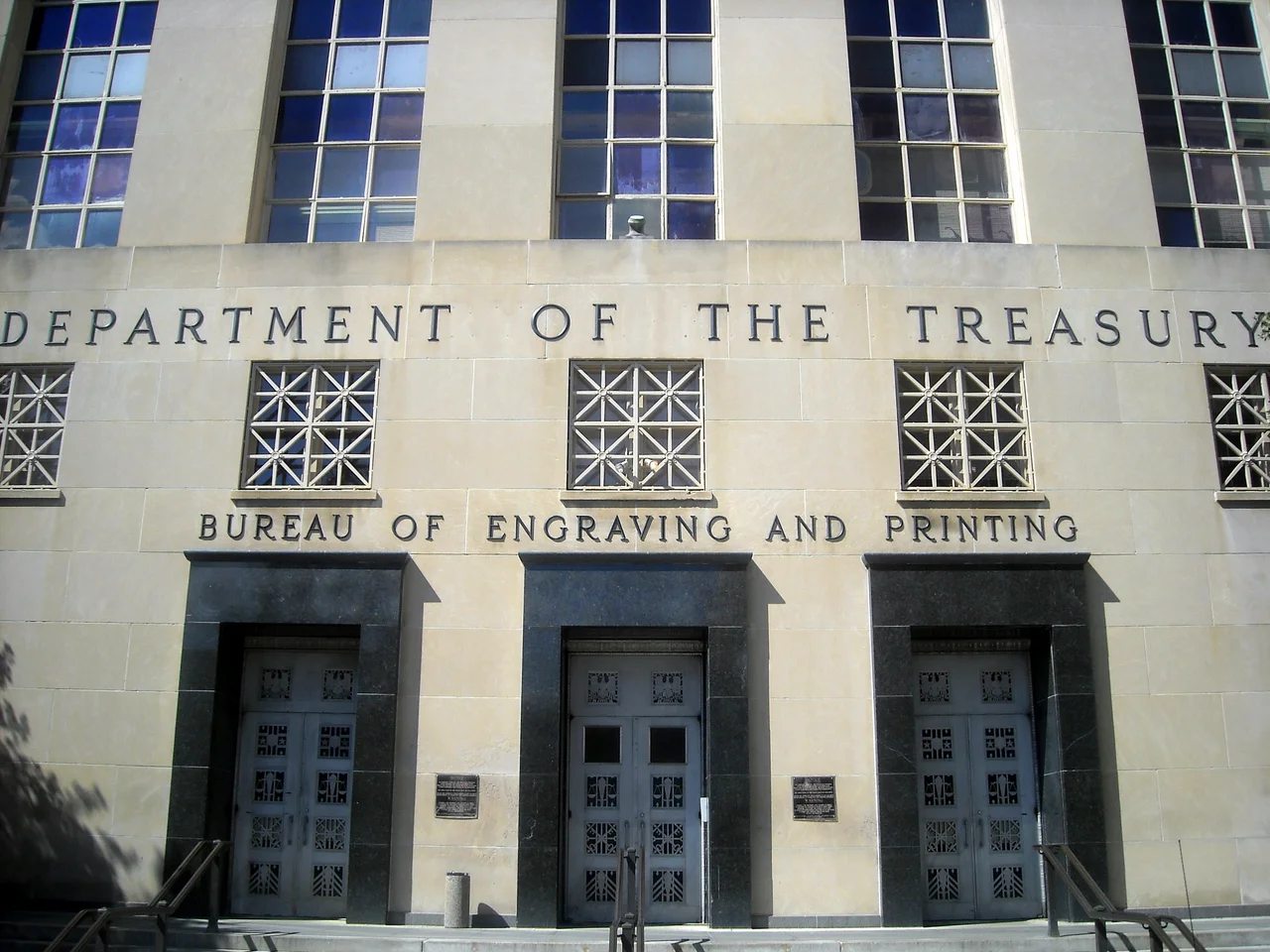

Bureau of Engraving and Printing
Walk past the 15th Street SW entrance and you might not notice anything unusual. The building is dignified, Indiana limestone over a steel frame, the kind of federal architecture that recedes politely behind the larger memorials of the National Mall. Then you hear it: the deep rhythmic thump of intaglio presses through the granite trim. Inside, paper runs through machines at thirty-two notes per sheet. Each sheet of distinctive paper, dampened just slightly, is pressed against engraved steel plates so hard the fibers push into the engraved lines and pull the ink out. Six and a half billion dollars in notes leave this building most years. They cost about ten cents each to make.
Civil War Cash Flow
In July 1861, the Union ran out of coins. The Civil War was three months old and the federal government could not pay its bills, so Congress authorized Treasury Secretary Salmon Chase to issue paper Demand Notes that promised redemption in metal at some later date. The government had no facility to print money. The American Bank Note Company and the National Bank Note Company produced the sheets, four notes to a sheet, and shipped them to the Treasury Department where clerks signed them by hand and other workers cut them out with scissors. The Second Legal Tender Act of July 1862 finally gave Treasury the authority to print its own. What would become the Bureau of Engraving and Printing began that summer as an unnamed operation in a Treasury basement. It would not be officially named for another twelve years.
More Than Money
From its first days the BEP printed more than currency. By 1864 it was making passports for the State Department and money orders for the Post Office. It produced interest-bearing notes, refunding certificates, compound interest Treasury notes, and bonds. Beginning in July 1894 it took over the printing of every postage stamp in the United States, a monopoly it would hold for 111 years until the Postal Service moved to private printers in 2005. The first BEP stamp was a six-cent James Garfield issue. By the end of that first year the Bureau had printed and shipped 2.1 billion stamps. Today the BEP still makes Treasury securities, military commissions, white House admission cards, and ID cards for dozens of federal agencies, though postage stamps and passports have moved elsewhere. The notes are what people think of first, but they have always been part of a much larger catalog of secure paper.
Four, Eight, Twelve, Eighteen, Thirty-Two
The arc of BEP history is an arc of increasing efficiency, measured in notes per sheet. The Civil War sheets held four. World War I pushed the presses to eight. The 1929 currency redesign, the first major change since 1861, shrank the bills to their current size and let the Bureau go to twelve notes per sheet. By 1952, after a decade of experimentation with faster-drying inks, the Bureau moved to eighteen. In 1957 came dry intaglio printing on special paper, which eliminated the need to dampen sheets before each pass and pushed capacity to thirty-two. Since 1968 every American banknote has been printed this way. The press squeezes the paper into engraved lines on a steel plate, picks up the ink, releases. Backs are printed first, then faces, then the sheets are overprinted with Treasury seals and serial numbers. The result is a piece of currency with a tactile, three-dimensional ink relief that no copier can quite reproduce.
Two Buildings, Soon One
The Washington facility is two buildings facing each other across 14th Street. The main building between 14th and 15th streets SW was finished in 1914, its 505-foot neoclassical facade looking across Raoul Wallenberg Place toward the Tidal Basin and the Jefferson Memorial. It is listed on the National Register as the Auditor's Building Complex. The annex, completed in May 1938, runs 570 feet along 14th Street with five wings extending north and south from a central spine. A free thirty-minute guided tour walks visitors past the production floors during business hours. Construction began on a second BEP facility in Fort Worth, Texas in 1987, both to increase capacity and to provide a backup in case Washington went down. Currency from Fort Worth carries a small FW to the left of the face plate number. In April 2022, Governor Larry Hogan announced that the Washington operation would move to a 104-acre site on the Beltsville Agricultural Research Center in Maryland, with completion originally expected in early 2027, though construction was put on hold in January 2025 due to budgetary constraints. The Tidal Basin facility will eventually fall silent.
Other Touches
The BEP operates its own police force, with 187 officers as of 2020, responsible for protecting the facilities and personnel under a memorandum of understanding with the DC government. The Bureau also runs the U.S. Currency Reader Program, which provides free battery-powered iBill devices to visually impaired Americans. Slide a bill in, and a small voice announces the denomination. The Treasury seal on each note is overprinted in green ink. The serial numbers are typographic, not engraved. The paper is twenty-five percent linen and seventy-five percent cotton, made by a single Massachusetts mill that has been the sole supplier for more than a century. Every dollar is a small artifact of nineteenth-century craftsmanship enforced by twenty-first-century industrial discipline, made by people who go to work every morning in a limestone building beside the Tidal Basin.
From the Air
The BEP main building is at 38.8856 degrees north, 77.0331 degrees west, on Raoul Wallenberg Place SW between 14th and 15th streets, just east of the Tidal Basin and the Jefferson Memorial. Best viewed at 1,500 to 2,500 feet AGL with the Mall to the north and the Potomac to the south. Reagan National (KDCA) is two nautical miles southeast across the river. The site lies inside the P-56 prohibited area; viewing is from authorized riverside approaches only.
Nearby Stories
- Gunston Hall 1.1 km away
- 2023 Baltimore Shooting 4.9 km away
- Battle of Middleburg 6.6 km away
- Crownsville Hospital Center 10 km away
- Battle of Loudoun Heights 13 km away
- First Battle of Rappahannock Station 20 km away
- Howard County, Maryland 21 km away
- Harriet Tubman Underground Railroad 50 km away