
Burgh Island
Twice a day the sea returns and Burgh Island becomes an island again. For the six hours of high tide, the only way across the 270 yards of water from Bigbury-on-Sea is the sea tractor: a Fordson-powered contraption that drives across the submerged sandy bottom with its wheels underwater while passengers ride a platform high above. When Agatha Christie wanted to strand ten strangers on a remote island in 1939, she didn't have to invent the geography. She knew this place. She had a beach house here, built as her writing retreat, still standing on the island today.
Soldier Island and the Pilchard Inn
Christie used Burgh Island twice. It became Soldier Island in *And Then There Were None*, where her ten guests are picked off one by one, and it served as the setting for the Hercule Poirot mystery *Evil Under the Sun* in 1941. The 2001 television adaptation of *Evil Under the Sun* filmed on the actual island, closing a circle that opened sixty years earlier. The Pilchard Inn, the pub that still serves drinks on the island, traces its history back to 1336. It may have begun as guest lodgings for a medieval monastery, the rest of which is believed to lie beneath the current hotel's foundations. After the Dissolution, fishermen took over: pilchard fishermen, who used the old chapel atop the island as a 'huers hut' from which to raise a 'hue and cry' when shoals appeared offshore.
A Place of Many Names
The island has been called many things. Early records knew it as St Michael's Island. Maps from 1765 hedge their bets with 'Borough or Bur Isle.' An 1908 postcard called it Burr Island. As late as 1947, the Ordnance Survey was still labelling it Borough Island. The current name, Burgh, is what's left after centuries of shortening. The Romans may have known the area too: tin ingots recovered from the River Erme estuary wreck, just a few miles east, suggest this stretch of South Devon was an ancient tin trading port. The 1st-century BCE writer Diodorus Siculus described tin being traded from a tidal island off the British coast, a passage usually attached to St Michael's Mount in Cornwall. The Erme ingots have made some historians wonder if he meant Burgh instead.
Art Deco on the Sand
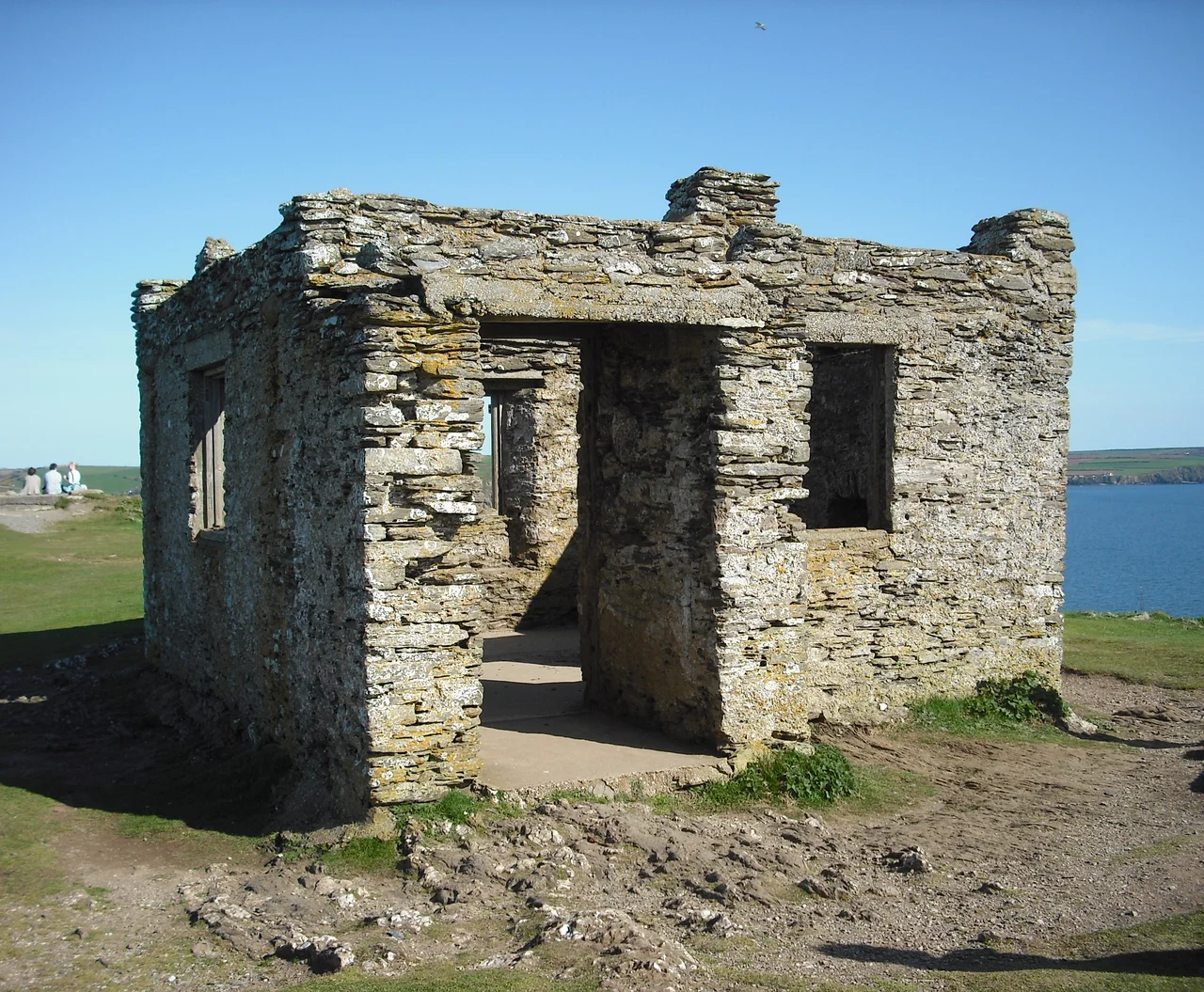
The hotel that dominates the island today was built in the 1930s and remains one of England's most complete Art Deco buildings: white walls, curved balconies, peacock-feather motifs, the whole vocabulary of inter-war glamour set against a backdrop of Devon weather. During World War II, the strategic position that drew smugglers and pilchard fishermen drew anxious British generals: anti-tank defences and two pillboxes were dug in on either side of the causeway in case German landing forces tried to use the island as a beachhead. An observation post went up on the summit. None of those defences were needed. The island sold in 2018 to a venture called Project Archie, and went back on the market in 2023 for fifteen million pounds.
From the Air
Burgh Island sits at 50.28 degrees north, 3.90 degrees west, just off the South Devon coast at Bigbury-on-Sea. From the air it appears as a small green dome of headland connected to the mainland by a pale tidal sandbar that vanishes and reappears twice daily. Plymouth (EGHD) is 14 nm to the west, Exeter (EGTE) 32 nm to the north-east. Best viewing altitude is 1,500-2,500 feet on a clear day, ideally an hour either side of high water when the tractor's wake traces a line across the water.
Nearby Stories
- Davidstow Circuit 3.7 km away
- Golden Hind 3.9 km away
- Powderham Castle 4.4 km away
- Fowey Lifeboat Station 5.1 km away
- Okehampton Castle 12 km away
- Battle of Plymouth (1652) 19 km away
- Goonhilly Satellite Earth Station 44 km away
- German Submarine U-672 73 km away