
Burns Cottage
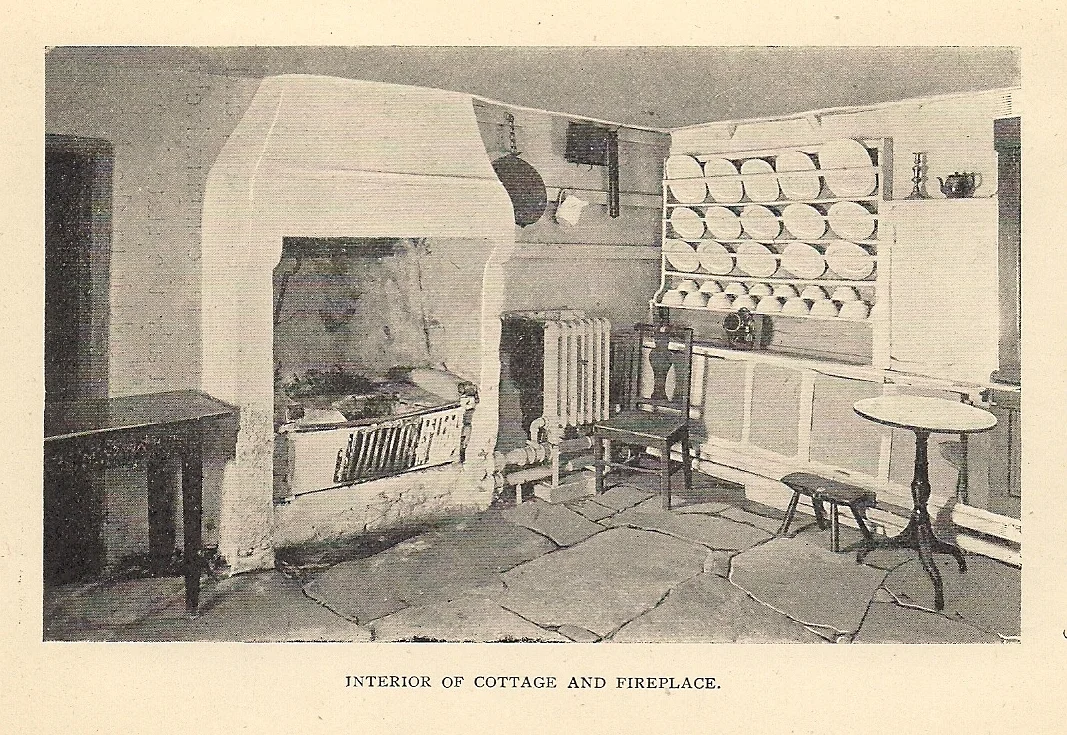
Two of the four rooms were for the family. The other two were for the livestock. William Burnes, who built the cottage with his own hands in 1757 and named the place after himself, was not a man with money to spare. The byre and barn shared the same long, low, thatched roof as the kitchen and the parlour. On 25 January 1759, in a bed alcove inside the kitchen wall, his wife Agnes gave birth to a boy whose name would later be spelled slightly differently: Robert Burns.
Born in a Bed Box
The cottage is a long, low, thatched building fronting the main street of Alloway. Inside are four rooms: a small kitchen and parlour for the family, with the byre and barn for animals beyond. The kitchen contains an alcove that houses a bed box - effectively a built-in box bed - and that is where Burns was born. The whole structure is clay and thatch, the simplest possible building materials. Four rooms. Two of them for people. This was the standard farming-cottar arrangement of mid-18th-century lowland Scotland: animals and humans under the same roof, the warmth of one helping the warmth of the other through the long damp Ayrshire winters.
Sold to Shoemakers
The Burns family did not stay long. As the children kept arriving, they needed more space, and they moved to a larger house in the south-east of Alloway. William Burnes sold the cottage to the Incorporation of Shoemakers in Ayr - one of the trade guilds, who would have rented it out as an investment property. The cottage's literary status was not yet obvious. Burns himself died in 1796 at the age of 37, his reputation rising fast but his birthplace still a working building. The shoemakers' tenants did what tenants do.
The Pub Years
After Burns's death, the cottage became a pub - the operation run for a time by a Mr Goudie from Riccarton, who saw the opportunity to monetize the poet's growing fame. As the volume of pilgrims grew, the pub had to be physically extended. Most of those extensions were later destroyed when the cottage was returned to its original lifetime configuration. The English poet John Keats made the pilgrimage in 1818, two decades after Burns's death. Before he arrived, Keats wrote to a friend that "one of the pleasantest means of annulling self is approaching such a shrine as the cottage of Burns - we need not think of his misery - that is all gone - bad luck to it - I shall look upon it all with unmixed pleasure." His encounter with the cottage's alcoholic custodian returned him sharply to thoughts of misery. The shrine was not quite a shrine yet.
The Suffragette Attempt
There is one episode in the cottage's history that rarely gets told in the official tour. The Suffragettes - the militant wing of the women's suffrage movement in early 20th-century Britain, who recognized the cottage's symbolic power - once attempted to blow it up. On 8 July 1914, two women planted devices packed with blasting powder beneath the building, with long fuses laid. A nightwatchman heard them and interrupted the attempt; a violent struggle ensued, one woman escaped, and the cottage survived intact. They understood what they were doing: destroying something the establishment held sacred would force the establishment to listen. The attempt failed. But the episode is a quiet reminder that the building was not always treated with reverence by people who had reasons of their own.
Restoration and the National Trust
In 1881 the Burns Monument Trust bought the cottage and began converting it back to its appearance during Burns's lifetime. The pub-era extensions came down. The bed box was preserved. The whitewashed clay walls and thatch were maintained. Today the cottage is owned and protected by the National Trust for Scotland and forms part of the larger Robert Burns Birthplace Museum in Alloway - which includes the cottage, the Brig o' Doon, the ruined Alloway Auld Kirk, the 19th-century Burns Monument, and the original manuscripts of his poems. A reproduction was even built in Atlanta, Georgia, in 1911, by Scottish immigrants who wanted their own piece of the poet. The original still stands where William Burnes built it, 266 years after the birth that made it famous.
From the Air
Burns Cottage sits at 55.4328 N, 4.6335 W in the village of Alloway, just south of Ayr along the River Doon. From the air it is part of the larger Robert Burns Birthplace Museum complex, with the medieval Brig o' Doon visible nearby and the ruined Auld Kirk in its small graveyard. Glasgow Prestwick (EGPK) lies 6 nm to the north - a 5-minute hop. Best viewing from 1,000-2,000 ft AGL; the Firth of Clyde and the Isle of Arran form the western horizon.
Nearby Stories
- Kilbirnie 4.2 km away
- East Kilbride 5.4 km away
- Knockshinnoch Disaster 7.3 km away
- Machrie Moor Stone Circles 9.4 km away
- Kenmure Castle 16 km away
- Ballantrae Lifeboat Station 20 km away
- Loch Fyne 38 km away
- SM UB-85 46 km away