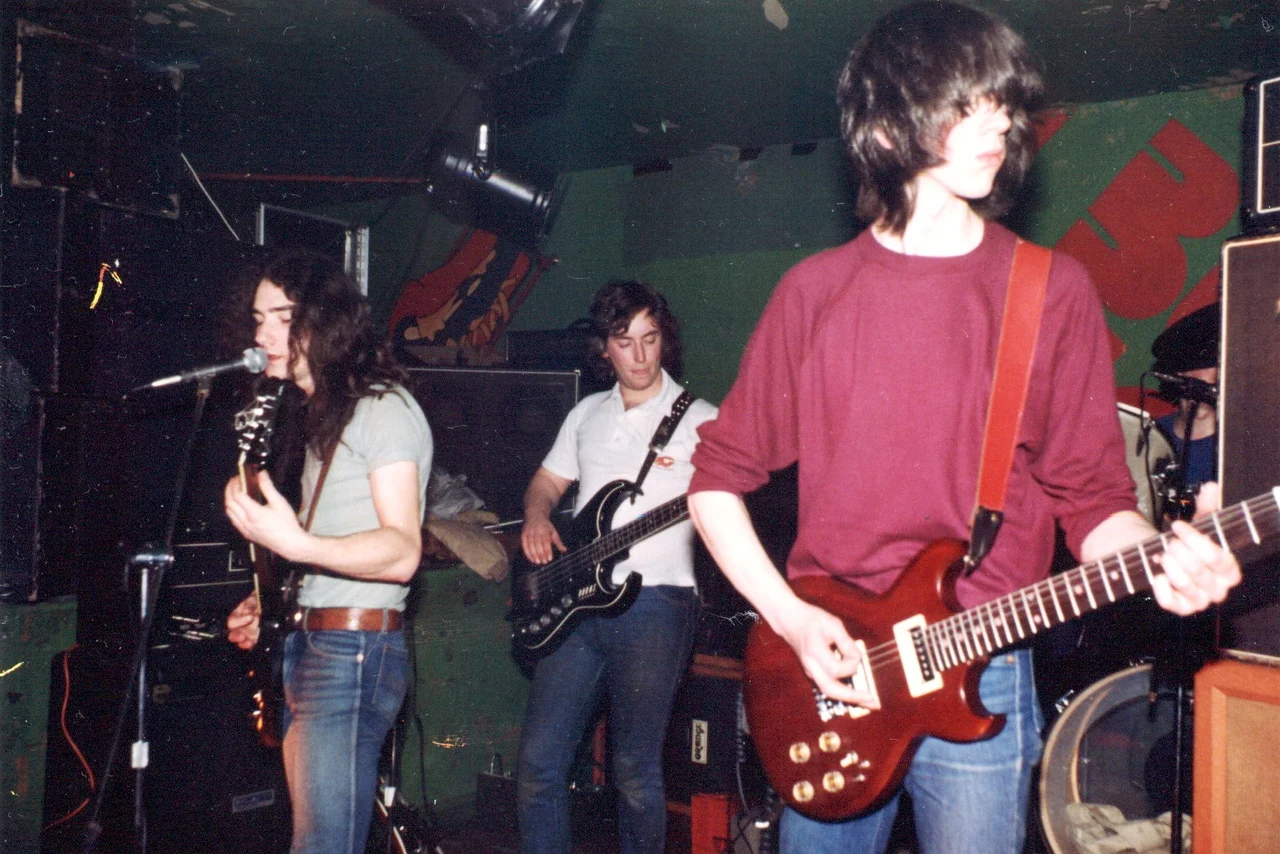

Burns Howff
Most of the bands that mattered in Scottish rock in the late 1960s and 1970s passed through one address in central Glasgow: 56 West Regent Street, a pub called the Burns Howff. It was, by all accounts, a modest room with a stage at one end and a bar downstairs. What happened on that stage, though, did not stay modest. Maggie Bell stood there. Alex Harvey met his band there. Members of what would become Simple Minds recorded their first studio tapes in what was essentially a walk-in cupboard upstairs. For about fifteen years, the Howff was the place a Glasgow band proved itself.
The House Band Who Got Famous
The Howff's resident band in its early years was a group called Power. They changed their name to Stone the Crows, which is how most people remember them now, and they took with them on the long road two of the great Glasgow musicians of that generation. Maggie Bell sang vocals, a voice that critics would compare to Janis Joplin for the rest of her career, and James Dewar played bass. Dewar, known to friends as Jimmy, later joined the Robin Trower Band with the ex-Procol Harum guitarist Robin Trower and the drummer Reg Isidore, and his soulful bass and vocal work on records like Bridge of Sighs gave Trower's blues-rock a center of gravity that no other singer could replicate. He died young, in 2002. Stone the Crows itself ended in 1972 when their guitarist Les Harvey was electrocuted onstage in Swansea. The Howff's history runs through bright careers and through tragedies, the two sometimes belonging to the same person.
Alex Harvey's Audition Room
Alex Harvey was already a Glasgow veteran when he started looking, in the early 1970s, for a band to back him in a new direction. He found them at the Burns Howff. The musicians he met there, members of the Glasgow group Tear Gas, would become the Sensational Alex Harvey Band, one of the most theatrical and influential acts in British rock of that decade. Alex Harvey on stage was a one-man theater company, part Brecht and part Glasgow pub fighter, and the band built around him at the Howff matched that energy. They went on to records like Framed and The Impossible Dream, and to a long and very strange afterlife of influence on punk and on every later Scottish band that has cared about a frontman's swagger. Other bands cycled through the Howff stage in the same period: Beggars Opera with their progressive rock, the avant-garde Chou Pahrot, the three-piece Foxy of Brian Denniston, Jimmy Johnston, and Nod Kerr, and the Shard, a five-piece R&B and soul outfit that played the upstairs lounge for about three years in the late 1960s.
STUDIO in a Cupboard
Late in the Howff's life, somebody installed a recording studio in the upstairs lounge and called it, with engineering economy, STUDIO. It was, the survivors recall, essentially a walk-in cupboard. The microphones picked up traffic noise from West Regent Street and the muffled thump of the bar downstairs. One of the clients was a band called Johnny and the Self Abusers, a punk outfit playing regularly across town at a pub called The Mars Bar. They recorded, then broke up. Out of the wreckage came two new bands: The Cuban Heels and Simple Minds. The Cuban Heels enjoyed a brief, sharp career. Simple Minds became, eventually, one of the biggest stadium acts of the 1980s, with Don't You (Forget About Me) reaching number one in the United States. Pop history travels in odd corridors, and one of them ran through a closet in a Glasgow pub.
Tuesday Night Theatre
The Howff was not only a band venue. From 1973 on, a resident DJ in the bar area called Gordon Elrick ran a service called the Pony Express, which played rock to the drinkers downstairs and piped the same music up to the lounge during band breaks. Elrick also invented theme nights. The most loved was the Tuesday Club, where regulars would dress up and mime to old standards, turning a quiet weeknight into the busiest evening in the area. It is the kind of human detail that gets lost when you list the band names. A pub is not only the famous people who came through it. The Burns Howff finally closed in 1984, the building taken for other uses, the stage dismantled, the upstairs cupboard with its microphones forgotten. The Maggie Bell and Alex Harvey records remain; so does, more quietly, the memory of regulars in costumes lip-syncing on a Tuesday night because the room had room for that, too.
From the Air
The Burns Howff stood at 56 West Regent Street in central Glasgow, near the corner with West Nile Street, at approximately 55.864 N, 4.261 W. The building itself, three blocks north of Buchanan Street's busiest stretch, is no longer the venue but the address remains. Glasgow International (EGPF) sits 6 nm west; Glasgow Prestwick (EGPK) lies 28 nm southwest. From 1,500 to 2,500 feet AGL the dense Victorian grid of central Glasgow is unmistakable, with the Necropolis and Glasgow Cathedral marking the east boundary and the River Clyde curving south.
Nearby Stories
- Mauchline 3.6 km away
- Shotts 4.2 km away
- HMS Ulysses (1917) 7.7 km away
- Rothesay Castle 8.8 km away
- Inchcailloch 10 km away
- Strachur 14 km away
- Battle of Dollar 16 km away
- Crawford Castle 16 km away