.jpg)
Burns Monument, Kilmarnock
Kilmarnock has a particular claim on Robert Burns: the first edition of his poems was printed here in 1786, by a local printer named John Wilson. Only 612 copies came off Wilson's press. Today those copies are known as Kilmarnock Editions, and finding one is the literary equivalent of striking a vein. So when the Burns Monument went up in Kay Park in 1879 to honour the town's most famous literary connection, the people of Kilmarnock had every reason to expect the structure to stand as long as the poems themselves. Then in 2004 it burned down.
Subscriptions and a Stone
On Burns Night 1877, a movement to erect a memorial in Kilmarnock began at a public meeting. The subscriptions came in faster than anyone had expected. What had started as a planned marble statue grew into a memorial building, the organisers reasoning that the public response demanded the larger gesture. The foundation stone was laid on 14 September 1878 by R. W. Cochran-Patrick of Woodside, Depute Provincial Grand Master for Ayrshire. The Masonic dedication marked the gravity of the project. Less than a year later, on 9 August 1879, the completed monument was unveiled by Colonel Charles Alexander of Ballochmyle MP at the formal opening of the new forty-acre Kay Park. The Burns Monument was its focal point. Visitors climbed the elevated site east of the town centre to see the marble Burns surveying the park his admirers had built around him.
The Fire of 2004
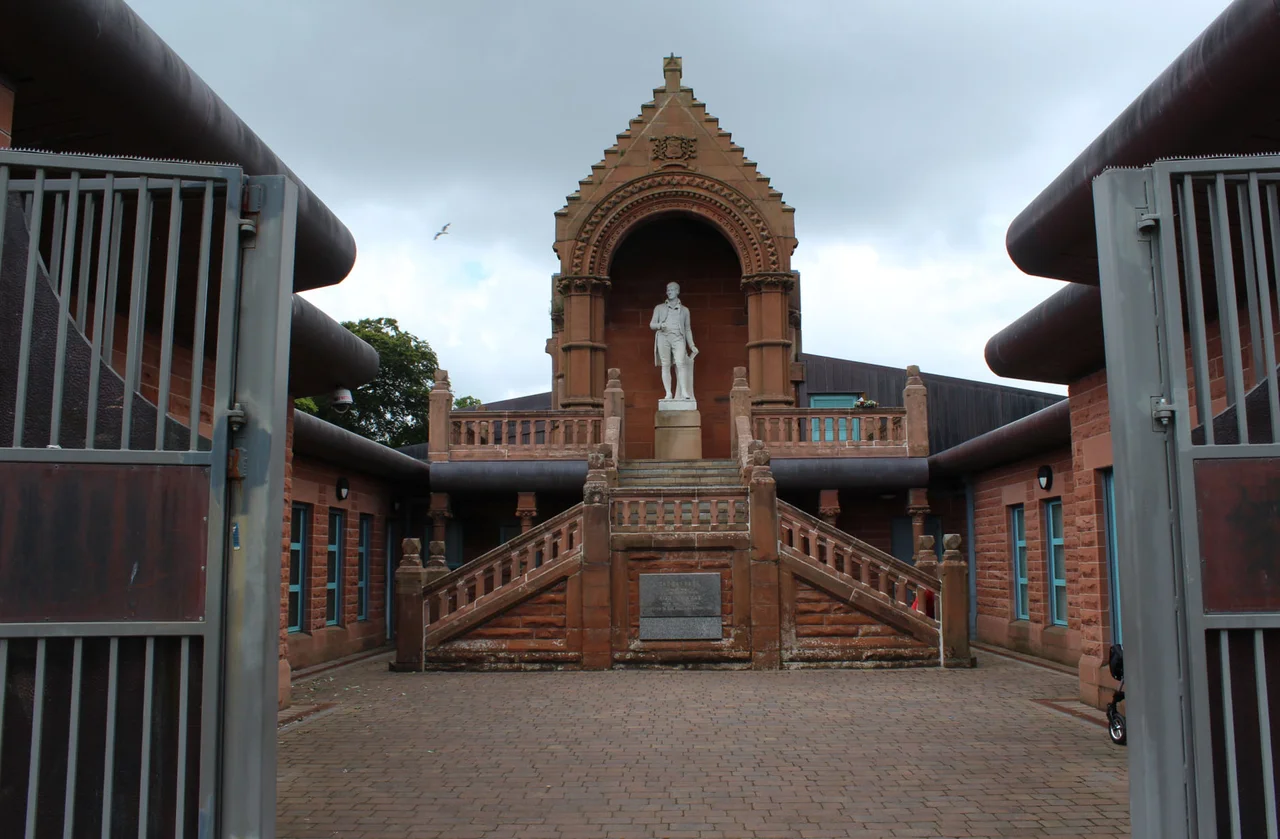
After years of council neglect, fire took most of the building in 2004. The category B listed monument that had stood for 125 years was reduced to a portico and a staircase, the statue itself surviving among the ruins. What to do with the surviving fragment became a public question. East Ayrshire Council architects designed an extension that would envelope the remaining staircase and portico, creating a courtyard with the statue as a focal point on the northern elevation. The result, opened in May 2009 by then-First Minister Alex Salmond, cost five million pounds and was named Scotland's first purpose-built genealogy centre. The Burns Monument Centre houses records and resources for tracing family history, an apt secondary purpose for a memorial to a poet whose work was so deeply embedded in Scottish identity and emigration.
The Carbuncle Question
Not everyone admired the new building. In July 2010, the Burns Monument Centre was named one of six finalists for the Carbuncle Cup, an annual award given by Building Design magazine to the ugliest building in the UK completed in the previous twelve months. The Carbuncle Cup is itself a kind of architectural performance, public taste rendered as anti-prize. The nominator of the Kilmarnock building described it as a "forced, clumpy monstrosity with pointlessly random rooves." The Centre did not win the cup that year, but the nomination stuck in local memory. A fragment of the 1879 portico inside a 2009 envelope, designed to serve a function the original architects never imagined, was bound to provoke arguments. Architectural reconciliation between centuries rarely pleases everyone.
What Burns Would Have Made of It
Robert Burns lived from 1759 to 1796 and would not have recognised any of this. The first printer of his work was a local craftsman in a small Ayrshire town; the monument that later commemorated him was a Victorian gesture of regional pride; the genealogy centre that now surrounds the surviving fragment is a 21st-century civic facility. Each layer reflects what its era thought a literary memorial should do. The Kilmarnock Editions, those 612 copies of 1786, are the original artefact, and they did not need a building. They never have. Burns himself moved among the working people of Ayrshire, drew his materials from their lives and language, and would have found something funny in the idea that his admirers later argued about the architectural merit of the place where they argued about him. The statue still stands in the courtyard, surveying what is left.
From the Air
Burns Monument sits at approximately 55.61°N, 4.49°W, in Kay Park on the eastern edge of Kilmarnock town centre in East Ayrshire. Best viewed from 2,000-4,000 feet, the monument is a recognisable landmark in the green wedge of Kay Park east of the town. Nearest airport is Glasgow Prestwick (EGPK) about 8 nm southwest; Glasgow International (EGPF) is about 24 nm north. The town of Kilmarnock spreads around the park; Dean Castle Country Park lies just north of the town centre. The River Irvine flows south of the park. Typical west-coast Scottish overcast applies.
Nearby Stories
- Clydebank 0.4 km away
- Dunoon 5.5 km away
- HMS Dasher (D37) 6.1 km away
- New Lanark 6.3 km away
- Falkirk Wheel 11 km away
- Drumlanrig Castle 11 km away
- Ailsa Craig 18 km away
- Maybole Castle 18 km away