_(2010).jpg)
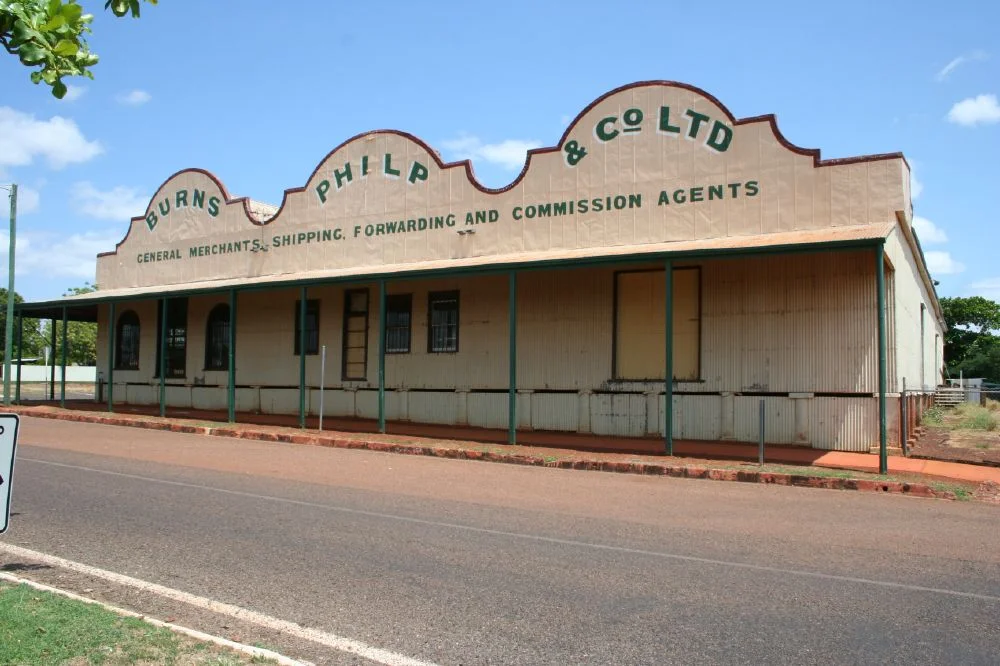
Burns Philp Building, Normanton
The lettering across the parapet still makes its pitch to a vanished world: BURNS PHILP & Co LTD, and beneath it, in a careful arc, GENERAL MERCHANTS, SHIPPING, FORWARDING AND COMMISSION AGENTS. Look closely at one upper window and you can still read the ghost of older paint - CADBURY'S COCOA - advertising to riverboats that stopped coming a century ago. This great corrugated-iron warehouse sits on the high point of Normanton's main street, close to where the town wharves once worked the tide. For more than 120 years it traded continuously, supplying hay and molasses and farm machinery to a scattered, isolated population. It is the oldest building anywhere of a company that once stretched its arms across Australia and the South Pacific.
Where the River Was the Road
Everything came by water. In the 1880s, Normanton sat sixty kilometres up the Norman River from the Gulf of Carpentaria, and every sack of flour, every length of fencing wire, every barrel destined for the cattle stations and goldfields of the north-west arrived by boat. That single fact explains the building's position - hard against the river, with loading platforms angled toward the water and door openings set at the height of a truck bed. James Burns understood the geography before most. He had built his first store in Townsville in 1873, supplying the rough mining camps of the Palmer and the Etheridge, before malaria drove him south to Sydney and he handed the Townsville operation to Robert Philp. The two men kept circling back to each other, and to the Gulf, where the real money was moving.
The Octopus of the North
When the partners formally amalgamated as Burns Philp & Company in 1883, builder Andrew Murphie was soon engaged to raise this warehouse - claimed to be the firm's largest in Queensland outside Brisbane. The boldness paid off almost immediately. In the financial years of 1884-85 and 1885-86, the little Normanton store generated more profit than the company's premises in the far larger city of Townsville. Burns and Philp pressed every advantage. They bought out rival storekeepers, ran their own steamships, and wrote clauses into the mail contracts that carried their cargo first and cheapest. By the 1890s the company had earned a nickname that was half admiration and half complaint: the 'Octopus of the North,' its tentacles wrapped around shipping, retail, and trade from the Gulf to the islands beyond.
Fossilised in Amber
Then the tide went out. The Croydon goldfields faded in the early twentieth century, and a new railway carried Cloncurry's copper trade away to Townsville instead of down to the Gulf. Between 1890 and 1910, Burns Philp rebuilt almost every one of its mainland stores - but the Normanton branch was simply left alone, too remote to bother with. Company historians later described it, not unkindly, as 'fossilised in a stagnant community,' an old kind of structure supplying a wide range of goods to a motley collection of isolated people. That neglect is precisely why it survives. Of the firm's nineteenth-century Queensland stores - in Brisbane, Cairns, Bowen, Cooktown, Burketown, Thursday Island and more - only this one and two others remain. The rebuilding that modernised the rest erased them.
Reading the Building
Step inside and the structure tells its own story. Three long gabled bays run parallel to Caroline Street, divided by walls and linked by arched openings. A former employee who worked here from 1978 to 1986 remembered the layout exactly: the front bay for sales, the rear for stocking goods, the back section heavy with hay, feed and molasses. Some of the original timber shelving still lines the walls. Out behind the building stands a detached strong room of rendered masonry, its heavy metal door and curved concrete roof built to guard the takings of a frontier town where banknotes were scarce - the store once issued its own paper notes for change. Today the front bay holds Normanton's tourist information centre and library, a working welcome desk inside a fossil of the trading age.
From the Air
The Burns Philp Building stands at 17.668°S, 141.081°E, on the corner of Landsborough (Burke Developmental Road) and Caroline Streets at the north-eastern edge of Normanton. Its triple-gabled corrugated-iron bulk and curved painted parapet sit on the town's high ironstone ridge and are genuinely visible from the air on approach, as well as from the river when arriving from the northern port of Karumba. Best viewed from 1,500-2,500 ft AGL. The nearest aerodrome is Normanton Airport (ICAO YNTN), roughly 3 km north; Karumba (YKMB) lies about 70 km north-west on the Gulf coast, and Mount Isa (YBMA) is the nearest major airport, some 370 km south. Dry-season skies (May-October) offer the clearest light; the wet season can flood the surrounding plains and the river road.
Nearby Stories
- Flinders River 7.8 km away
- Delta Downs Station 49 km away
- Normanton to Croydon Railway Line 53 km away
- Golden Gate: The Richest Reef on the Field, Now a Field Again 61 km away
- 2000 Australia Beechcraft King Air Crash 65 km away
- Croydon Station: End of the Line That Floods on Purpose 84 km away
- Sweers Island 112 km away
- Aboriginal Shire of Kowanyama 214 km away