Golden Gate: The Richest Reef on the Field, Now a Field Again
Stand on the Gulf Developmental Road a few kilometres north-west of Croydon and there is almost nothing to see: low scrub, red earth, the foundations of a battery, the wreck of a cyanide plant, a cemetery whose headstones outlast the town that filled it. This was Golden Gate. For a decade and a half it was the beating heart of the Croydon goldfield, a township of around fifteen hundred people at its peak, with its own weekend train service running out from Croydon. The reef beneath it turned out to be the richest on the entire field - and when the reef gave out, the town simply ceased to be. What remains is one of north Queensland's many deserted towns, an archaeological site on the heritage register where the scale of what was here has to be imagined rather than seen.
False Start
Golden Gate did not announce itself. The reef on the Croydon goldfield north-west of town was first worked in 1886, in the first frantic months of the rush, then abandoned the very next year as the early claims came up meagre. For four years it sat idle while the rest of the field churned. Then, in 1891, work recommenced - and that second attempt found what the first had missed. A rich ore chute was discovered in Rogers' No. 1 Golden Gate mine, and suddenly the abandoned ground was the most valuable on the field. The lesson of Golden Gate is the lesson of so much hard-rock mining: the gold was never where it was easy, and the difference between a worthless claim and a fortune was often a few more metres of patient, dangerous digging.
The Best Reef on the Field
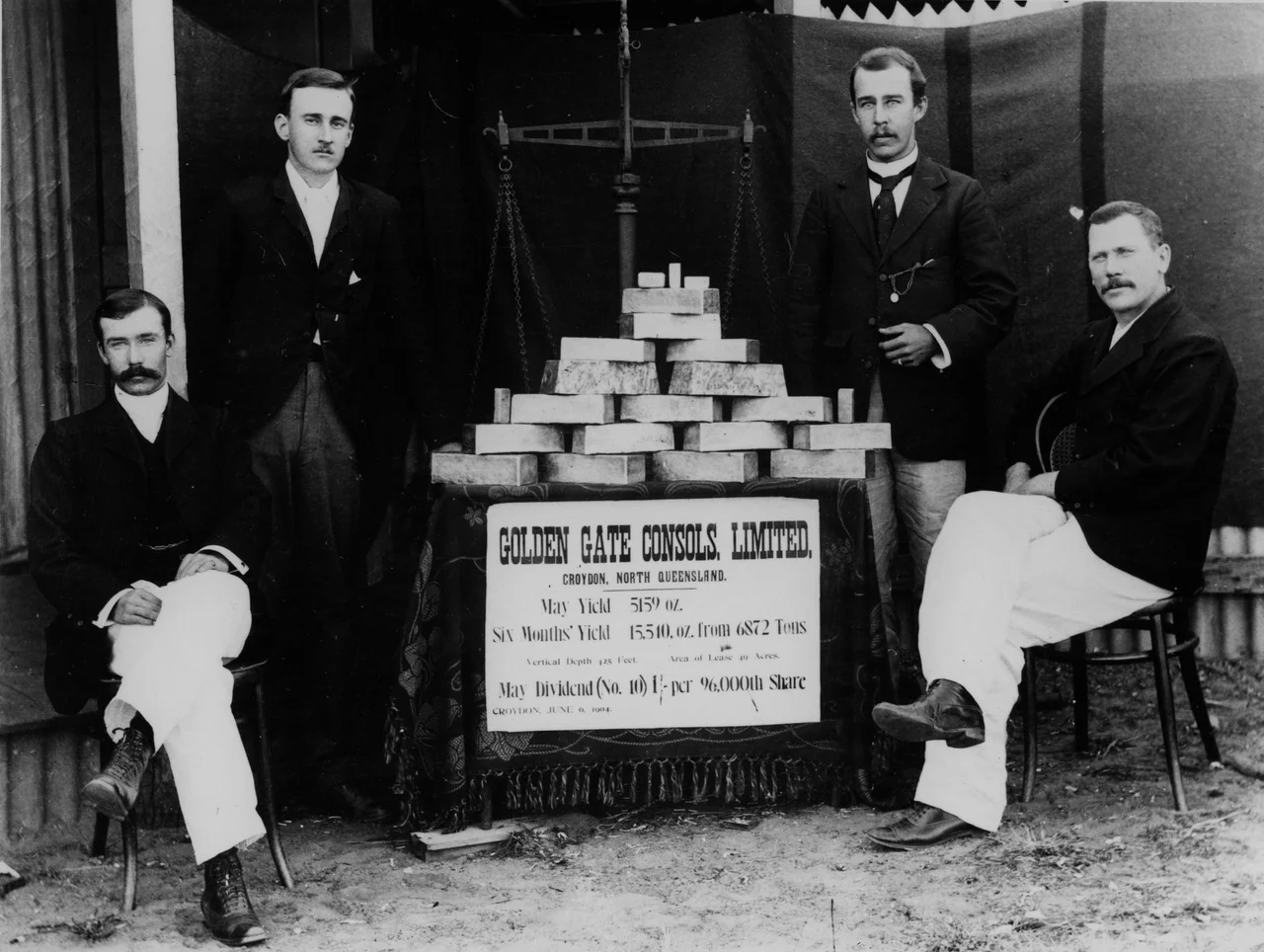
The Golden Gate reef was a large, well-defined body of gold-bearing quartz shot through with sulphides, running north to north-west and worked along a total length of 2.5 kilometres. It drew serious capital - mines like Golden Gate No. 1, Croydon Consols, and the South claims paid real dividends in the 1890s and 1900s. Between 1886 and 1911, in its most productive years, the reef yielded around 483,000 ounces of gold from 244,364 long tons of ore. That single reef accounted for more than one-third of everything the entire Croydon goldfield ever produced. The payable ore, though, was shallow by the standards of deep mining - the records suggest it petered out at a vertical depth of roughly 90 metres - and a reef that does not go down forever is a town with an expiry date.
The Town and the Train
While the gold lasted, Golden Gate was a real place with a real life, not just a cluster of shafts. It sat right on the Normanton-to-Croydon railway, four miles west of Croydon, and from 1902 a weekend "suburban" railmotor service connected the two towns - a commuter line in the middle of the Gulf Savannah. Excursion trains brought picnickers and race-day crowds out along the line. There were the ordinary institutions of an Australian mining town: a post office, a school, businesses, a cemetery. The reef's prosperity peaked between about 1895 and 1901, the years when fifteen hundred people could make a living from the ground beneath their feet and the railway connected them to the wider world.
Back to the Savannah
Decline came as surely as it had come to Croydon itself. Production fell away after 1911, and the slow unwinding followed the familiar order of a dying field: the post office closed in 1919, the school in 1921, the last mining company shut its operations in 1922. The people left, the buildings were carted off or fell down, and the savannah took back its ground. What survives is a heritage-listed complex of relics - the Croydon Consols pump shaft, the No. 10 North mine, the battery and cyanide plant, and the Golden Gate cemetery - scattered across country that gives no hint a town of fifteen hundred ever stood here. Some of the old workings still hold contamination from the chemistry of gold extraction, so the warning signs are worth heeding. It is a quiet, sobering place: proof of how completely a boom can erase itself.
From the Air
Golden Gate lies at 18.16 degrees south, 142.20 degrees east, on the flat Gulf Savannah plain about 4 miles (roughly 6 km) north-west of Croydon, just off the Gulf Developmental Road and on the line of the old Normanton-to-Croydon railway. From the air there is little to fix on - the townsite has largely returned to scrub - but the dead-straight rail line and the road running north-west out of Croydon point the way, and the disturbed ground, old workings and dam scars of the mining complex break the otherwise uniform plain. The nearest airfield is Croydon Airport (ICAO YCRY, IATA CDQ) just south-east; Normanton (YNTN) lies about 145 km north-west along the rail line, and Cairns (YBCS) is the regional hub to the east. As across the whole Croydon field, the dry season (April to November) gives near-constant clear skies and the best chance of picking out the faint geometry of the vanished town.
Nearby Stories
- Normanton to Croydon Railway Line 28 km away
- Georgetown: The Piece of North America in the Outback 87 km away
- Burns Philp Building, Normanton 123 km away
- Millungera Station 156 km away
- Mungana Archaeological Area 199 km away
- Augustus Downs Station 247 km away
- Great Northern Railway (Mt Isa line) 254 km away