
Burrell Collection
Sir William Burrell never met a beautiful object he could not bring himself to want. The Glasgow shipping magnate spent more than seventy years buying art, on long collecting trips, through dealers, by post, in vast quantities, and across categories that ought to have been incompatible. He acquired Assyrian palace reliefs and Chinese Tang horses and Degas pastels and medieval tapestries and seventeenth-century Persian carpets and Gothic stained glass and Egyptian funerary statues, and he gave essentially all of it, around nine thousand objects, to the city of Glasgow in April 1944. The museum that finally opened to display the gift took almost forty years to build, and another generation later was named Museum of the Year for the second time.
A Gift, and Its Conditions
Burrell signed the memorandum of agreement with Glasgow Corporation in April 1944, in the middle of a world war, and he attached unusual conditions. He wanted his collection housed in a single, distinct building, set in countryside, within four miles of Killearn in Stirlingshire and not less than sixteen miles from the Royal Exchange in Glasgow. The location was specific, almost stubborn. London had been his first choice; he approached the Westminster government with the idea of a separate national institution along the lines of the Wallace Collection, and the war priorities of 1944 made that impossible. London County Council also looked at it, then declined when the cost became clear. Glasgow agreed. Then the city found the conditions impossible to meet, the rural setting incompatible with air quality and the practical requirements of public access. Decades of negotiation followed, until finally the Burrell family released Glasgow from the country-house clause and the museum was sited inside Pollok Country Park in the south of the city. Construction began in May 1978. Five years later it opened.
A Building Built Into a Collection
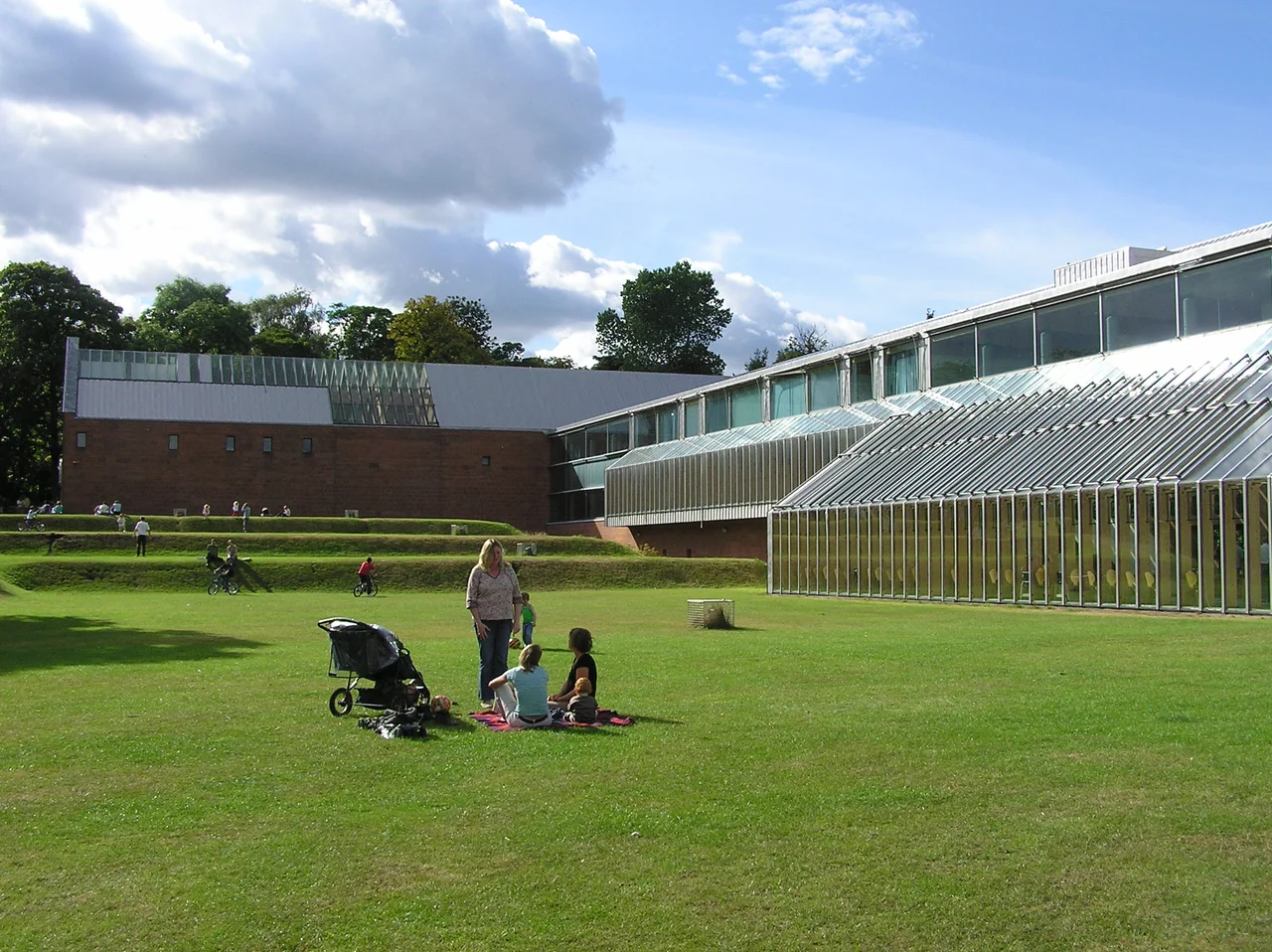
The architects' insight was that some pieces in Burrell's collection were architecture themselves. Romanesque doorways, sixteenth-century stone archways, whole reconstructed rooms from the Burrells' home Hutton Castle near Berwick on Tweed; these things wanted to be built into the museum's structure rather than displayed inside it. Scandinavian in feel, low and timbered and full of natural light from a glazed central courtyard, the museum sits with its long flank against the woodland of Pollok Country Park and its other side opening onto formal lawns. You enter through a sixteenth-century stone arch set in a modern red sandstone gable, an effect that announces the museum's central trick: old and new threaded together so closely that you cannot quite tell where one stops and the other starts. It was awarded an A listing by Historic Scotland in February 2013, recognised as one of Britain's finest 1970s buildings. A 68.25-million-pound refurbishment closed it from 2016 to March 2022, repairing the famously leaky roof and adding gallery space. King Charles formally reopened it in October 2022, and in July 2023 it won the Art Fund Museum of the Year, the only non-national museum to take the outright prize twice.
Nine Thousand Objects, One Eye
What ties together a head of a royal attendant from Ashurnasirpal II's North-West Palace at Nimrud, around 880 BCE, and a Manet painting of women drinking beer? Only William Burrell's eye. There are more than 200 tapestries and carpets, including the Wagner Garden Carpet from seventeenth-century Iran, considered one of the most remarkable garden carpets to survive. There are more than 700 stained-glass panels, a Conservation project that since 2013 has restored the thirty-four panels from the Carmelite church at Boppard-am-Rhein in Germany, a combined surface of fourteen square metres of medieval glass. There are oak furniture pieces, suits of armour, weapons, an extensive collection of Islamic art, ceramics from China going back to the Tang Dynasty (618 to 907 CE), and over twenty works by Degas alone. Burrell did not specialise. He collected what he found beautiful, and trusted that beauty would hold the collection together. So far, it has.
What Provenance Reveals
Burrell bought heavily in the 1930s and 1940s, when many works came onto the European market as the result of forced sales by Jewish collectors fleeing Nazi persecution. He did not know, and could not have known, the full story of every transaction. After the UK government established the Spoliation Advisory Panel in 2000, Glasgow Museums listed Burrell works with gaps in provenance between 1933 and 1945. Two cases have been resolved. A still life by Jean-Baptiste-Simeon Chardin came from the forced sale of the A. S. Drey gallery in Munich; in 2004 the Panel found in the heirs' favour, they accepted a 10,000-pound ex gratia payment, and the painting remains in Glasgow. A Swiss early sixteenth-century tapestry called The Visitation came from the collection of Emma Budge, a Jewish collector in Hamburg whose estate was forcibly liquidated; in 2014 the Panel ruled the same way, and Glasgow paid the Budge estate the current market value of the tapestry, which remains in the collection. These are real people, two among many, whose loss is now part of the Burrell's story as much as any of Burrell's own acquisitions are. The museum lists them. That is, at least, the first step in remembering them properly.
From the Air
The Burrell Collection sits in Pollok Country Park in south Glasgow at approximately 55.83 N, 4.31 W. From the air the museum's low, dark roof and the surrounding park stand out against the dense suburban grid; Pollok House lies a short walk south. Glasgow International (EGPF) is 5 nm to the northwest; Glasgow Prestwick (EGPK) 22 nm south-southwest. From 1,500 to 2,500 feet AGL on a westerly approach the park's green canopy is easily distinguished from the surrounding tenements of Pollok and Pollokshaws. Pollokshaws West railway station, the nearest, is roughly a ten-minute walk from the museum.
Nearby Stories
- Mauchline 3.6 km away
- Shotts 4.2 km away
- HMS Ulysses (1917) 7.7 km away
- Rothesay Castle 8.8 km away
- Inchcailloch 10 km away
- Strachur 14 km away
- Battle of Dollar 16 km away
- Crawford Castle 16 km away