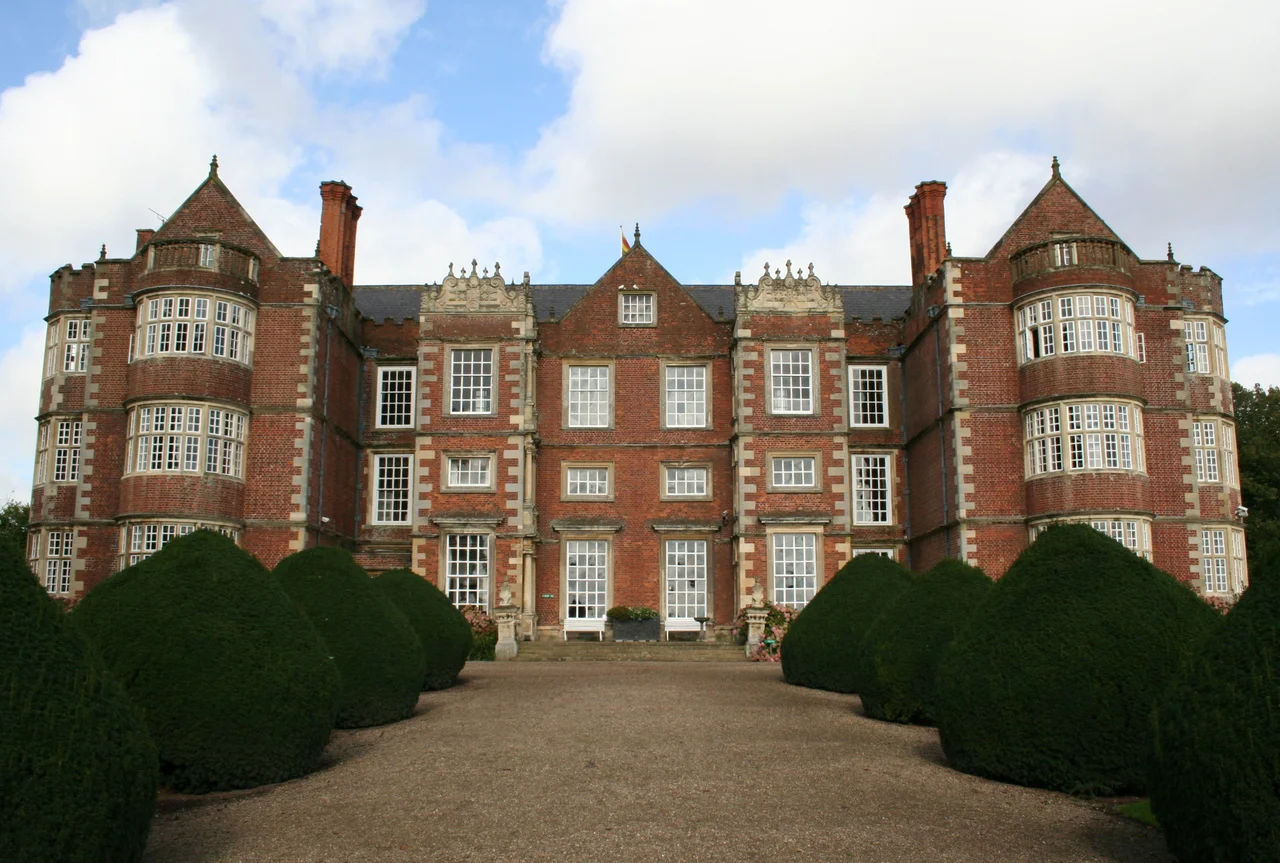

Burton Agnes Hall
The story the Boyntons told for centuries goes like this. Anne Griffith, the youngest daughter of the man who built Burton Agnes Hall, was attacked walking home one evening by men who wanted her gold ring. She lived just long enough to make her sisters promise that her head would be kept inside the house she loved. The promise was not kept. She was buried whole. Strange noises began. Doors slammed. The sisters had her body exhumed, took the skull, and bricked it into a wall of the Great Hall. The disturbances stopped. Every later attempt to remove the skull, the family said, brought the noises back, until eventually the skull was returned and walled up for good. Nobody now knows exactly where in the house it lies.
A Plan from Smythson, Maybe
Sir Henry Griffith built the present hall between 1601 and 1610 after the Crown made him a member of the Council of the North. He worked from designs attributed to Robert Smythson, the Elizabethan architect whose other houses include Hardwick and Wollaton. A surviving Smythson plan shows a square block with bay windows around a small internal courtyard, but the house as built does not match the drawing exactly. Two of the corner bay windows are semicircular instead of five-sided. The west front has been heavily altered. The whole arrangement reads as a first version that picked up changes during construction, either from Smythson rethinking or from Sir Henry pushing back. The semicircular windows are almost certainly Smythson's own. They appear on two of his other plans.
The Long Gallery
The main facade is built a storey higher than the rest of the house so the second floor could carry a Long Gallery running its full length. Wagon-roofed, richly plastered, the gallery is the showpiece of the interior, and Francis Johnson restored its ceiling in two stages between 1951 and 1974. Inside the gallery and the surrounding rooms much of the original seventeenth-century fitting still stands. Carved woodwork, plaster, alabaster. The alabaster overmantel in the Great Hall depicts the parable of the Ten Virgins, copied from a design by Pieter Bruegel the Elder that Hieronymus Cock printed in Antwerp in the 1560s, the engravings travelling from Flanders to the Yorkshire Wolds and onto a fireplace.
Three Thousand Plant Species
The walled flower garden is laid out with a games motif. A central chessboard is paved in black and white. Other gardens around it are themed by colour and games, draughts, snakes and ladders, hoop toss, each one a self-contained room of plants. The whole estate holds three thousand plant species, including the National Collection of Campanulas. A market garden grows seasonal vegetables. Whimsical statues turn up throughout the grounds. The woodland walk is locally famous for snowdrops in February, when the trees flush white at ground level before the leaves come back. Both the Elizabethan hall and the older Grade I-listed Norman manor house from 1173 next door are open to visitors year-round.
Stuteville to Cunliffe-Lister
Roger de Stuteville built the first manor house on this site in 1173, the same one that survives as the Norman ruin next to the Elizabethan hall. The Welsh Griffith family inherited the estate in 1457 and held it through to Sir Henry, who built the Elizabethan house. His daughter Frances married Sir Matthew Boynton, the governor of Scarborough Castle, in the 1620s. Her sister Anne is the one who, according to the legend, never quite left. The Boyntons held the place for centuries. When the eleventh baronet died in 1899 it passed through the Wickham line to Marcus Wickham Boynton, who ran a successful stud farm and was High Sheriff of Yorkshire in 1953. He died in 1989 and left the property to a twelve-year-old distant cousin, Simon Cunliffe-Lister, grandson of the politician William Whitelaw. Cunliffe-Lister and his mother now manage it under the Burton Agnes Preservation Trust.
From the Air
Burton Agnes Hall sits at 54.06 degrees north, 0.32 degrees west, between Driffield and Bridlington on the eastern slope of the Yorkshire Wolds. From 2,500 to 4,000 feet the rectangular Elizabethan block stands clear against its walled gardens, with the older Norman manor block immediately adjacent. The Wolds rise gently to the west. The North Sea coast at Bridlington is about seven nautical miles east. Humberside Airport (EGNJ) is roughly 28 nautical miles south. Watch for low cloud blowing in off the sea in early morning.
Nearby Stories
- SM UC-47 2.1 km away
- 2025 North Sea Ship Collision 6.5 km away
- North York Moors 8 km away
- Wilberforce House 11 km away
- Howden 12 km away
- Kirkham Priory 12 km away
- Robin Hood's Bay 27 km away
- Breagh Gas Field 44 km away