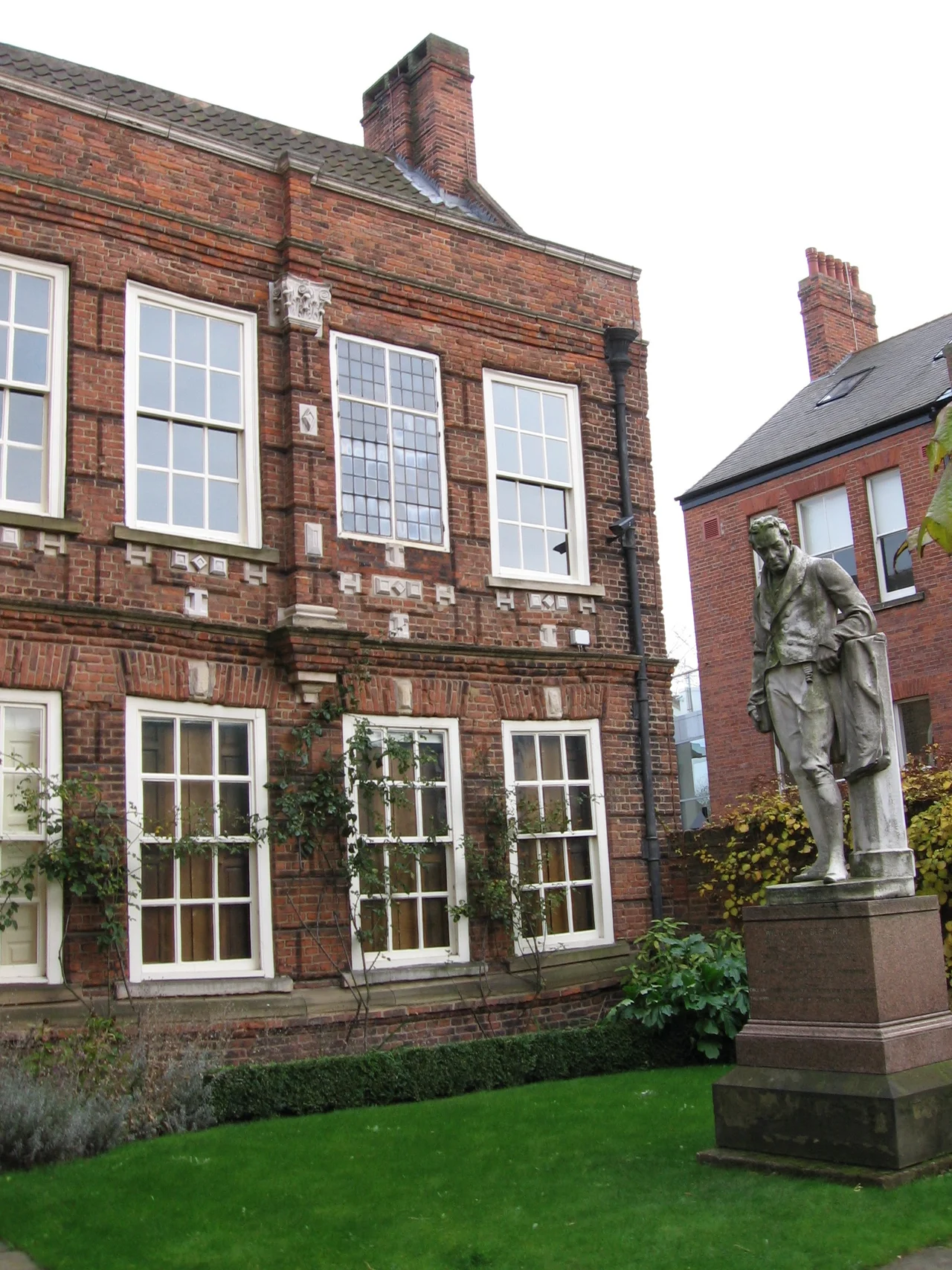

Wilberforce House
The merchants who built this house got rich on wool and timber and quayside access to the River Hull. The man born in it on 24 August 1759 grew up to spend his career in Parliament trying to dismantle a different trade entirely, the trade in human beings that moved an estimated twelve million Africans across the Atlantic in chains. Wilberforce House faces the same High Street it has since the early seventeenth century, an Elizabethan and Jacobean brick frontage with garden behind running down to the river. Inside, the museum that opened in 1906 and was rebuilt in 2007 puts the lives of the enslaved at the centre of the story, not as background to a great Englishman's career but as the people whose freedom that career was meant to serve.
The house and its merchant
The house is Grade I listed, the highest category of British architectural protection, and is one of three surviving merchants' houses on Hull's High Street, along with Blaydes House and Maister House. The Wilberforce family were Baltic merchants. The garden originally ran down to the River Hull so ships could be loaded almost from the back door. William, born here in 1759, inherited that fortune and never had to work for a living. He went up to Cambridge, was elected MP for Hull at the age of 21 in 1780, and four years later took the Yorkshire county seat as an Independent. After a religious conversion in 1785 he committed the rest of his life and his Parliamentary time to two long arguments. One was for what his contemporaries called the reformation of manners. The other was for the abolition of the slave trade and then of slavery itself.
The people the argument was about
The triangular trade that Wilberforce and his allies set out to break carried African captives across the Atlantic in conditions deliberately designed to maximise profit per cubic foot of cargo space. Around 1.8 million people died on the voyage. The survivors were sold into plantation labour growing sugar, tobacco and cotton on Caribbean islands and on the mainland of the Americas. The museum names some of them where the record allows. Olaudah Equiano, kidnapped from what is now Nigeria at around the age of eleven, bought his own freedom, wrote a memoir that became a bestseller in 1789, and helped force the question into British political discussion. Mary Prince, born into slavery in Bermuda and sold repeatedly, dictated the first account by a Black woman published in Britain in 1831, helping move public opinion against the institution itself. Quobna Ottobah Cugoano, formerly enslaved in Grenada, published an explicit abolitionist tract in 1787 that argued for an end to slavery, not just the trade. Their names sit beside the white parliamentarians in the museum because the argument inside Westminster was being made outside it first.
Two Acts, forty years apart
The Slave Trade Act passed on 25 March 1807, banning British participation in the Atlantic trade. Wilberforce had been moving the same bill in different forms for nineteen years. It did not free anyone already enslaved in British colonies. That second fight took another twenty-six years and the work of a new generation of campaigners, including Thomas Fowell Buxton in Parliament and Mary Prince and the activist networks outside it. The Slavery Abolition Act passed on 28 August 1833, a month after Wilberforce died. It freed roughly 800,000 enslaved people across the British Empire over the following years, though it also paid 20 million pounds in compensation, not to those who had been enslaved but to the people who had owned them. The museum does not flinch from this. The Act was both a moral milestone and a financial settlement with the slaving classes, and Britain is still arguing about it.
Mandela Gardens
The 2005 to 2007 redevelopment cost 1.6 million pounds and reopened the museum on 25 March 2007, the bicentenary of the Slave Trade Act. The front garden was renamed for Nelson Mandela. The statue of Wilberforce in it was restored in 2011 at a cost of 10,000 pounds, and now stands as a Grade II* listed structure on the National Heritage List for England. Adjoining the museum is Oriel Chambers, home to the University of Hull's Wilberforce Institute, which researches both historical slavery and the modern forms that still exist, including human trafficking, forced labour and debt bondage. Each year the city awards the Wilberforce Medallion to someone working against contemporary slavery. Kofi Annan received it in 2017. The house, which had to close in 2020 because of the pandemic, reopened to visitors in May 2023. In 2023 it also doubled as Harker House in the Netflix miniseries Bodies; the cameras found a face that has been watching the High Street for four hundred years.
From the Air
Wilberforce House stands at 53.7441 degrees north, 0.328 degrees west on the High Street in Hull's old town, a few metres from the bank of the River Hull. From the air the most useful landmark is the tidal surge barrier where the River Hull meets the Humber Estuary. The museum quarter clusters on a few hundred metres of narrow brick street parallel to the river. Humberside (EGNJ) is the nearest civil field, 16 nautical miles southwest across the estuary; Leeds Bradford (EGNM) is 50 nautical miles west. Recommended altitude 2,500 to 4,000 feet AGL gives a clear view of the museum quarter, the river, and the old quayside neighbourhood from which Hull's wool and Baltic trade once shipped.
Nearby Stories
- Skipsea Castle 3.9 km away
- 2025 North Sea Ship Collision 4.8 km away
- Gainsborough, Lincolnshire 6.1 km away
- SM UC-47 9.7 km away
- Howden 12 km away
- Battle of Stamford Bridge 14 km away
- Battle of Winceby 28 km away
- HMS Cobra 50 km away