
Buttermere
Buttermere is small. At roughly two kilometres long and barely half a kilometre wide, it would scarcely register among the lakes of larger countries. Yet it sits in one of the most concentrated landscapes in Britain - cradled by High Stile, Robinson, Fleetwith Pike, Haystacks, and Grasmoor, each fell pressing close to the water as if leaning in to listen. The footpath around the lake runs through a rock tunnel beneath Hassness. The water flows out through a short stream called Buttermere Dubs and into Crummock Water, then onward as the River Cocker to meet the Derwent at Cockermouth and finally the Irish Sea at Workington. Geographers measure all of this. What they cannot measure is how much human story has gathered on this two-kilometre shore.
Lake by the Dairy Pastures
The name has two plausible origins. The first, favoured by modern place-name scholars, traces it to Old English: butere mere, the lake by the dairy pastures. The fertile alluvial flats at both ends of the water would have made fine grazing, and 'butter lake' fits a working agricultural landscape. The second draws on the Viking past. Robert Ferguson argued in 1866 that the name preserved an Old Norse personal name: Buthar's mere, the lake of Buthar. Either way, the surrounding vocabulary tells you who once lived here. Streams are 'becks' from Old Norse bekkr. Mountains are 'fells' from fjall. Waterfalls are 'forces' from fos. Ravines are 'gills,' valleys are 'dales' from dalr, and small lakes are 'tarns' from tjorn - a word meaning teardrop.
The Last Stand of Jarl Buthar
Local tradition turns the second etymology into a story. After William the Conqueror's Harrying of the North in 1069, a Norse-Cumbrian chieftain called Jarl Buthar - sometimes Boethar - is said to have retreated to the hidden valley of Buttermere and waged a guerrilla war against the Normans for almost half a century. From his stronghold here, the legend goes, he raided supply columns bound for the isolated Norman garrison at Carlisle, ambushed patrols, and inflicted such losses that the conquerors could not fully grip this corner of England until well into the 12th century. How much is true and how much is folklore is unclear; Jarl Buthar appears in 12th-century Norman documents, but most of his story comes filtered through local memory and Nicholas Size's 1930 dramatised history, The Secret Valley. Rosemary Sutcliff's 1956 novel Shield Ring imagined the same final battle at Rannerdale. Whatever the historical core, the valley still feels like a place where someone could vanish.
Mary at the Fish Inn
In the small village of Buttermere stood the Fish Inn, and within it grew up a young woman named Mary Robinson, born in 1778. Travellers passing through the Lakes began to write about her beauty in their guidebooks, and 'the Maid of Buttermere' became a kind of celebrity before she had any say in the matter. In 1802, a man calling himself Colonel Alexander Hope arrived. He was charming, claimed to be the brother of an earl, and asked Mary to marry him. She agreed, and the wedding was reported in newspapers as far away as London. Samuel Taylor Coleridge wrote about 'the romantic marriage.' Then a London paper exposed the truth. The man was John Hatfield - a forger, debtor, and serial bigamist who had already abandoned at least two wives. He was arrested, escaped, was recaptured in South Wales, and was hanged at Carlisle in 1803, not for the bigamy itself but for forgery. Mary was twenty-four, suddenly famous, and not for any choice she had made.
What Came After
It is easy to remember the scandal and forget the woman. Mary Robinson lived another thirty-five years after Hatfield's exposure. The public raised subscriptions for her. In 1807 she married a local farmer, Richard Harrison, and had four children. She lived until 1837, an ordinary Cumbrian life resumed in the same valley where she had been turned briefly into a story. Melvyn Bragg's 1987 novel The Maid of Buttermere drew her back into public attention, and the Fish Inn still stands in the village. The lesson the valley keeps is a quiet one: a young woman was deceived by a clever criminal, the press made spectacle of her pain, and she went home, married someone honest, and kept on living. The fells around the lake do not care about any of it. They were here for Jarl Buthar, for Mary, and they will be here long after the rest of us.
Walking the Shore
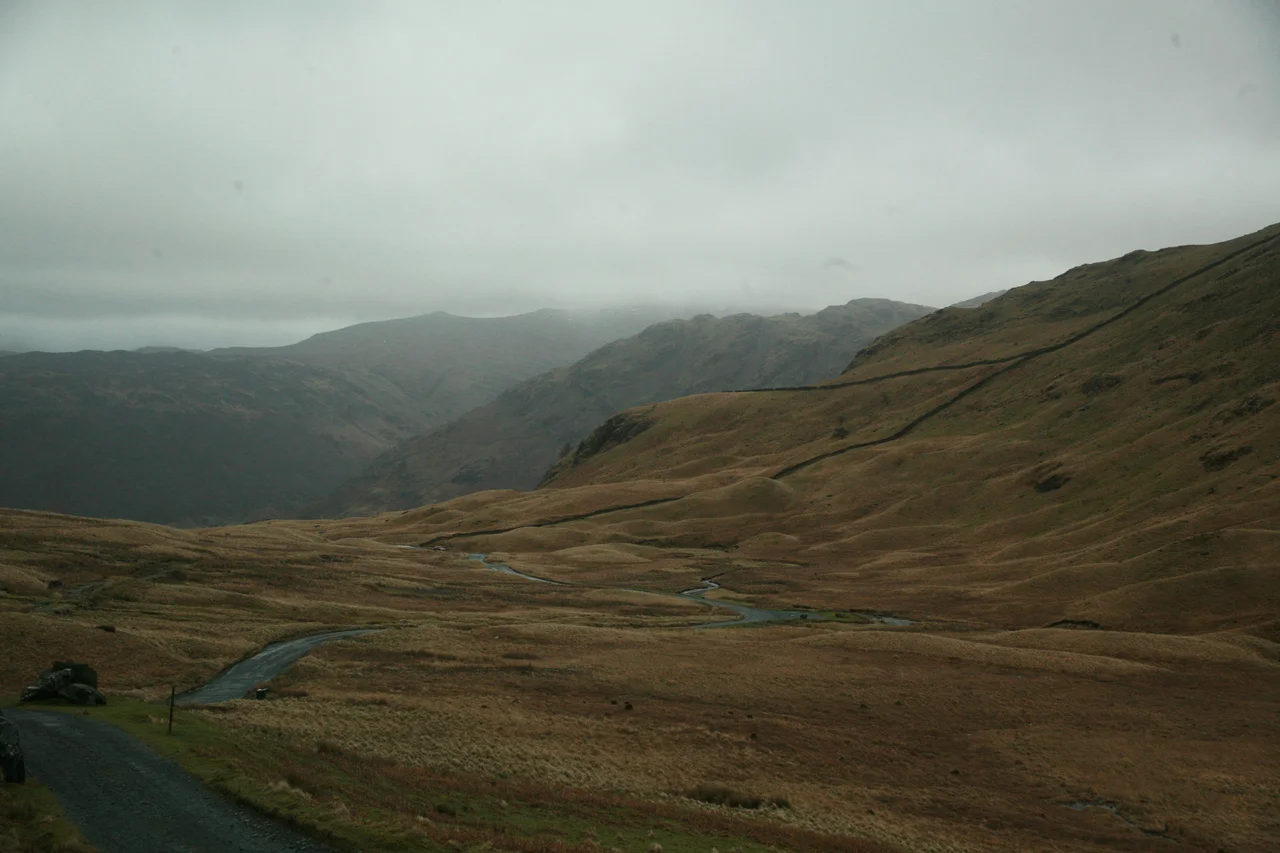
The lake belongs to the National Trust as part of its Buttermere and Ennerdale property. The shoreline path is about six and a half kilometres - flat by Lake District standards, dramatic by anyone else's. Access by road comes from three directions: from Cockermouth in the north-west, from Borrowdale over the Honister Pass, or from Braithwaite and the Newlands Valley by Newlands Hause. Each approach delivers a different first sight of the water. The Honister route, descending past slate-grey scree, may be the most theatrical. The Newlands approach is the quietest. All of them end at a lake small enough to walk around in an afternoon, surrounded by fells too steep for that walking ever to feel modest.
From the Air
Coordinates 54.5333 N, 3.2667 W. Buttermere lies in a north-west to south-east trending glacial valley in the western Lake District, joined to Crummock Water by a short stretch of marshy ground. From the air, the two lakes appear almost continuous, with the village of Buttermere at the divide. Surrounding peaks include Grasmoor (north-west), High Stile (south-west), Haystacks and Fleetwith Pike (south-east). Recommended altitude 3,000-4,500 ft AGL. Nearest airports: Carlisle Lake District (EGNC) to the north, Blackpool (EGNH) to the south. The Honister Pass, immediately south-east, holds the UK 24-hour rainfall record; expect rapid weather change.
Nearby Stories
- Lowther Castle 5.5 km away
- Black Combe 6.6 km away
- Levens Hall 6.8 km away
- Threave Castle 13 km away
- Ruthwell Cross 18 km away
- Raeberry Castle 24 km away
- RAF Spadeadam 24 km away
- Cashtal yn Ard 33 km away