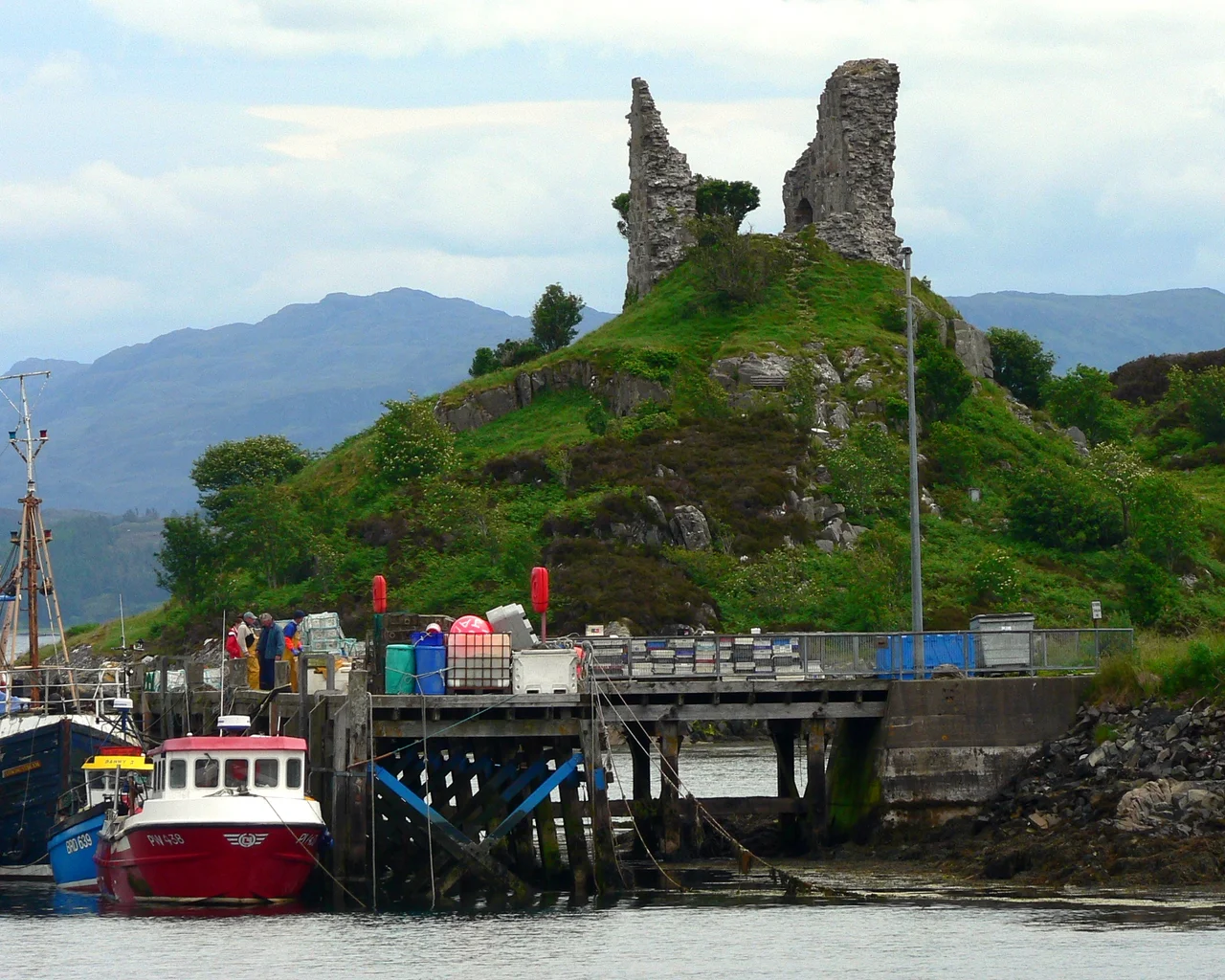

Caisteal Maol
The name in Gaelic means simply "bare castle." It stands on a low headland above the harbour of Kyleakin on Skye, looking across the narrow strait to Kyle of Lochalsh on the mainland - and tradition says it began because of a chain. Around the year 900, a MacKinnon chief named Findanus married a Norse princess nicknamed Saucy Mary, and the pair strung a heavy chain across the sound. Every ship that wanted through paid for the privilege. Whether or not the chain ever existed, the position certainly mattered: all shipping bound for the inner Hebrides had to pass this point or else face the open passage of The Minch, and Caisteal Maol controlled the easier choice.
Saucy Mary's Bargain
The MacKinnon tradition runs that Findanus, the fourth chief of his clan and great-grandson of Alpín mac Echdach, brought Dunakin - the older name for Caisteal Maol - into the family through his marriage to a Norse princess. Saucy Mary's chain became a profitable arrangement. The princess is said to be buried on Beinn na Caillich, the hill above the village, her face reputedly turned toward Norway. Whatever the truth of the chain story, the connection to Norway is real enough. King Haakon IV is thought to have assembled his fleet here before the Battle of Largs in 1263, which is why the village is called Kyleakin - Haakon's kyle. Medieval documents also call the castle Dunakin, or Dun-Haakon, which is suggestive on its own.
The Battle That Ended Norse Scotland
Haakon's defeat at Largs effectively ended Norse domination of the Scottish islands. The longships that had gathered in the kyle below the castle sailed south expecting victory and returned, in much smaller numbers, having lost. Within three years the 1266 Treaty of Perth ceded the Hebrides to Scotland. Whatever Findanus's chain might once have collected, the castle now sat at the western edge of a Scottish kingdom rather than the eastern edge of a Norwegian one. The MacKinnons remained in possession. The present structure - a rectangular keep of three storeys, walls dating from the late 15th or early 16th century by document and carbon dating - was built or rebuilt several centuries after the original tradition begins.
A Meeting of Chiefs
In 1513, the chiefs of the Hebridean clans met inside this keep and agreed to support Donald MacDonald as Lord of the Isles. It was one of the last great gatherings of an old order - the Lordship of the Isles had been forfeited to the Scottish crown in 1493, and the clans were trying, unsuccessfully, to recover it. The last occupant of Caisteal Maol was Neill MacKinnon, a nephew of the 26th chief, who is recorded as living here around 1601. After that the castle was abandoned to weather and gravity. The basement level - believed to have contained the kitchen - is filled with rubble and has never been excavated. The main floor, once a public dining space, is open to anyone who climbs up to it.
Stabilised by Lightning
On 14 February 2018, a lightning strike destroyed part of the surviving ruins. The lightning was probably not the first to hit the castle in five centuries, but it was the one that brought the conservators. Historic Environment Scotland subsequently stabilised what remained. The keep now stands as a partial silhouette above the village, walls thick enough to last another five hundred years if the weather and the rock allow it. Kyleakin itself has changed beyond Findanus's recognition - the Skye Bridge opened in 1995 a short walk north of the village, replacing the ferry that ran from the harbour, and Saucy Mary is now mostly a name on a hotel and a passing tour-guide story. The chain across the kyle, if it ever existed, is long dissolved. The position remains.
From the Air
Coordinates 57.2719°N, 5.7208°W on the north side of Kyleakin village. From 2,000-3,000 ft AGL the keep is visible as a square stone tower on a low headland above the harbour, with the Skye Bridge spanning the narrows just to the northeast. Kyle of Lochalsh sits across the strait on the mainland. Nearest fields: Plockton (EGPO) 4 nm north, Broadford bay 5 nm south. Watch for venturi winds through the kyle, especially in westerlies and easterlies. Beinn na Caillich rises to the south above the village.
Nearby Stories
- Arisaig 5.3 km away
- Talisker distillery 9.7 km away
- Loch Torridon 11 km away
- Uig 12 km away
- Neptune's Staircase 16 km away
- Glen Affric 18 km away
- Corrieshalloch Gorge 34 km away
- Coll 39 km away