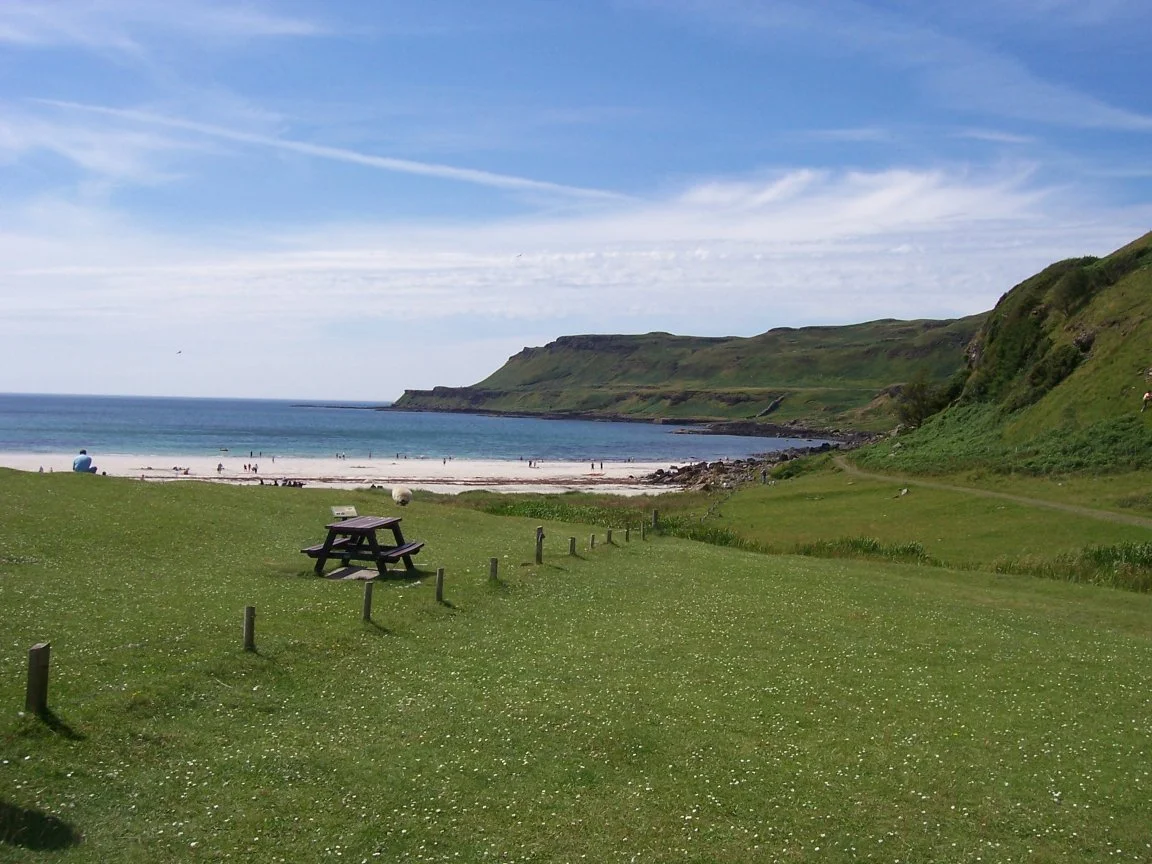

Calgary, Mull
Calgary, Alberta has 1.7 million residents, skyscrapers, an NHL team, and an annual stampede that brings in a million visitors. Calgary, Mull has perhaps a dozen scattered houses, no shop, and a farmhouse cafe that closes when the gardener feels like it. The connection between them is one Victorian house, one Mounted Police colonel, and one summer holiday in 1876. Stand on the curved white beach at low tide, watching a river meander across the sand toward the Atlantic, and the geography of the transfer makes a strange sort of sense. Names travel light. They only need someone to carry them.
Beach of the Meadow
The Gaelic name is Cala ghearraidh, which translates as beach of the meadow, or, more precisely, the hard sandy landing place beside the pasture. Cala is a specific word: not any beach, but the kind firm enough to drag a boat onto. That fits Calgary Bay exactly. The sand here is unusually pale, calcareous, ground from millennia of broken shells. Behind it stretches a broad apron of machair, the grassy meadow that grows only on this kind of calcium-rich sand and only along Scotland's western coasts. A river crosses the beach at every low tide, cutting fresh channels through the sand. The bay is framed by low hills, partly wooded, sheltering the meadow from the worst of the Atlantic weather. The Vikings may have named it differently, from the Old Norse kald gart, cold garden. Local opinion on which etymology is correct is firmly divided and unlikely to be resolved.
The Colonel's Holiday
James Macleod was born on Skye in 1836, emigrated to Ontario with his family as a child, and rose through the Canadian military to become the second commissioner of the North-West Mounted Police. In the summer of 1876 he came back to Scotland for a holiday and stayed at Calgary House, a castellated Gothic mansion built in 1817 above the bay. He returned to Canada that autumn just as the Mounted Police were establishing a new fort on the prairie where the Bow and Elbow rivers meet. The location needed a name. Macleod suggested Calgary, after the place he had just left. The fort was renamed in 1876. The city grew up around it. By the time anyone in Mull noticed, Calgary, Alberta had eclipsed its namesake by several orders of magnitude. The original hamlet is still small enough to walk through in five minutes.
The Pier and the Puffers
The small stone pier at Calgary was built for Clyde puffers, the steam-driven cargo boats that supplied the west coast before roads reached the remoter glens. The puffers delivered coal to the Mornish Estate and took sheep across to graze on the Treshnish Isles, the archipelago that lies a few miles offshore. The pier still stands, though the puffers are long gone. Above the houses, a rocky knoll holds the remains of an Iron Age dun, a small fortified enclosure. Many of its stones were quarried to build the houses themselves, an everyday cycle of construction that has continued on Mull for at least two thousand years. The dun's outline survives in fragments. Anyone walking up to it gets a panorama of the bay below, the meadow, and the open Atlantic beyond.
Maclean's Verse
The Gaelic poet Sorley Maclean wrote about Calgary Bay in his sequence Dàin do Eimhir, completed in the late 1930s. In the poem Tràighean (Beaches), the second verse uses Calgary as a setting for eternity: a place where the speaker imagines spending forever with the woman he loves, listening to the surf and watching the light change on the machair. Maclean is recognised as one of the major Gaelic poets of the twentieth century, and his choice of Calgary among all the beaches of Scotland says something about its quality. The bay has the kind of pale, almost tropical light that disappears the moment cloud comes in. When it returns, it is briefly the most surprising stretch of coastline in the Hebrides.
From the Air
Coordinates 56.58°N, 6.26°W on the northwest coast of Mull, accessed by the single-track B8073 road. Best viewed at 1,500-3,000 feet AGL approaching from the west or south, with the pale crescent of Calgary Bay framed by low hills and the Treshnish Isles visible a few miles offshore. Nearest airports: Glenforsa Airfield (private grass strip) 15 nm east on Mull, Tiree (EGPU) 30 nm west, Oban (EGEO) 35 nm southeast. Open Atlantic exposure brings sudden weather changes and frequent low cloud.
Nearby Stories
- Lismore Seminary 6.1 km away
- Muck 8.6 km away
- Tiree 12 km away
- Glenfinnan Railway Station 15 km away
- Colonsay 21 km away
- Loch Fyne 29 km away
- German submarine U-722 44 km away
- HMS Audacious 91 km away