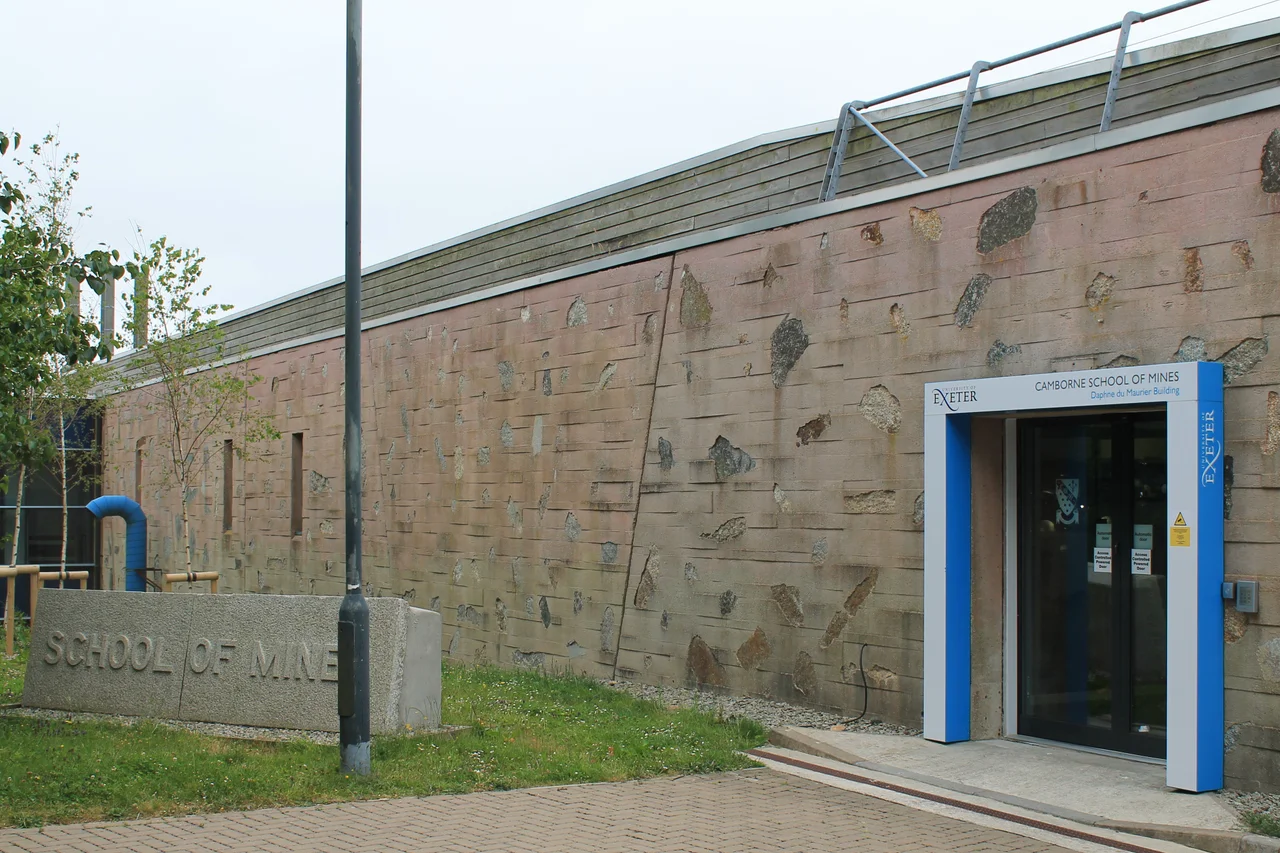

Camborne School of Mines
By the time Cornwall's tin trade peaked in the late 19th century, the county was running out of two things at once: ore and miners. The deposits that had built Cornwall went deep and ran thin. The men who knew how to chase them, the third- and fourth-generation Cornish miners who could read a lode the way a sailor reads a swell, were already booking passage to South Africa, Australia, Malaya, the American West. The Camborne School of Mines, founded in 1888, was built to keep up with the diaspora. If Cornish mining was going to scatter to every continent, somebody had to train the men running the shafts. That somebody turned out to be a granite-walled school on the windswept edge of a Cornish moor.
The Granite Origin
The roots reach back to 1829, when John Taylor published a prospectus calling for a school of mines in Cornwall. Classes for miners began in Truro in 1839, scattered across Camborne, Pool, St Just and St Agnes by 1858, and by 1863 some 200 students were studying at eleven separate mining education centres in the county. The bricks finally came together in 1876, when Gustavus Lambert Basset, one of the great Cornish mine entrepreneurs, bequeathed money for a laboratory in Camborne. In 1887 J.J. Beringer delivered a lecture proposing a proper Mining School. A year later, the Camborne School of Mining opened its doors. It was small, practical, and embedded in a working mining district where students could descend into living shafts as part of their education.
Exporting Cornishmen
Almost from the beginning, the school's reputation outran Cornwall itself. As tin and copper prices wavered at home, CSM graduates fanned out to where mining was booming. They worked the Witwatersrand goldfields, the Malayan tin belt, the silver-lead mines of Mexico, the copper porphyries of the American West, the gold reefs of Western Australia. They came to be called Cousin Jacks. To employ a Cornishman was to employ someone whose grandfather had probably worked underground too. The school cemented this network with its Associateship of the Camborne School of Mines, the ACSM, awarded to every qualifying graduate since 1910 and recognized in mine offices from Johannesburg to Coolgardie.
King Edward Mine
In 1897 the school leased King Edward Mine from the Pendarves family to give students a real working pit for practical instruction. It was the kind of place where the lessons were unforgiving: pumps, hoists, drills, explosives, ventilation, the unglamorous mechanics of getting ore out of the ground without losing anyone. The mine was abandoned in 1924 when it flooded, and the school transferred its practical training to Great Condurrow Mine. King Edward later reopened as a museum, but its role in the curriculum reverberates. International Mining Games hosted at the site in 2012, 2018 and 2025 have continued the tradition of putting students in mucking boots, with the 2025 CSM teams taking first place in both the men's and women's competitions.
Through the Decline
Cornwall's mines closed one by one through the 20th century, and the school was repeatedly rebuilt around the ruins. The original CSM building was demolished in 1979 to make way for a Tesco. The school moved to the Trevenson Campus at Pool, then in 2004 to a new building at the Tremough Campus in Penryn, the same hilltop now shared with Falmouth University. In 1993 it merged with the University of Exeter. In 1998 South Crofty, the last working Cornish tin mine, closed and put hundreds of Camborne residents out of work. By 2020 even the school's BEng in mining engineering, the only one offered in the UK, was paused for the first time. The program returned in 2023, retooled as a four-year in-service degree linked to mine apprenticeships.
Notable Cousin Jacks
The alumni roster reads like a gazetteer of 20th-century resource extraction, with detours into stranger territory. James Howard Williams, known as Elephant Bill, ran teak elephants through Burmese forests during the Second World War. Sam E. Jonah became chief executive of Ashanti Goldfields, one of the largest gold producers in Africa, and was later knighted. Eric Roberts trained as a mining engineer at Camborne and went on to become an MI5 agent during the war, running a network of fascist sympathisers under a fake Gestapo cover. Geoffrey Healey designed the Austin-Healey marque of cars. Albert Ernest Thomas managed mines in the Australian gold rush towns of Coolgardie and Norseman and sat in the Western Australian parliament. The school sent out engineers; it also sent out characters.
What the Penryn Campus Looks Like
The current school sits on the Tremough Campus, a hillside above the Penryn River where the campus shares ground with Falmouth University and the wider Combined Universities in Cornwall. Inside is a £1.5 million microbeam analytical facility crammed with electron microscopes, X-ray fluorescence spectrometers and a QEMSCAN system that identifies minerals one particle at a time. The museum, free and open weekdays, holds fluorescent minerals that glow under UV, ore samples from mines that no longer exist, and historic artefacts from the school's first century. Outside, students still gather for the annual Bottle Match against the Royal School of Mines, a sporting fixture first played in 1902. The trophy is, naturally, a bottle.
From the Air
The Penryn Campus sits at 50.17°N, 5.13°W on a low hill above the Penryn River, about three nautical miles north of Falmouth harbour. From a light aircraft transiting Cornwall the campus reads as a cluster of modern academic buildings on a green hillside, with the working clay pits of mid-Cornwall and the granite uplands of Carnmenellis to the north. The nearest commercial airport is Newquay Cornwall (EGHQ), about 25 nm north-northeast. Land's End Airport (EGHC) lies 25 nm to the west. Approach altitudes of 2,000-3,000 feet AGL give clean views of the Carrick Roads estuary southward and the chimney stacks and waste tips of the old Camborne-Redruth mining belt to the north.
Nearby Stories
- Morvah 2.9 km away
- Carnewas and Bedruthan Steps 6.1 km away
- Liskeard 7.5 km away
- Battle off Lizard Point 14 km away
- Polperro 17 km away
- MV Cita 47 km away
- HMS Affray 86 km away
- 1979 Fastnet Race 96 km away