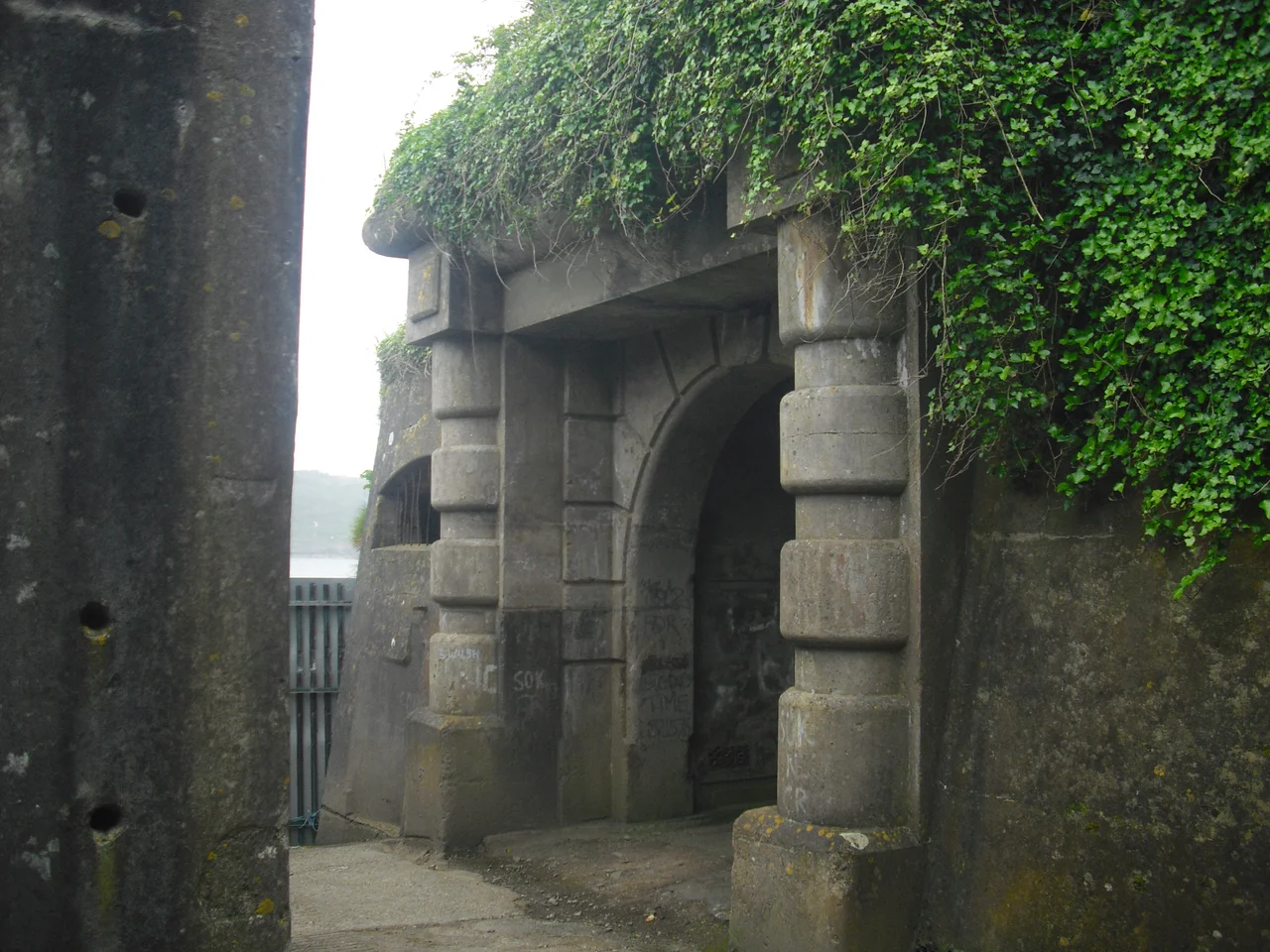

Camden Fort Meagher
On Ram's Head, the headland that crowns the western entrance to Cork Harbour, a Victorian fort hides most of itself underground. Camden Fort Meagher looks, from the road, like an unremarkable green hill with a single low entrance gate. Inside, a spiral staircase drops to a vaulted gunpowder magazine. Tunnels lead from the magazine to seaward gun batteries hidden in the cliff face. A two-tiered musketry gallery commands a dry moat twenty-eight feet wide. The fort was built to defend one of the most strategically important harbours in the British Empire, and at its peak it bristled with twenty guns and over two hundred soldiers. It also housed something stranger: a launching station for the Brennan Torpedo, the world's first practical guided weapon, a wire-steered missile that pre-dated radio guidance by half a century.
Five Hundred Years of Forts
The first defence built on Ram's Head was James' Battery in 1550, extended again in 1600. After the Nine Years' War in Ireland the position fell into disuse. The British Royal Commission of the 1850s revived it - one of the great Victorian audits of imperial defence, which concluded that the great harbours of the United Kingdom were dangerously exposed and that something had to be done about it. Construction at what was then called Fort Camden began in 1861, using a combination of convict, military, and civilian labour. Much of what was built was put underground. Magazines, casemated batteries behind shields, a labyrinth of tunnels and zigzag paths - the fort was designed to absorb hits that surface fortifications could not. In the 1880s and 1890s the guns were upgraded to breech-loading rifles, a minefield was laid across the channel, and the Brennan Torpedo station was added at the waterfront.
The Brennan Torpedo
What set Camden apart from the other British coastal forts of its era was the Brennan Torpedo station, built on the waterfront in the 1890s. The Brennan was a wire-guided weapon - the first practical guided weapon in the world, according to the Wikipedia source - designed to be launched from the slipway and steered by operators on shore toward an approaching warship. The system was sophisticated, expensive, and required constant skilled maintenance, and a second torpedo slipway was added at Camden after 1900. The Brennan was eventually obsoleted by self-propelled torpedoes and faster naval gunnery. But for two decades, a weapon you could steer with wires sat ready in the slipway at Camden, waiting to be sent out into Cork Harbour if an enemy fleet ever appeared at the entrance.
Camden, Meagher, and Crosshaven
The fort was handed to the Irish Defence Forces in 1938, when the United Kingdom relinquished the Treaty Ports installations under the Anglo-Irish Treaty arrangements. The new Irish state renamed all three harbour forts after Irish patriots: Fort Westmoreland on Spike Island became Fort Mitchell, Fort Carlisle at Whitegate became Fort Davis, and Fort Camden became Fort Meagher - after Thomas Francis Meagher, who had fought in the Young Irelander Rebellion of 1848. The Irish Army used the fort for training Civil Defence and Reserve Defence Forces through mid-century, then in the 1980s handed it to Cork County Council, who had no immediate plan for what to do with forty-five acres of overgrown Victorian masonry.
A Volunteer Restoration
It became, for the next two decades, a ruin that the trees took back. In 2010 a group of Crosshaven locals - many of them descendants of men who had served in the fort, or who had played in its tunnels as children - leased the site from the council and began to clear it. They cleaned out the magazines, opened the bright tunnel that runs from the parade ground to the lower batteries, restored the casemated barracks, and built a café with a view of the harbour mouth. The fort reopened in 2011 as Camden Fort Meagher, the new name combining both halves of its 160-year history. It is open seasonally, on weekends and bank holidays between May and September, with exhibits on the Brennan Torpedo and the layered story of British and Irish coastal defence. Reenactors sometimes occupy the parade square. The wind off the Atlantic carries the same salt smell it carried in 1861, when the convicts and soldiers first cut into the headland to build the fort that has stood here ever since.
From the Air
Located at 51.808°N, 8.279°W on Ram's Head, the western promontory at the entrance to Cork Harbour, just south of Crosshaven village. The nearest airport is Cork (EICK), about 20 km north-west. From the air the fort is hard to spot because most of it is underground, but the cleared parade square and the new visitor facilities make a small bright patch on the green headland; Spike Island (with its companion fort) lies opposite, across the harbour entrance, with Cobh visible further inland.
Nearby Stories
- Walter Siepmann 6.3 km away
- Gaeltacht na nDéise 11 km away
- Fermoy 12 km away
- Canovee 14 km away
- Rathcoole Ambush 16 km away
- SS Folia (1907) 20 km away
- Cloghan Castle, Lough Hyne 35 km away
- SM U-27 91 km away