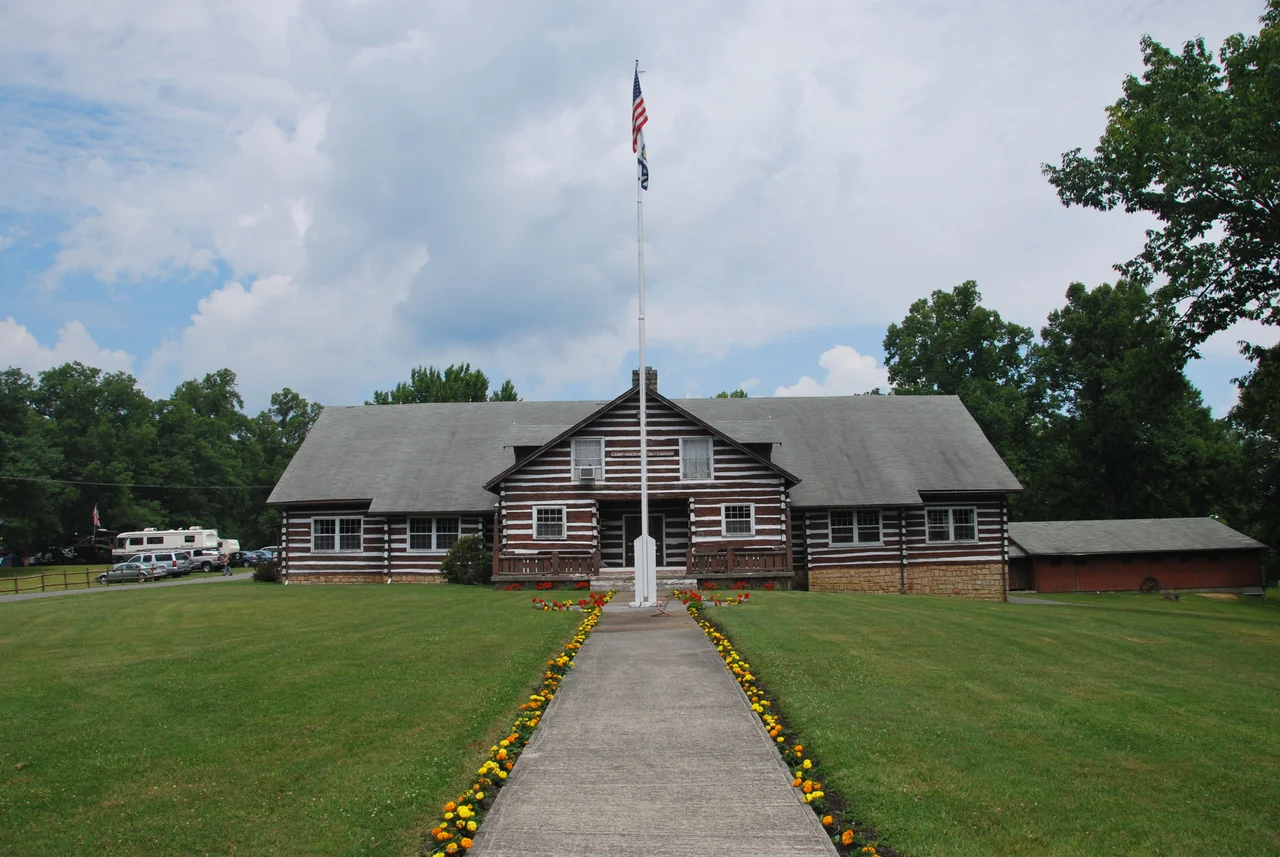

Camp Washington-Carver Complex
In 1937, West Virginia's legislature passed an act setting aside land near Clifftop for a children's camp. The state's 4-H program had been running camps for years, but they were segregated, and the new site was designated specifically as the West Virginia 4-H Camp for Negroes. Construction began two years later as a Works Progress Administration project. By 1942, a remarkable log building stood among the trees of Fayette County - the Great Chestnut Lodge, said to be the largest log structure ever built entirely of American chestnut in West Virginia. It still stands. The camp it anchors, renamed Camp Washington-Carver after integration, is now a National Register historic district, a state cultural site, and the home of the Appalachian String Band Music Festival.
Why Chestnut
American chestnut once dominated the eastern forests of the United States. By the 1930s, the chestnut blight introduced from Asia at the turn of the century had killed billions of trees across the species' range. The standing dead chestnut left behind was straight-grained, rot-resistant, and abundant - the perfect material for ambitious WPA construction projects. Builders at Camp Washington-Carver used it lavishly. The Great Chestnut Lodge was raised between 1941 and 1942 in the form of a modified Latin cross, with a gabled Assembly Hall as the main block and a Dining Hall extending as a wing. Every log is American chestnut. It remains, by long-standing claim, the largest log structure built entirely of chestnut in West Virginia - a memorial in timber to a species the forest no longer contains in any meaningful number.
A Camp for Black Children
The original purpose of the camp was straightforward and shaped by its era: West Virginia's 4-H program operated separate camps for Black and white youth, and Clifftop was the Black camp. For Black children growing up in the coal towns and tenant farms of Appalachia, this was the place they got to spend a week in the woods, learning agriculture, public speaking, and the soft skills the 4-H movement was built on. Beyond the lodge, the WPA built supporting structures - a log cottage in 1940, two frame dormitories in 1942, a water tower, a small pond. The camp opened its doors to thousands of children over the decades. After school desegregation, it was renamed Camp Washington-Carver, honoring both Booker T. Washington and George Washington Carver, and the activities broadened to include the wider public.
From Camp to Cultural Center
In 1980 the West Virginia Department of Culture and History took over administration of the site, and that same year it was listed on the National Register of Historic Places. The state has since invested in stabilizing the chestnut lodge, restoring the dormitories, and turning the open meadow at the heart of the camp into a venue for cultural programming. The Appalachian String Band Music Festival - known to everyone as Clifftop - moved its weeklong gathering here in 1990, and has filled the campsites every summer since with fiddlers, banjo players, and dancers from around the world. Smaller events fill the calendar at other times of year: heritage festivals, gospel sings, school field trips. A historical marker on the access road tells visitors what the camp was, and a National Park Service partnership with New River Gorge National Park has helped extend its reach.
Walking the Grounds
On a quiet weekday outside festival season, the camp feels almost still. The chestnut logs of the great lodge have darkened to the color of old bronze. The pond reflects the sky and the surrounding hardwoods. The dormitories sit empty, waiting for the next round of campers. Standing in the open field that runs out from the lodge, it is possible to imagine both layers of the place at once - the children of segregated Appalachia stepping off buses for their week in the woods, and the modern crowds of the string band festival pitching tents in the same grass. The chestnut wood and the meadow do not distinguish between them. They hold what has happened here, and they wait for what comes next.
From the Air
Camp Washington-Carver Complex sits at 38.01 N, 80.97 W, on a forested plateau in southern Fayette County, West Virginia, near the village of Clifftop. Recommended viewing altitude is 3,000 to 5,000 feet AGL. The cleared meadow surrounding the chestnut lodge and the small pond at its edge make the site visible from the air; the surrounding landscape is dense hardwood forest. Nearest airports are Raleigh County Memorial (KBKW) about 20 miles southeast and Greenbrier Valley (KLWB) in Lewisburg about 30 miles east.
Nearby Stories
- West Virginia State Capitol 4.7 km away
- Greenbrier County, West Virginia 13 km away
- Beckley, West Virginia 13 km away
- Clay, West Virginia 16 km away
- The Greenbrier 18 km away
- Webster Sycamore 26 km away
- Kanawha State Forest 26 km away
- Welch, West Virginia 40 km away