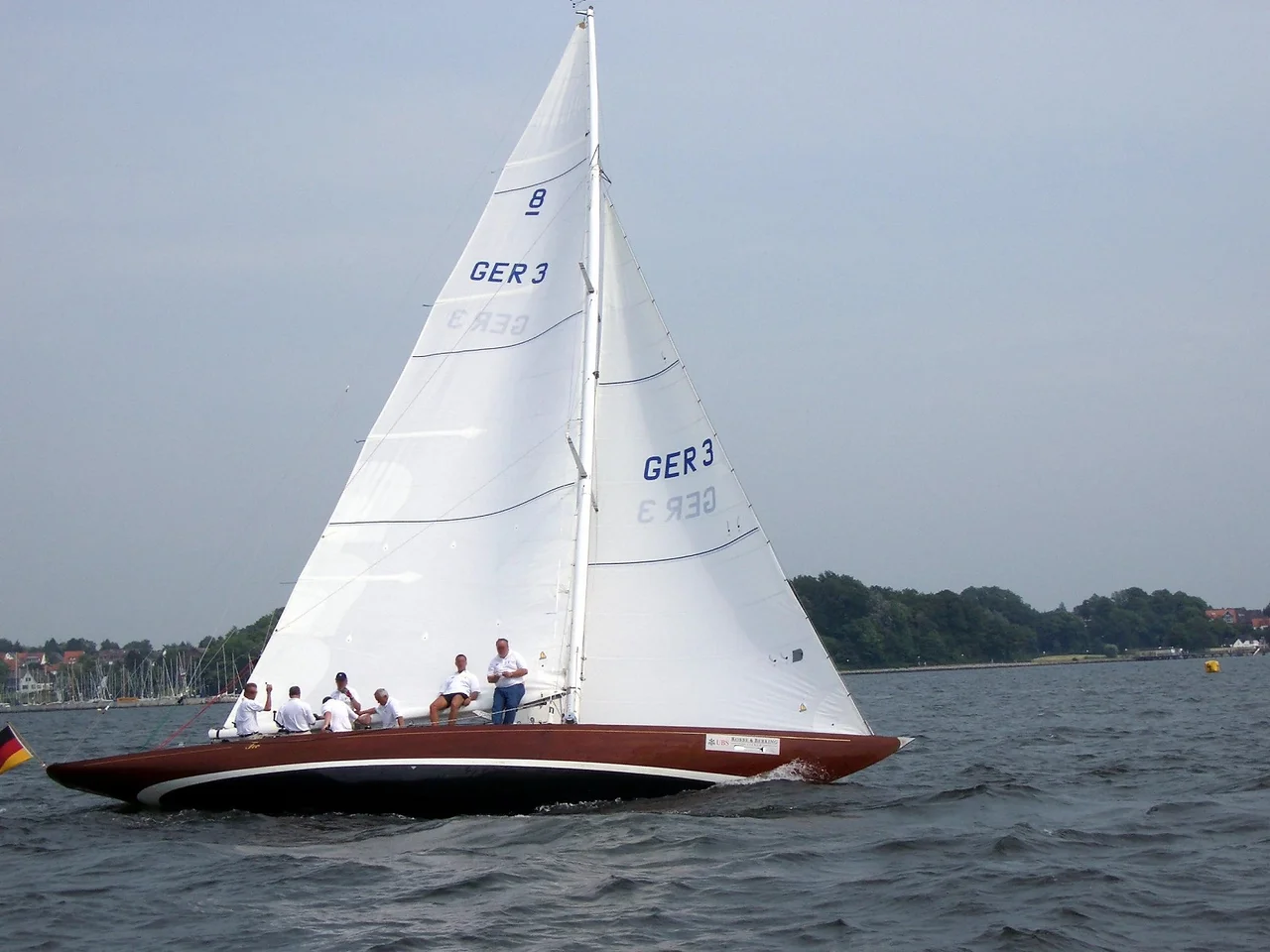

Camper and Nicholsons
In 1782, a London-trained shipwright named Francis Amos leased a strip of land from the Royal Naval Dockyard at Gosport and started building boats for local fishermen. Two hundred and twenty-three years later, in 2005, the same shipyard - by then on the site of what is now Endeavour Quay - shut its gates for the last time. In the interval, the firm that became Camper and Nicholsons built yachts for Vanderbilts and Rothschilds and Onassis, designed J-class racers that fought Sir Thomas Lipton's failed America's Cup challenges, manufactured 96 landing craft for the 1943 Allied landings, lost most of its archive in a 1941 fire, and outlived nearly every other yacht builder of its era. It is the oldest leisure yacht-building company in the world.
Three Generations of Hands on the Helm
Amos took on his great-nephew William Camper as an apprentice in 1809 and left him the business at his death in 1824. William Camper in turn took Benjamin Nicholson as apprentice in 1842, and by 1855 Nicholson was doing most of the design work; the firm became Camper and Nicholson to reflect it. By 1875, Ben's sons were running the place and the company became Camper and Nicholsons - plural. Ben's son Charles Ernest Nicholson, the most famous designer the firm ever produced, designed boats from delicate one-design keelboats up to J-class behemoths over the next sixty years. His nephew Charles Arthur Nicholson followed him; Charles Arthur's sons Peter and George followed in turn. Peter became Commodore of the Royal Yacht Squadron in 1994. George chased superyacht clients up and down the Riviera. It was a remarkable run for a single family in a single yard.
Shamrocks and Endeavours
The J-class yachts were the largest sailing racers of the early 20th century, built to a measurement rule that allowed enormous masts and razor-thin margins. Camper and Nicholsons built five of them. Shamrock IV - Sir Thomas Lipton's fourth attempt at the America's Cup - launched in 1914 and lost the 1920 challenge after a wartime delay. Shamrock V launched in 1930 for Lipton's last unsuccessful try. Velsheda, named for William Lawrence Stephenson's three daughters, came in 1933. Then Sir Thomas Sopwith - the aviation pioneer who built Hurricanes - commissioned Endeavour in 1934 and Endeavour II in 1936, both for America's Cup challenges. None of the British J-class yachts ever brought home the Cup. But Velsheda, Endeavour, and Shamrock V have all been restored and still race today; you can occasionally see them in the Solent during Cowes Week, ghosting along under enormous Bermudian sails.
Wartime
Both World Wars turned the yard inside out. In the First World War the firm converted civilian steam yachts into hospital ships - including Lord Dunraven's 493-ton Grianaig, which the 76-year-old peer himself sailed across the Channel evacuating wounded from France and Gallipoli. They built flying-boat hulls at Gosport for the Gosport Aircraft Company, towed across to Northam, in Southampton, for assembly. In the Second World War, two of the firm's Bounty-class motor yachts joined the Little Ships of Dunkirk. The yard built motor gun boats originally ordered by the Turkish navy and converted them to British use; five became blockade runners that brought Swedish ball bearings out of neutral ports under cover of night. For D-Day, the firm designed and built 24 SLUG boats - Surf Landing Under Girder - to deploy anchors for the Mulberry harbours, plus 96 Landing Craft Assault used in the 1943 landings in North Africa and Italy. Both yards were bombed repeatedly and kept working.
The Yachts of Princes and Onassis
The clients read like a who's who of inter-war wealth. William Kissam Vanderbilt II circumnavigated the world in MY Ara, a 851-ton motor yacht originally laid down for a Frenchman and finished as a warship in 1917. The Rothschilds had Rhodora and then the 709-ton Rhodora II, equipped with an operating theatre and a garage for a Rolls-Royce. Thomas Sopwith had Vita and then Philante, the 80.6-metre yacht that supported his America's Cup challenges and which Norway bought after the war as the Royal Yacht Norge. The 1928 motor yacht Monica passed through several owners before Aristotle Onassis gave her to Prince Rainier and Grace Kelly as a wedding gift; renamed Deo Juvante, she was the yacht on which they spent their honeymoon. Today, restored and renamed simply Grace, she still sails.
Creole, the Wooden Giant
In 1927 the yard built Vira for Alexander Smith Cochran. At 689 tons, the staysail schooner was the largest yacht ever built at the Gosport yard, and she remains the largest wooden sailing yacht in the world. Her first owner thought her masts were too tall and had them shortened; her later owner, Sir Connop Guthrie, restored them. She was renamed Creole after a favourite dish of one of her owners. The Royal Navy requisitioned her in 1939, renamed her Magic Circle, and used her for minehunting. Stavros Niarchos bought her in 1947 and restored her to such luxury that the journalist Sir Frederick Brundrett called her interior "more like a country house than a ship." Maurizio Gucci bought her in 1982 and lavished another restoration on her - including, at his wife's insistence, having a medium named Frida search the ship to identify the cabin where Niarchos's wife Eugenia had died of an overdose. Creole still sails.
Closing the Yard
By the 1970s the centre of yacht-building had shifted to the Mediterranean and to fibreglass. In 1972 Crest Securities merged with Camper and Nicholsons to form Crest Nicholson. The Southampton yard at Northam closed in 1979 - access blocked by the new Itchen Bridge. A management buyout took the Gosport operation private again in 1981, and the workforce dropped from 250 to 65. Nautor's Swan acquired the yard in 2001, then closed it in 2005, ending 223 years of continuous boat-building on the site. The brokerage arm - Camper and Nicholsons International, founded as a Mediterranean subsidiary in 1961 - is still in business, though it took an awkward turn in August 2024 when the superyacht Bayesian, for which the firm was service provider, sank in a storm off Sicily. Yacht-building has left Gosport, but two centuries of records sit in the National Maritime Museum and the Scottish Yachting Archives - waiting, like Camper and Nicholsons' boats, for the next generation to come looking for them.
From the Air
Located at 50.79°N, 1.12°W on the western shore of Portsmouth Harbour. The historic Gosport yard site (now Endeavour Quay) sits just south of the harbour mouth, opposite HMNB Portsmouth across the water. Best viewed inbound to Southampton (EGHI), 20 nm to the west, or on a Solent transit between Portsmouth and the Isle of Wight. Watch for restricted areas around HMNB Portsmouth and active naval traffic. Lee-on-Solent (EGHF) and Bembridge (EGHJ) are the nearest small airfields.
Nearby Stories
- Bluestonehenge 3.5 km away
- Charterhouse School 7.5 km away
- Amberley Museum & Heritage Centre 12 km away
- 1958 BOAC Bristol Britannia Crash 14 km away
- Swanage Lifeboat Station 14 km away
- Siege of Basing House 18 km away
- Wellington Clock Tower 51 km away
- D-Day: The Longest Day 157 km away