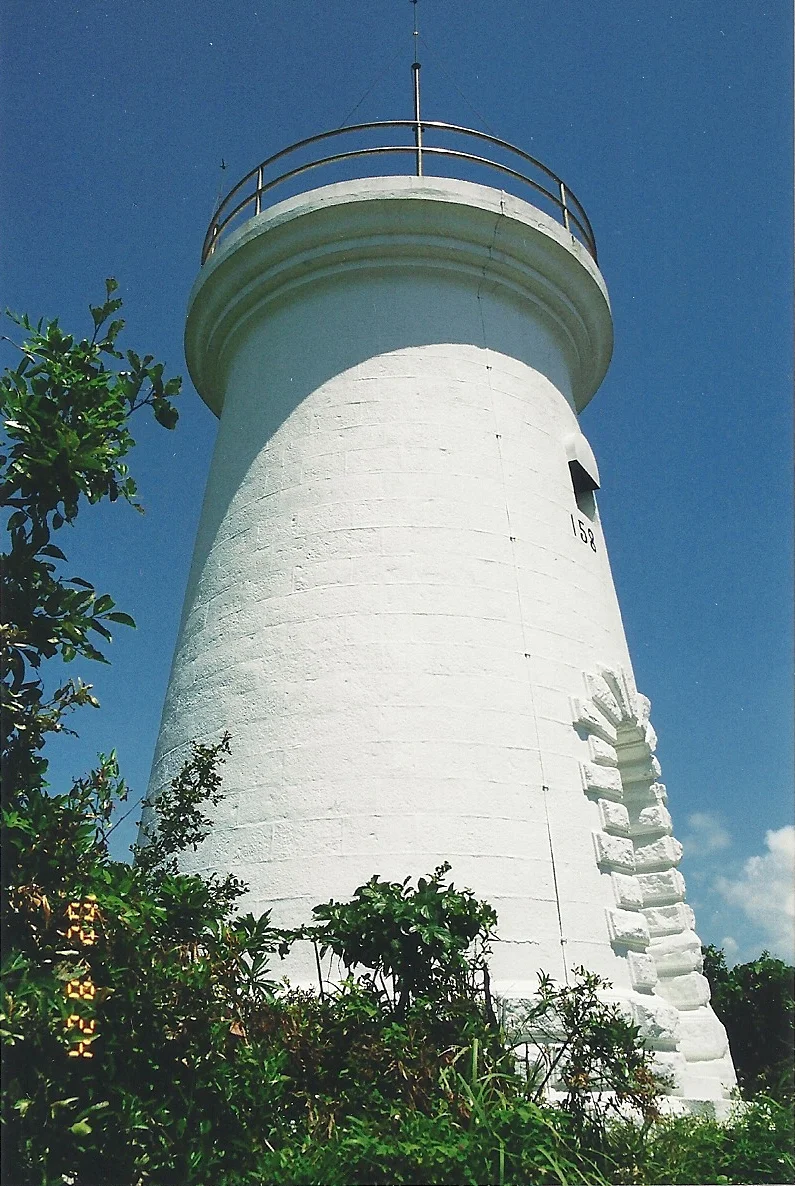

Cape D'Aguilar Lighthouse
The light came on in 1875. It went off in 1905. Then, 70 years later, it came on again. Cape D'Aguilar Lighthouse has been many things in its long life — the oldest lighthouse in Hong Kong, a declared monument, a relic of Victorian maritime engineering — but its biography is also a record of being needed, then superseded, then needed once more. The stone tower at the southeastern tip of Hong Kong Island, 9.7 meters tall and still standing, has outlasted empires and technologies alike.
Named for a General
The lighthouse bears the name of Major-General Sir George Charles d'Aguilar, a British officer who commanded forces in Hong Kong in the 1840s during the early years of colonial rule. The cape itself carries his name too, and the lighthouse simply extended that designation to the sea.
Construction was completed and the light first entered service on 6 April 1875. The technology was state of the art: a fixed dioptric first-order Fresnel lens, a system that uses concentric glass rings to bend and concentrate light into a powerful beam. The focal plane sat 200 feet above sea level, high enough to be seen in clear weather at a range of 23 nautical miles. For merchant ships and passenger steamers threading the South China Sea toward Hong Kong harbor, the white beam at Cape D'Aguilar was a reliable landmark — a signal that landfall was close.
Made Redundant, Then Revived
Twenty-one years after Cape D'Aguilar began operation, a more powerful lighthouse opened on Waglan Island, to the southeast. The Waglan Island Lighthouse, better positioned to cover the shipping approaches from the open Pacific, rendered the Cape D'Aguilar light unnecessary. In 1905, the light was removed. Its first-order Fresnel lens was transferred to the Green Island Lighthouse, on the opposite side of the harbor, where it replaced a smaller fourth-order lens.
Cape D'Aguilar went dark. For seventy years the tower stood at the cape without purpose, preserved by its own solidity and by the difficulty of dismantling masonry built to last. Then, in 1975, the lighthouse was returned to service with an automated system — no keeper required, no daily maintenance, just a steady signal going out over the dark water. It has been lit ever since.
Today the structure stands 9.7 meters tall and is a declared monument of Hong Kong, one of five pre-war surviving lighthouses in the territory. The others are the two on Green Island, the Waglan Island Lighthouse, and the Tang Lung Chau Lighthouse — both Waglan and Tang Lung Chau are also declared monuments.
The Architecture of Endurance
Hong Kong's declared monuments are buildings and structures deemed to have sufficient historical, cultural, or architectural significance to warrant legal protection against demolition or alteration. The designation is not given lightly. Cape D'Aguilar Lighthouse earned it through age, rarity, and the quality of its original construction.
Pre-war buildings in Hong Kong were tested by occupation, aerial bombardment, and decades of tropical humidity. Many did not survive. The five pre-war lighthouses that remain — including Cape D'Aguilar — are among the oldest standing structures in the territory. The lighthouse's design reflects standard British colonial maritime engineering of the late nineteenth century: solid masonry, a lantern room at the top, and a form that has barely needed modification in 150 years. The Fresnel lens is gone, replaced by modern optics, but the tower itself is original.
Light Over Water
Cape D'Aguilar sits at the southeastern corner of Hong Kong Island, where the land runs out and the South China Sea opens wide. Ships have passed this point for centuries — trading junks, colonial steamers, container vessels, fishing boats — and the lighthouse's job has always been the same: mark the land so that those at sea know where they are.
The cape now lies within the Cape D'Aguilar Marine Reserve, a protected area established to conserve the remarkable marine biodiversity of these waters. The lighthouse overlooks one of Hong Kong's least-disturbed coastal environments. Swimmers who venture into the reserve find surge channels, sea caves, and underwater rock formations. The lighthouse that once warned ships away from the rocks now stands over a place deliberately kept wild, a quiet reversal of its original mission.
From the Air
Cape D'Aguilar Lighthouse stands at approximately 22.209°N, 114.259°E, on the southeastern tip of Hong Kong Island. From the air, the cape is a recognizable rocky headland where the island's southern coast meets the open South China Sea. The lighthouse itself is small but sits on prominent terrain; at altitudes of 1,000 to 2,500 feet, the structure and the surrounding cape are clearly visible in good weather. The nearest major airport is Hong Kong International Airport (VHHH) on Lantau Island, approximately 28 km to the northwest. Flying the southern coast of Hong Kong Island eastward from VHHH at low altitude offers clear sightlines to the cape, with D'Aguilar Peak visible to the north and the Lamma Channel to the west. The marine reserve waters around the cape show characteristic deep blue-green clarity compared to the more turbid harbor waters.
Nearby Stories
- Shek Pik 1.7 km away
- Tung Ping Chau 4.8 km away
- Hong Kong 12 14 km away
- Wanshan Archipelago Campaign 16 km away
- Pearl River Delta 18 km away
- Battle of Penghu 478 km away
- Penghu Air Raids 487 km away
- Cape Maobitou 596 km away