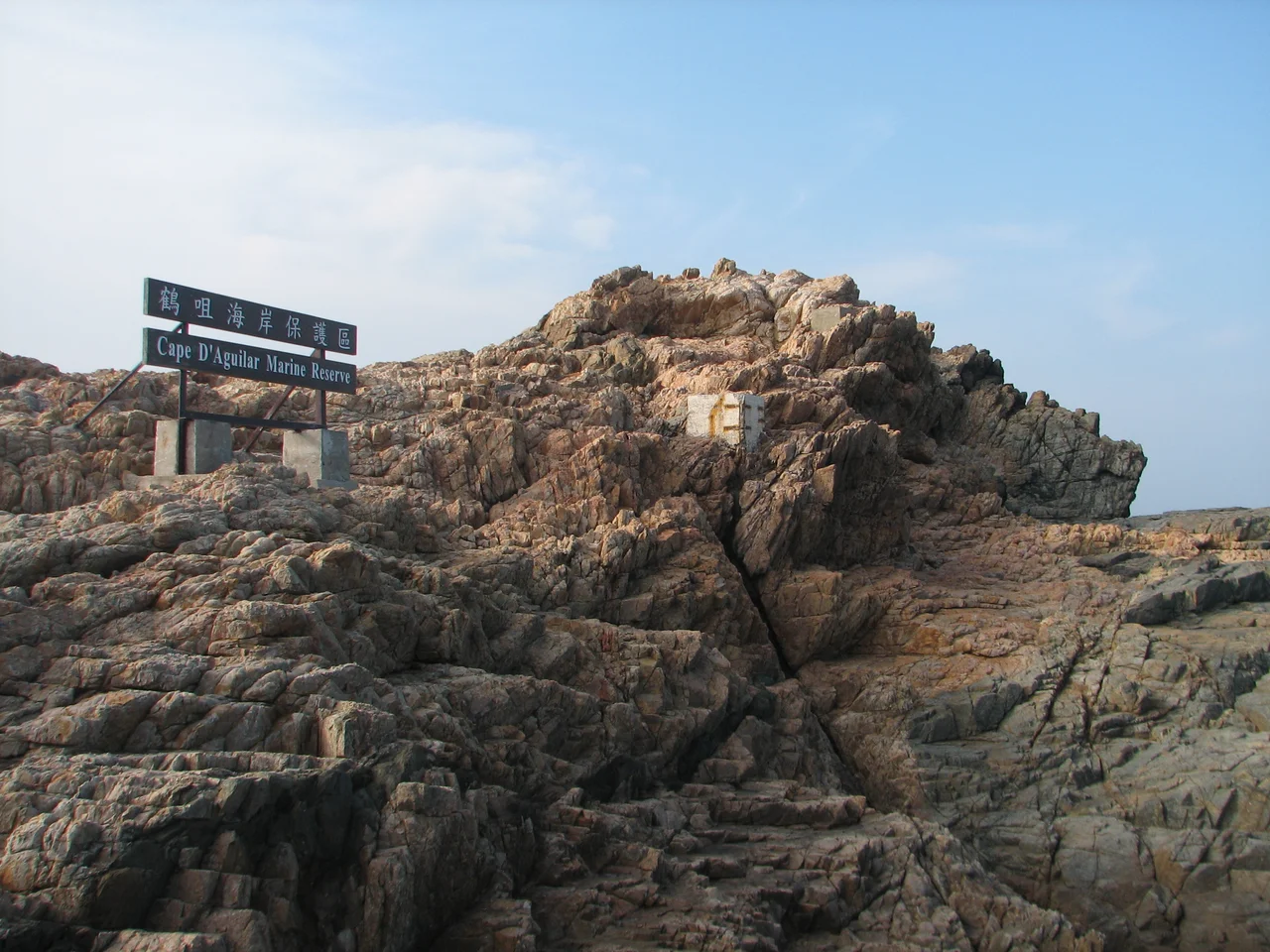

Cape D'Aguilar Marine Reserve
On 12 April 1955, a juvenile fin whale was found floating among debris near the Ming Shan Wharf in Victoria Harbour. It had separated from its mother while migrating north from the South China Sea, most likely due to sickness. The calf appeared lethargic and was slowly starving. Marine police euthanised it — a gunshot to the head, the method later described by the Swire Institute of Marine Science as 'the most humane' available. British Hong Kong was then absorbing wave after wave of refugees from the mainland, and the following day the whale's flesh was publicly carved up and distributed as food for refugee camps, drawing an audience of up to 1,000 people. Some fishermen, worried the 'ghost fish' would bring bad luck, made an 8-metre paper whale, burned it, and released it in Tseung Kwan O. The skeleton was passed to University of Hong Kong zoologists. Thirty-six years later, it arrived at Cape D'Aguilar.
The Only Marine Reserve
Cape D'Aguilar Marine Reserve — known in Chinese as 鶴咀海岸保護區, Hok Tsui Hoi Ngon Bou Wut Keui — occupies the far southeastern corner of Hong Kong Island, covering a stretch of rocky coastline mainly between Kau Pei Chau island and the shore. It was designated in July 1996 under the Marine Parks Ordinance, making it Hong Kong's only Marine Reserve — a designation distinct from the territory's Marine Parks in the strictness of its protections. Fishing, swimming, diving, and the collection of organisms are all strictly prohibited. Researchers must obtain a permit from the Agriculture, Fisheries and Conservation Department before conducting scientific work there. The reserve is managed by the AFCD in partnership with the Swire Institute of Marine Science, a research faculty of the University of Hong Kong that maintains a research facility on site.
Rocky Shores and Subtidal Life
The 1991 designation of Cape D'Aguilar as a Site of Special Scientific Interest came five years before the Marine Reserve was formally established. The rocky shores and subtidal habitats here are among the most ecologically significant in Hong Kong — sheltered enough to support rich intertidal communities of sea urchins, sea anemones, barnacles, and hundreds of invertebrate species, yet exposed enough at the headland to maintain the tidal flushing that keeps those communities healthy. The Swire Institute of Marine Science has operated here since the early 1990s, making the site one of the longer-running marine research stations in southern China. Its biodiversity centre is intended to eventually house not just the research collections but also the whale skeleton that has been displaying outdoors since 1991.
The Whale That Became a Symbol
On 27 June 1991, the fin whale skeleton — 6.4 metres long, the bones of a juvenile male calf — was moved from the University of Hong Kong campus to its current location on the shores of Cape D'Aguilar, next to the newly established Swire Marine Laboratory. It had spent 35 years on display across different buildings on the HKU main campus before undergoing a year-long reconstruction. The skeleton was often mistaken for the remains of Hoi Wai, a famous female orca who performed at Ocean Park Hong Kong from 1979 to 1997 — a confusion the institute has worked to correct. Swims considers the skeleton an important symbol of marine conservation: a whale that fed refugees, whose bones became a teaching tool, whose story spans colonial Hong Kong, the refugee crisis of the 1950s, and the emerging conservation movement of the 1990s.
Typhoon Mangkhut and a 3D-Printed Future
In September 2018, Typhoon Mangkhut — one of the strongest storms on record in southern China — struck Hong Kong with sustained winds that cracked the whale skeleton's ribs, dislodged the lower right jawbone, and blew the left hip bone away entirely. The Swire Institute organised the 'Restoring Hong Kong's Whale' campaign to raise funds for repair. The longer-term plan is more ambitious: move the original skeleton into the new biodiversity centre on site for preservation, and replace the outdoor display with a 3D-printed replica designed to withstand typhoons, salt spray, and the humidity of Hong Kong summers. The calf that died in a harbour in 1955, carved up in a refugee crisis, will eventually exist in two forms simultaneously — the real bones inside, and a printed copy standing on the rocks facing the South China Sea.
From the Air
Cape D'Aguilar Marine Reserve sits at 22.21°N, 114.26°E at the southeastern extremity of Hong Kong Island, where the island's terrain drops sharply to the sea. At 2,000–3,500 feet, the headland's rocky profile is visible projecting south from the island's mass, with Stanley Peninsula to the west and the open South China Sea ahead. The reserve's rocky coastline contrasts visually with the more sheltered harbour to the north. Primary airport is VHHH (Hong Kong International Airport) on Lantau Island, approximately 37 km west-northwest. Approaching from the south provides the clearest view of the cape's exposed southeastern face.
Nearby Stories
- Lok Ma Chau Loop 2.3 km away
- Portas do Cerco 2.3 km away
- Kweilin Incident 17 km away
- Wanshan Archipelago Campaign 34 km away
- Nanxiong Formation 115 km away
- Battle of Nanpeng Island 148 km away
- Heyuan 169 km away
- Cape Maobitou 632 km away