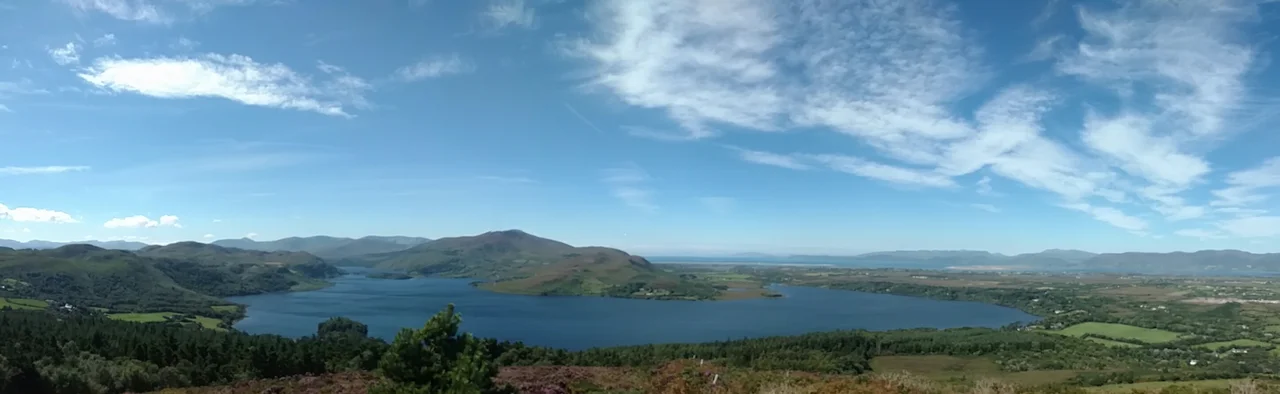

Caragh Lake
It is hard to stop a holiday house being built in a place this beautiful, but the Kerry slug is doing exactly that. The Kerry slug is small, mottled, slow, and protected by European conservation law, and its presence around Caragh Lake has tangled planning permission in a way that decades of building once routinely overrode. The lake sits between Killorglin and Glenbeigh in the Reeks District of County Kerry, dammed long ago at the Caragh River, with a view across its water to Carrauntoohil that the Irish Examiner once called possibly the most beautiful westerly view in Kerry. Caragh is glacial in origin, and the same ice that gouged this basin shaped the mountains behind it. The slug, in its quiet way, has become the lake's improbable champion.
A Lake Built by Ice
Caragh Lake lies in the Reeks District, the cluster of mountains and valleys around MacGillycuddy's Reeks in southwest Kerry. Geologists call it glacial in origin: the basin was scraped out by a tongue of ice during the last glaciation, and what fills it now is the Caragh River, dammed naturally where the bedrock and moraine ridge made a hollow that water could not escape. The lake feeds south toward Dingle Bay through the same river that named it. Its full Irish name, Loch Cárthaí, is older than any of the maps that show it, and like many Irish water features it shifts spelling and lenition depending on where you read it. The view across to Carrauntoohil, at 1,038 metres Ireland's highest peak, gives the lake's western shore its prized aspect: in late afternoon the granite turns warm and the water below it goes from dark blue to molten copper.
A Station That Doesn't Run Anymore
There used to be a railway here. The Great Southern and Western Railway's Farranfore-to-Valentia line ran along the southern shore of Dingle Bay from 1893 to 1960, and Caragh Lake had its own station on the way. It is hard to picture now, but the lake was once a destination on a working timetable, a place a Victorian traveller could reach from Dublin with a single ticket and a long, scenic afternoon. The line closed in 1960. The station site has gone the way of so many Irish branch-line stations, absorbed by other uses, but the trackbed in places has become a walking route, and the Laune Viaduct in Killorglin and the Gleensk Viaduct further west still carry the ghost of the railway across river and gorge.
Glannagilliagh and the Houses on the Shore
The north-eastern corner of the lake, around the townland of Glannagilliagh, is where the high-end houses are. Several of them predate modern planning rules and reach all the way to the water; some have private slipways, the kind of detail that says quietly how good the boating is when the wind drops on a summer evening. The Irish Examiner has been writing property features about Caragh Lake houses for years, with prices that climb whenever a particularly fine westerly view comes on the market. The lake has long been the kind of address where Kerry's older money keeps its summer place, but the architectural styles run wide, from low whitewashed cottages to glassy modern boxes, and what they share is the same view across to the Reeks.
The Slug and the Slow Defence of the Lake
Then the Kerry slug arrived in the planning files. Caragh Lake and most of its surrounding catchment fall inside the Killarney National Park, MacGillycuddy's Reeks and Caragh River Catchment Special Area of Conservation, a designation under European law that requires Ireland to protect the habitat of certain species. The Kerry slug, Geomalacus maculosus, is one of them: a small, dappled mollusc that grazes lichens on rocks and trees and lives almost nowhere else in Europe. Since its protection was recognised here, planning permission for new houses on the shore has become difficult to obtain, and what was once a quiet creep of development has slowed. There is a particular Irish satisfaction in the idea that a slug is now the gatekeeper of a multimillion-euro view. On a still morning, with the lake reflecting the mountains and a Kerry slug somewhere in the moss on a rock, the lake feels held in trust, which is more than most landscapes manage.
From the Air
Caragh Lake sits at 52.05 N, 9.867 W, in the Reeks District of Kerry between Killorglin and Glenbeigh. From the air the lake reads as a long irregular sheet of dark water set among green hills, with MacGillycuddy's Reeks rising sharply to the south-east and Carrauntoohil (1,038 m) clearly visible from a westerly approach. Nearest airport is Kerry (EIKY) about 25 km north-east; Shannon (EINN) lies about 95 km north. Best viewing altitude is 2,000 to 5,000 ft to take in the lake, the Reeks, and the run of the Caragh River toward Dingle Bay. The Reeks generate orographic cloud quickly, so expect summit cap and shifting visibility on the mountains even when the lake itself is bright.
Nearby Stories
- Inishtooskert 2.5 km away
- Staigue stone fort 5.6 km away
- Listowel 7.1 km away
- Castleisland 13 km away
- Ballyheigue Castle 13 km away
- Kealkill stone circle 15 km away
- RMS Carinthia (1925) 93 km away
- Sao Miguel 1951 km away