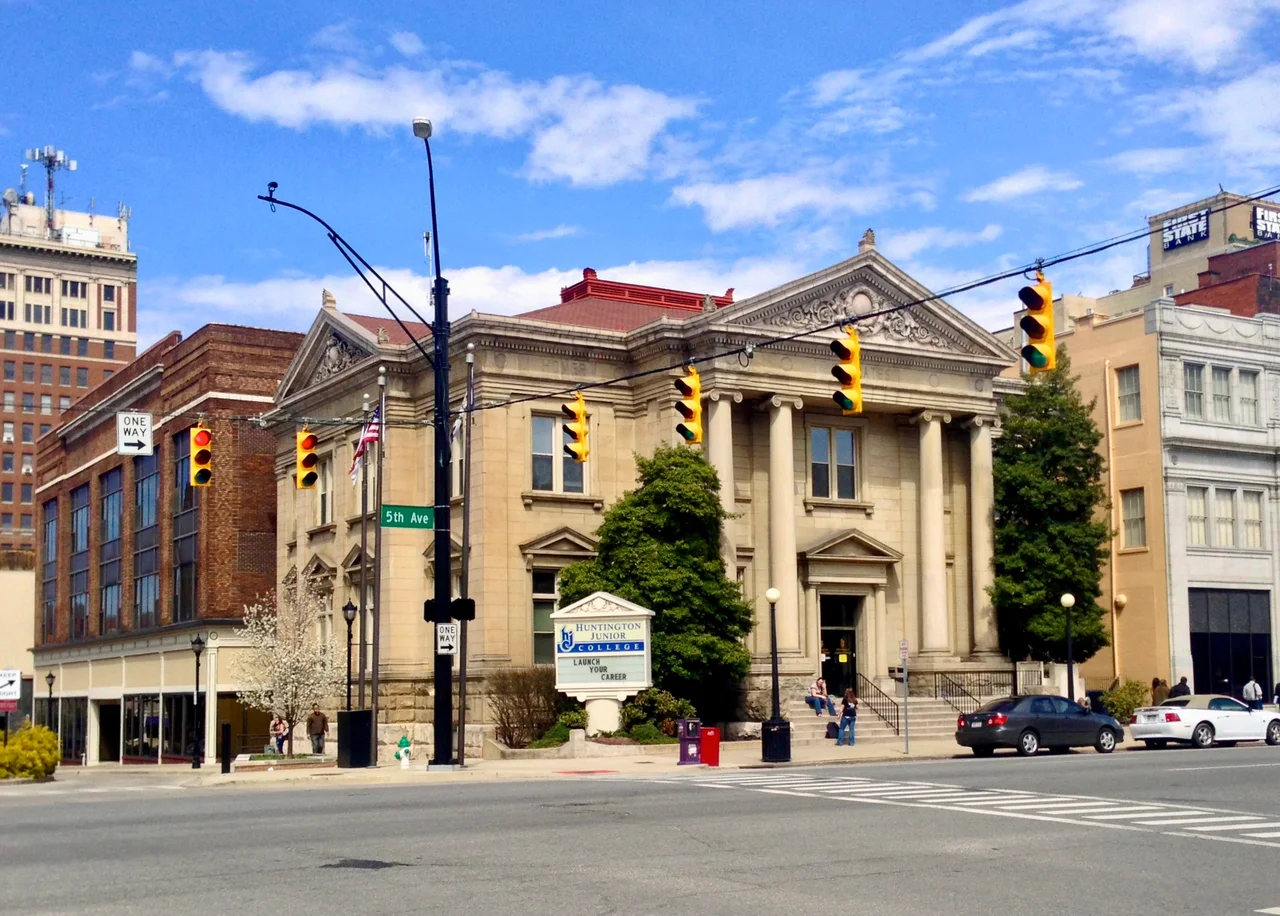

Carnegie Public Library, Huntington
Andrew Carnegie's philanthropy built more than 2,500 public library buildings across the United States and beyond. Huntington, West Virginia got one in 1903 - the first public library in Cabell County, completed at Fifth Avenue and Ninth Street in classical Beaux-Arts style. The library served the community for seventy-seven years before a new building opened across the street in 1980. But the Carnegie's most curious chapter happened on its front lawn in 1915, when a statue of a Union soldier disappeared from its base in the middle of a controversy over plans to put up a Confederate monument elsewhere in town. Witnesses saw the statue loaded into a wagon. After that, nobody saw it again.
Carnegie's Gift
When the library was built, no public library existed in Huntington or Cabell County. The only library in the city was a small collection at the First Congregational Church. Andrew Carnegie's library program had a standard pattern: the steel baron's foundation would fund the construction of a public library building if the local community pledged annual operating support equal to ten percent of the construction cost. Huntington made the pledge. Construction completed in 1903, with the building taking its place at the intersection of Fifth Avenue and Ninth Street - a prominent corner in what was then a growing industrial city. The Beaux-Arts architecture was standard Carnegie practice for the period, lending the building a classical seriousness that announced its public function before a single visitor stepped through the door.
The Union Soldier
Until 1915, a statue of a Union soldier stood at the library's southwest corner. The monument appears in postcards from the early twentieth century, helping to date its presence. It was probably erected by the Grand Army of the Republic - the veterans organization for Union soldiers, which raised many such statues across the North in the 1880s and 1890s. The statue's installation made political sense for Huntington. Cabell County had been part of West Virginia, the state that broke from Virginia in 1861 specifically to remain in the Union. A Union soldier on the library's lawn was a fitting marker of the city's Civil War allegiance and the values it claimed to inherit from that conflict.
The 1915 Disappearance
In 1915, plans were announced to build a Confederate monument at Ritter Park, also in Huntington. The plan was controversial. To many Huntingtonians, putting up a Confederate memorial in a city in a state that had explicitly rejected the Confederacy felt strange at best and politically pointed at worst. Around the time of this controversy, the Union soldier statue at the library vanished. Witnesses reported seeing it loaded into a wagon. The common assumption at the time was that the statue was being relocated to Ritter Park, perhaps as part of some compromise gesture. But the statue never appeared at Ritter Park. It never appeared anywhere. Whatever happened to it - whether it was destroyed, melted down, stolen, hidden, or simply lost - the Union soldier has not been seen since.
The Library After 1980
The Carnegie served as Huntington's public library until 1980, when the new Cabell County Public Library opened across the street. The transition is a story that has played out at Carnegie libraries across the country. The 1903 building, designed for a smaller collection and a different model of library service, could no longer accommodate the volumes, services, and accessibility expectations of a late-twentieth-century library. Rather than expand the historic structure, the community built new. The Carnegie was preserved but repurposed, becoming home to Huntington Junior College - now renamed Ameritas College Huntington as of 2025. The college, founded in 1936, now occupies what was for nearly eight decades the city's first public library - a building still in active use, still serving education, still honoring something of its original purpose.
The Corner Today
From above, the Carnegie sits at a corner that retains much of its early-twentieth-century character. Fifth Avenue runs east-west; Ninth Street runs north-south. The intersection is several blocks from Marshall University's campus and a similar distance from the Ohio River waterfront. The Beaux-Arts facade is still visible from street level - the classical entrance, the carved stone detail, the proportional severity of the design vocabulary. The space where the Union soldier once stood is now just a corner of the property, indistinguishable from any other patch of grass and pavement. The statue's disappearance has become a small Huntington legend, retold occasionally in local history columns and Lost Huntington features, kept alive by the simple unsolved oddity of a missing monument in a place that ought to be able to remember its own history.
From the Air
Located at 38.420 degrees north, 82.444 degrees west, in downtown Huntington, West Virginia. Recommended viewing altitude 3,500 to 5,500 feet AGL for clear views of the downtown street grid. Nearest airport is Tri-State (KHTS), about 4 nautical miles east. The Carnegie Library building sits at the corner of Fifth Avenue and Ninth Street, with Marshall University a few blocks east and the Ohio River about ten blocks north.
Nearby Stories
- Battle of Scary Creek 6 km away
- Portsmouth 7.2 km away
- Fred M. Vinson Museum and Welcome Center 14 km away
- Staats Mill Covered Bridge 24 km away
- Lake Tight 25 km away
- Battle of Blair Mountain 32 km away
- Lower Shawneetown 35 km away
- The Kentucky Meat Shower: When Flesh Fell From a Clear Sky 68 km away