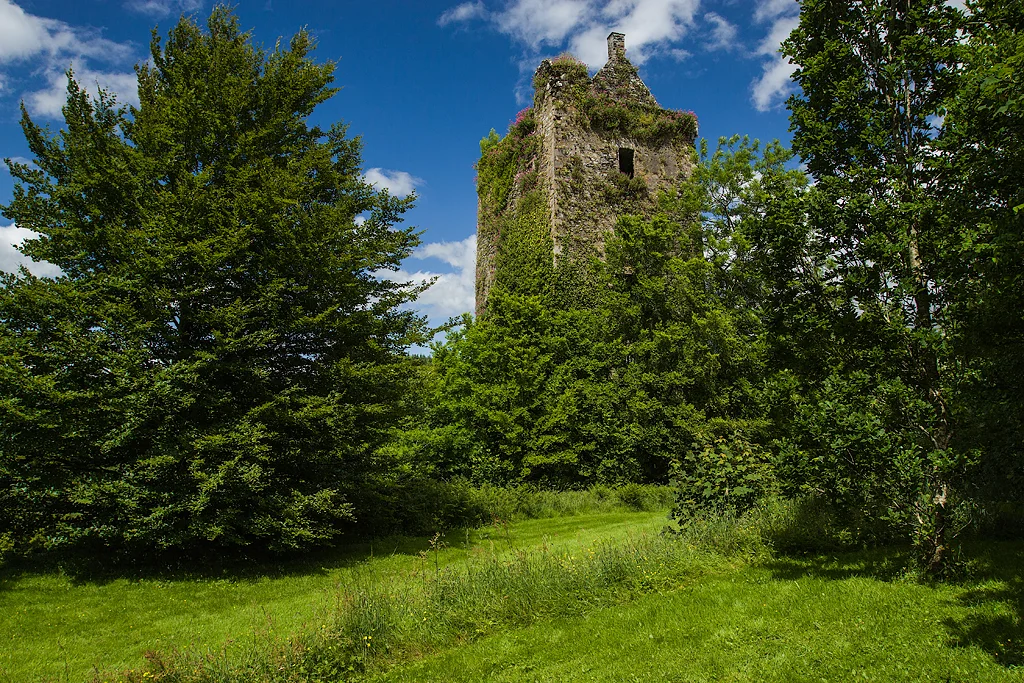

Carrignamuck Tower House
The MacCarthys built a chain of tower houses across County Cork in the fifteenth century, fortified residences that stretched westward beyond Macroom like a string of stone outposts. Carrignamuck is one of the few that survives. Five storeys, L-shaped, with a slate roof retrofitted in 1866 and a wooden front door that arrived at the same time, it sits two kilometres northwest of Dripsey village on private land. The cannon damage from 1650 is still visible. So is the murder-hole on the first floor, a vertical shaft through which defenders could drop unpleasant surprises on anyone breaking through the entrance below. The tower house is closed to the public. From the public road you can still see why Lord Broghill spent a morning shelling it.
Cormac Láidir, the Strong
Local tradition holds that Carrignamuck was originally Carrig Cormac, named for Cormac McTeige MacCarthy - known as Láidir, meaning the Strong - who succeeded as ninth Lord of Muskerry in 1449 and died in 1494. He was also the founder of Blarney Castle a few kilometres east. The tower house at Carrignamuck was reportedly the official residence of the Tanist, the designated heir in succession to Blarney. Within the family, this arrangement was tested early. Cormac's brother Eoghan lived as tanist at Carrignamuck for a period, until an argument between the brothers ended with Cormac dead and Eoghan disqualified from any claim on the title. Whatever happened in that quarrel echoes through the building today as the pattern of MacCarthy succession: by blood, by accident, sometimes by what one brother did to another.
A Less Romantic Name
Not everyone accepts Carrig Cormac as the original name. The historian O'Donoghue, writing in 1986, offered an earthier theory: that Carrignamuck means roughly the rock of the pigs, and that the name comes from a nearby location where pigs were customarily slaughtered to supply bacon for the inhabitants. The tower house, in this telling, took its name from the meat-processing site rather than the warrior-lord. Both stories may be true. Place names in Munster often layer over each other, an older Gaelic memory pushed underneath a newer noble association. The earliest depiction of the tower, on a sketch map of Muskerry around 1590, simply calls it Carrigomuck. The Down Survey of 1656-1658 lists Carrignemucke as the site of a castle and a mill.
Cromwell's Guns at Meeshal Hill
In 1650, near the end of the Cromwellian conquest of Ireland, Lord Broghill - Roger Boyle, first Earl of Orrery, leading a troop of Cromwellian soldiers - took up a position on nearby Meeshal Hill and bombarded Carrignamuck. The tower was a MacCarthy seat, and the MacCarthys had backed the wrong side. The garrison that survived the shelling included a contingent that Cromwell's forces then stationed in the building for some period - the conquerors using the fortress they had just battered. A century and a quarter later Smith's 1774 description of the Castle of Carrignamuck still noted that it had been inhabited by a Mr. Bear, once belonged to the Mac-Carthys, and had held an Oliver Cromwell garrison for some time. The memory was that long.
The Murder-Hole and the Garderobe
Inside Carrignamuck, the medieval defensive imagination is still legible floor by floor. The ground floor holds a lobby, a main chamber with a fireplace, and a smaller side chamber. The first floor adds a garderobe - the medieval latrine, simply a stone shaft to the outside - and the murder-hole chamber, positioned to look down on attackers who had forced the front door. One of the first-floor windows holds a timber frame said to come from the former Church of Ireland parish church at Aghabullogue, recycled material from a building that no longer exists. The second and fourth floors each have a fireplace. The fourth floor opens to an external wall-walk; the original battlements are gone. Repairs in 1866 added the slate roof and wooden front door that still close the building today.
From MacCarthy Seat to Private Property
In 1580, during the Second Desmond Rebellion, Donyll McTeige MacCarthy - tanist of Muskerry and brother of Sir Cormac McTeige of Blarney Castle - was living at Carrignamuck when he was injured in a skirmish between the Muskerry MacCarthys and Sir James Fitzgerald of Desmond. He died at the tower house. The succession that followed reads like a family balance sheet: Sir Cormac McTeige died in 1583, his brother Callaghan took the Muskerry title and then handed it to a nephew, and Callaghan kept Carrignamuck as a kind of consolation residence. His son Cormac inherited and then forfeited the estate in 1641. The Colthurst family bought the property and later built Dripsey Castle nearby. By 1944 it had passed again, this time to John O'Shaughnessy of the Dripsey Woollen Mills. The key to the building hung at Dripsey House for visitors who asked nicely.
From the Air
Located at 51.93°N, 8.75°W on the south bank of the Dripsey River, approximately 18 km west-northwest of Cork city. Cork Airport (EICK) sits about 20 nm southeast. Look for the rectangular footprint of the L-shaped tower among trees, with the nearby Dripsey Castle country house and farm complex to the immediate east. Recommended viewing altitude 2,000-3,000 ft. The tower house is on private property and not open to visitors; aerial reconnaissance is the most respectful approach.
Nearby Stories
- Ballyvourney 1.6 km away
- Castlemartyr 3.9 km away
- Ballybeg Priory 4.1 km away
- Kilbrittain 5.2 km away
- Shanbally Castle 10 km away
- Skibbereen 17 km away
- Castleisland 22 km away
- SM U-27 118 km away