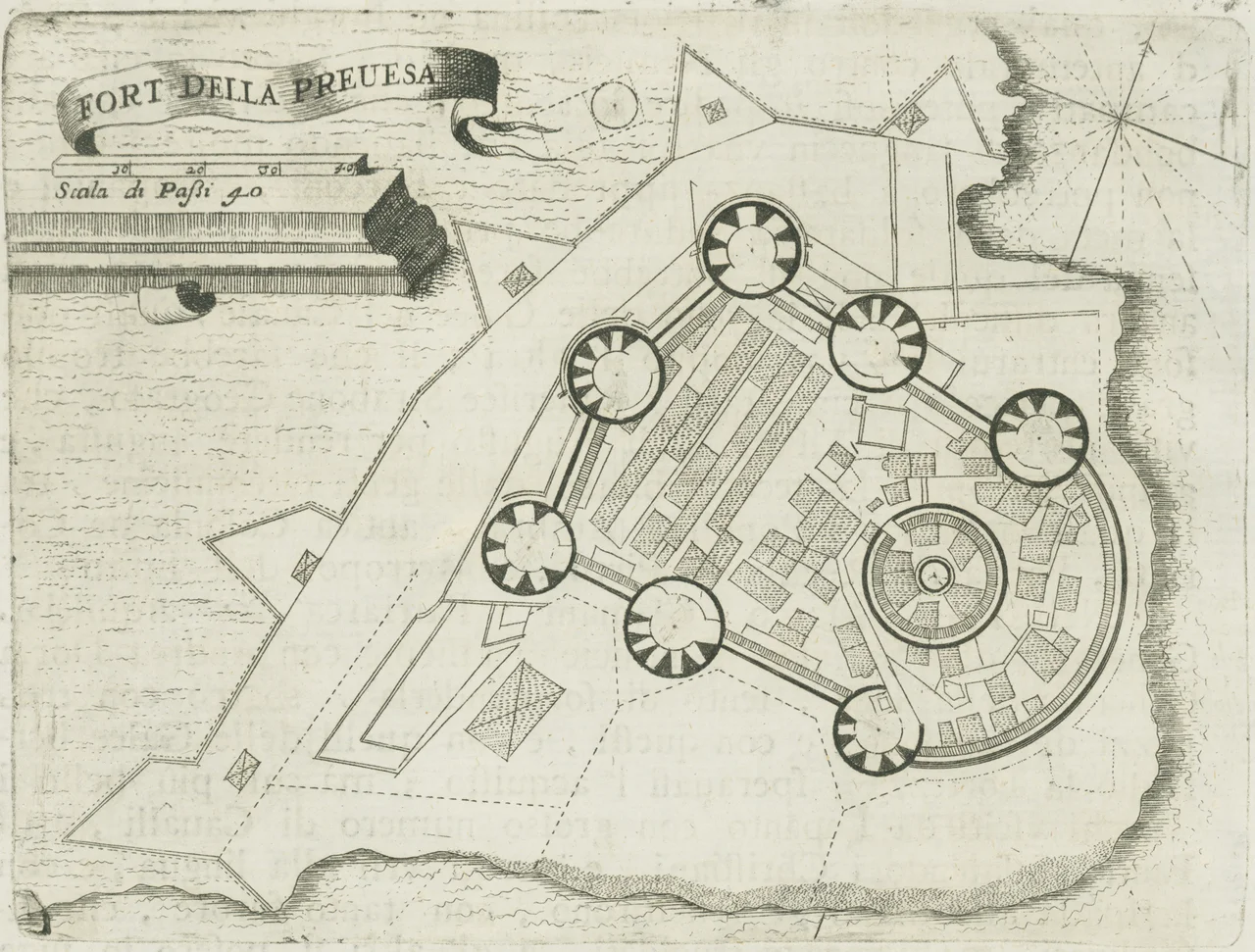

Castle of Bouka
The name comes from the Italian word bocca — mouth. That is what the Castle of Bouka was built to control: the mouth of the Ambracian Gulf, the narrow channel between the cape of Actium and the Epirus shore, where whoever held the water held the gulf behind it. The Ottomans built it in 1478, fifteen years after establishing their grip on the region. For 223 years, through six rounds of reinforcement and four armed attacks, the castle stood at that mouth. Then the Venetians blew it up rather than leave it standing for their enemies.
A Castle That Named a City
When the Ottomans completed Bouka in 1478, a small settlement formed to the north of its walls. The castle was known in Turkish as Preveze kalesi — the castle in the Passage — and the settlement took the same name, Preveza. The first dated document to record that name comes from 1481, a letter from a Venetian official in Corfu. Leonardo III Tocco, Count of Cephalonia, had already written to Venice three years earlier warning that this new castle at the mouth of the gulf was a threat to Venetian maritime interests. His letter referred to it as 'castello ala bucca delo gulfo' — the castle at the mouth of the gulf. He was right to worry. The castle that gave Preveza its name would prove one of the most strategically contested positions in the eastern Mediterranean for the next two centuries.
Attacked, Improved, Attacked Again
In 1481 — just three years after construction — a small Catalan fleet of twelve galleys and nine smaller vessels under a captain named Vilamarino arrived at the gulf entrance, found only fifteen Turkish soldiers defending the new castle, and temporarily seized it. They looted it and moved on. That raid set the pattern. The Ottomans reinforced Bouka in 1486–87, again in 1495, 1502, 1530, and 1552 under Suleiman the Magnificent. In 1538, the Ottoman fleet under Hayreddin Barbarossa used the castle as a base during the sea battle of Preveza, defeating the combined Christian fleets of Europe. In 1501, Venetian forces under Vice-Admiral Benedetto Pesaro engaged the castle while raiding the gulf. In 1605, the Knights of Saint Stephen from Pisa landed near Preveza by night, bombarded the castle at dawn, forced the Ottoman garrison of 80–100 men to surrender, and spent a day plundering the town — taking roughly 250 inhabitants, both Muslim and Christian, as captives before releasing the Christians at Antipaxoi and departing.
Evliya Çelebi's Preveza, circa 1670
Around 1670, the Ottoman traveler Evliya Çelebi visited Preveza and left a precise description of what he found. The castle was garrisoned by 250 soldiers. Inside the walls: narrow streets, about 100 small houses without gardens, a mosque built by Sultan Suleiman I. Outside the walls: 300 larger houses with gardens and a bazaar of 100 shops. It was a functioning small town wrapped around a military installation at one of the most strategically important passages in Greece. Fourteen years after Çelebi's visit, the Venetians would take it.
Seventeen Years and a Demolition
On 29 September 1684, at the start of the Morean War, the Venetians captured the Castle of Bouka and immediately set about improving it — widening the moat, strengthening the walls, adapting the fortification to their own defensive needs. They held it for seventeen years. When the Treaty of Karlowitz in 1699 obliged the Venetians to return Preveza to Ottoman control, they faced a choice. Handing back a strengthened, well-maintained fortress felt strategically unacceptable. In 1701, before the handover, they demolished it. The site the Venetians left behind was called Paliosaraga — Old Seraglio. In the early 1810s, Ali Pasha of Yannina built his summer residence on the ruins. After the Greek Army captured Preveza in 1912, a military supply unit occupied the site. Today very little of the castle remains, and the ground has not been substantially built upon — an absence that somehow suits a place that was built to hold a passage and ended by being erased.
From the Air
The Castle of Bouka stood at approximately 38.951°N, 20.756°E, on the Preveza peninsula at the narrow entrance to the Ambracian Gulf. From the air, the strategic logic is immediate: the channel between Actium (where LGPZ Aktion National Airport now sits) and the Preveza shore is less than a kilometer wide at its narrowest, and the castle controlled the western side of that bottleneck. Nearest airport: LGPZ, directly across the channel on the Actium promontory. Approach from the south at 3,000–5,000 ft for the clearest view of the gulf entrance and the Preveza waterfront. The modern city of Preveza occupies the peninsula.
Nearby Stories
- Lake Trichonida 15 km away
- Battle of Karpenisi 17 km away
- Phaneromeni Monastery, Lefkada 19 km away
- Paxos 19 km away
- 2015 Lefkada Earthquake 28 km away
- Lake Plastiras 29 km away
- Italian Destroyer Angelo Bassini 30 km away
- SM UC-38 47 km away