
Castle Rising Castle
When William d'Aubigny II built Castle Rising soon after 1138, he was not particularly interested in defending anything. Norfolk was prosperous but not strategically vital; the land around the site was thinly populated, with poor acidic soil. What the location offered was cheapness and space — room enough to build a palatial hunting lodge and establish a deer park stretching 16 miles in circumference. Historian Richard Hulme describes William's project exactly for what it was: not a fortress but a statement of arrival, the building of a man who had recently married the widow of a king and become the Earl of Arundel.
A Monument to Ambition
The great keep at Castle Rising is, by scholarly consensus, one of the finest Norman keeps in England. Historians Beric Morley and David Gurney call it 'one of the finest of all Norman keeps,' and its Romanesque decoration — pilaster buttresses, elaborate arcading — is thought to have been modelled on Norwich Castle, itself a building of exceptional quality.
The landscape William designed around it was as carefully considered as the architecture. The existing settlement was moved north to create a planned town adjacent to the new castle. A dovecot and a religious house were founded nearby, both being symbols of lordship at the time. The keep itself faced the town on one side, the deer park on the other — a deliberate arrangement placing the lord between his tenants and his hunting grounds, public face to one direction, private pleasure to the other. Rising Chase, the park beyond the castle, was shaped so that its boundaries stretched beyond the horizon when viewed from the keep.
Isabella of France
The most famous occupant of Castle Rising arrived under complicated circumstances. Queen Isabella — mother of Edward III, former co-regent of England, and a woman who had helped overthrow and murder her husband Edward II — fell from power in 1330 when her son moved against her and her partner Roger Mortimer. She was 35 years old. Edward III took control of government, had Mortimer executed, and arranged for his mother to live at Castle Rising.
This was not punishment in the harshest sense. Isabella received a yearly income of £3,000, which by 1337 had risen to £4,000. She maintained minstrels, huntsmen, and grooms. Edward visited with the royal household on at least four occasions. She extended the castle buildings, adding a residential suite and a private chapel in the central bailey. She ran up debts with local merchants — evidence of active domestic life, not mere confinement.
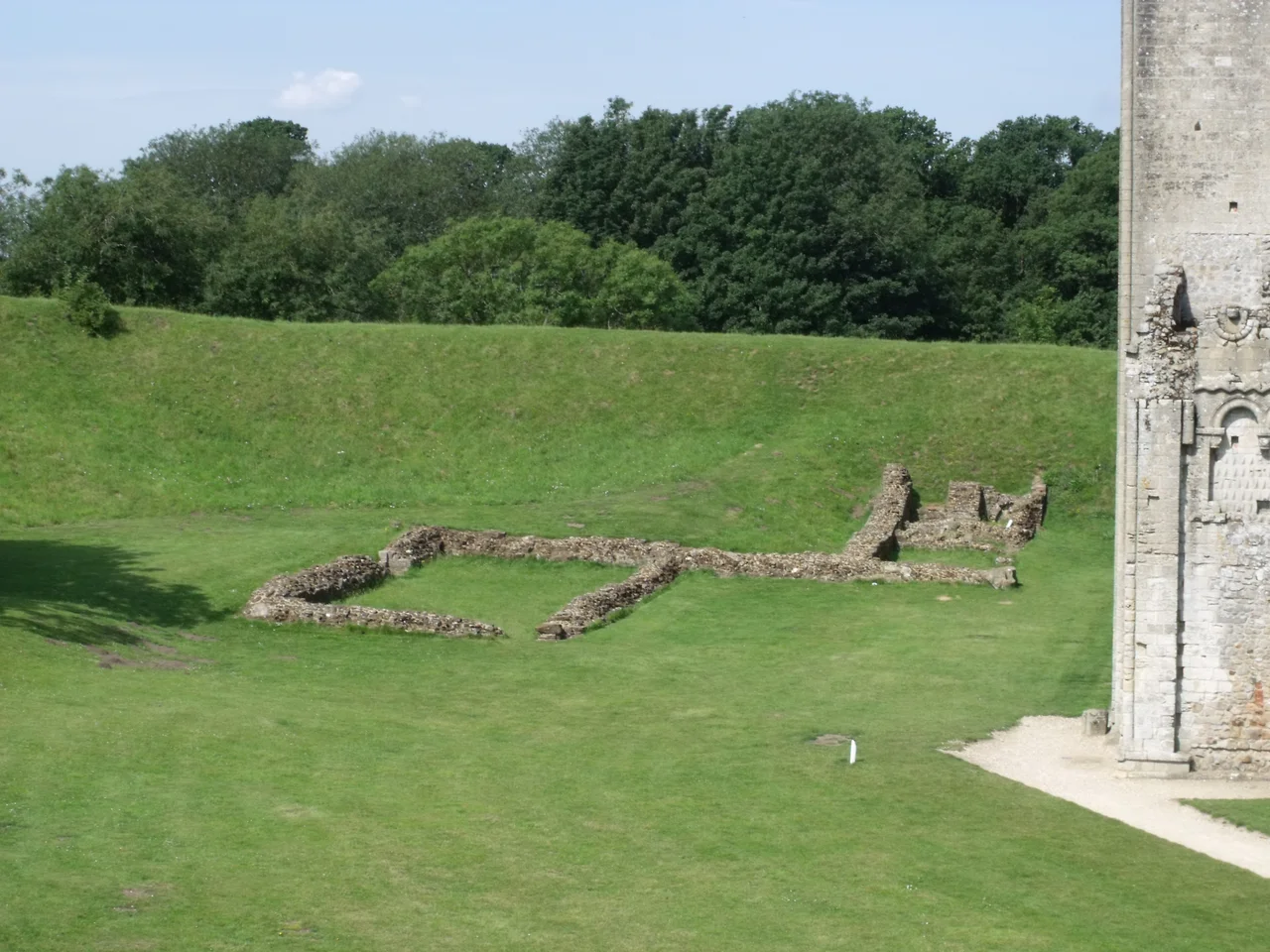
She lived at the castle until her death in 1358, nearly three decades of comfortable but circumscribed existence in the Norfolk countryside. The foundations of her chapel and the west range she built are still visible in the grass of the inner bailey.
Centuries of Decline
After Isabella, Castle Rising passed to Edward the Black Prince as part of the Duchy of Cornwall — Edward III having decreed in 1337 that the castle would belong permanently to the Prince of Wales. The Black Prince made repairs in the 1360s, including spending £81 on the 'Nightegale Tower' in 1365 (which part of the castle this refers to is no longer certain), and the structure was kept in reasonable order through the late medieval period.
Decay came slowly and then decisively. A survey between 1503 and 1506 described the castle as 'evyll repayred.' By the 1540s, with the roof of the keep collapsed, a later survey noted that everything except new lodgings was in 'greate ruin and decaye.' By the 1570s the earthworks were infested with rabbits whose warrens caused structural damage. A final survey calculated that full renovation would cost £2,000 — but that if demolished and sold for materials, the ruin would yield only £66.
Excavation and Open Air
The Victorian rediscovery of Castle Rising began with the Howard family, who inherited the property and opened it to the public around 1900. The Ministry of Works took custody of the site in 1958 and carried out systematic archaeological investigations during the 1960s and 1970s — excavating the keep, the Norman chapel, the earthwork defences, and the inner bailey in sequence.
Today the castle is managed by its owner, Baron Howard of Rising, under the care of English Heritage. The earthworks — covering 5 hectares, among the most impressive in Britain according to archaeologists Creighton and Higham — surround the roofless keep in their full medieval height. The Norman chapel, uncovered in the 1851 excavations by Henry Harrod after having been buried under the earth defences for centuries, has been restored. Visitors walk across the same ground where Isabella once maintained her court, past the foundations of a chapel whose existence was controversial for a hundred years before archaeology settled the question.
From the Air
Castle Rising Castle lies at 52.793°N, 0.469°E, approximately 6 km north-east of King's Lynn in northwest Norfolk. The nearest airports are King's Lynn (EGYL), roughly 7 km to the south, and Norwich International Airport (EGSH), about 60 km to the southeast. From the air, the castle's earthworks are among its most distinctive features: massive banks and ditches enclosing an area of 5 hectares, visible clearly from altitude in the flat Norfolk landscape. The village of Castle Rising is immediately adjacent. Best observed at low altitude on a clear day, when the height differential between the bailey banks and the surrounding countryside is most apparent.
Nearby Stories
- RAF East Kirkby 5.9 km away
- RAF Feltwell 8.6 km away
- RAF Matlaske 10 km away
- Chain Bridge Forge, Spalding 10 km away
- Norfolk Tank Museum 12 km away
- Skegness Lifeboat Station 14 km away
- Connington South Rail Crash 20 km away
- HMS Cobra 39 km away