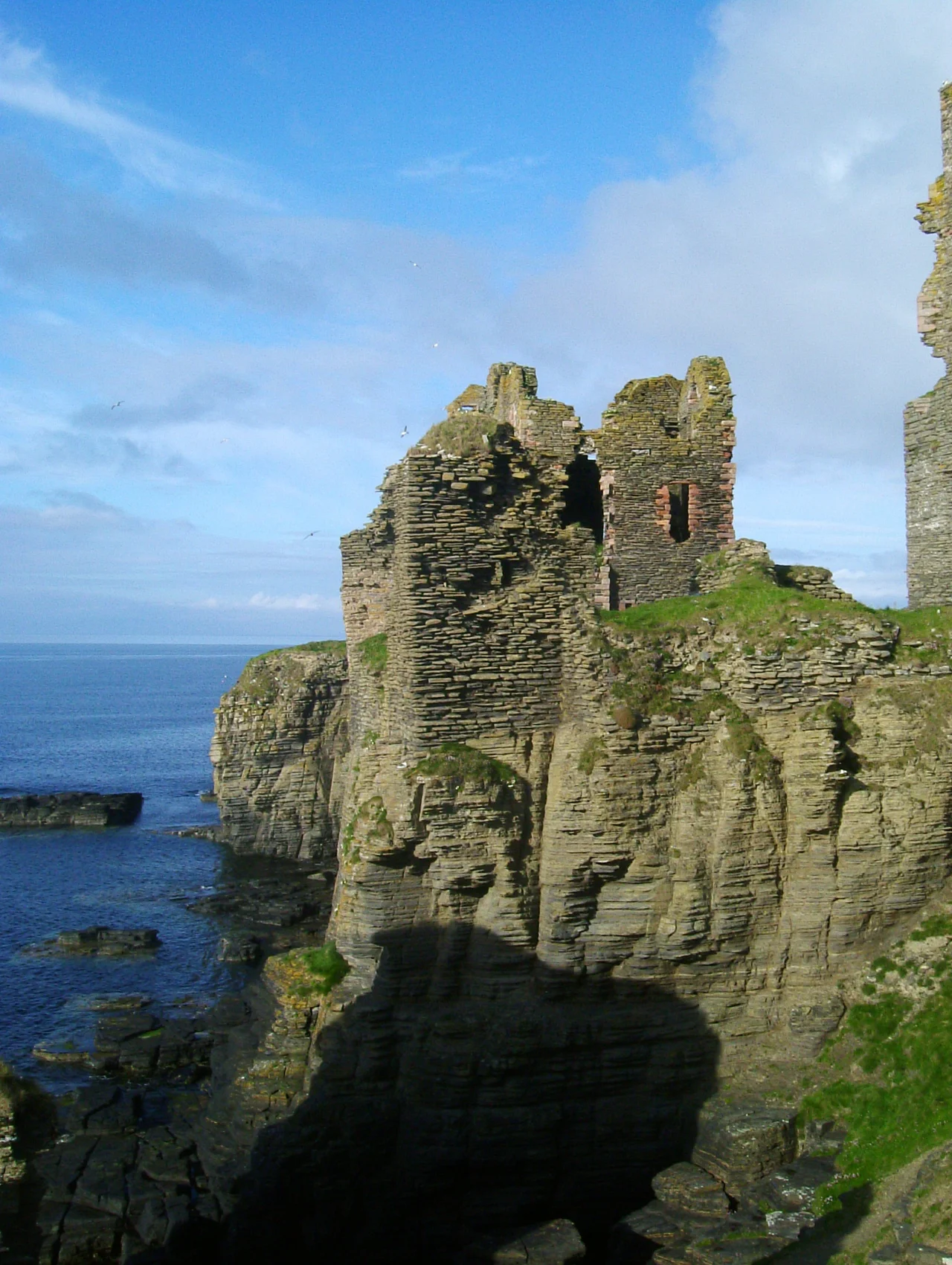

Castle Sinclair Girnigoe
An earl locks his son in a tower and starves him - not by neglect, but by design. For seven years John Sinclair, Master of Caithness, was held in the dungeon of Castle Girnigoe by his own father George Sinclair, the 4th Earl. When the earl finally decided the imprisonment had gone on long enough, he did not free his son. He fed him a diet of salted beef and gave him nothing to drink. John Sinclair died insane from thirst in 1577 in this castle, on a rocky promontory jutting into Sinclair's Bay north of Wick. Castle Sinclair Girnigoe is two castles in one - the 15th-century original and a 17th-century expansion - and almost everything that happened here was as dark as the dungeon where John died.
Two Castles, One Headland
The earlier castle - Castle Girnigoe - was built by William Sinclair, 2nd Earl of Caithness, sometime between 1476 and 1496. We know it was finished before 1513, because that was the year William died at the Battle of Flodden along with much of the Scottish nobility. The castle may have been built on the foundations of an earlier fortalice. Robert Sinclair describes the structure as a five-storey L-plan crow-stepped gabled tower house perched on the rocky promontory, with a secret chamber hidden in the vaulted ceiling of the kitchen. In 1606 a second castle - Castle Sinclair - was added: a gatehouse, additional buildings, and a curtain wall connected to the older structure by a drawbridge over a ravine. The two together formed one of the most formidable seats in northern Scotland, and one of the strangest in design - a fortress that was really two fortresses, sharing a single dramatic site.
Olave, John, and Bothwell
The castle's roll-call of inhabitants reads like a catalogue of misfortune and intrigue. In May 1573 the foud of Shetland - the sheriff of those northern islands - was brought to Girnigoe paralysed after a stroke. His name was Olave Sinclair. Four years later, in 1577, came the imprisonment and murder of John Sinclair, Master of Caithness, by his own father over suspicions of rebellion. In December 1594 the rebel Francis Stewart, 5th Earl of Bothwell - the nephew of Mary, Queen of Scots' notorious husband, and himself a man on the run from James VI - was at Girnigoe, sheltered by the Sinclairs. Later, George Sinclair of Keiss continued opposition to the senior Sinclair line and laid siege to the castle with firearms and artillery. He took it after what one chronicler called feeble resistance from the garrison. He, Sinclair of Broynach, Sinclair of Thura, and Mackay of Strathnaver were all declared rebels for their part - though political tides shifted and the declaration was quashed. Sinclair of Keiss eventually pursued his inheritance through the courts, with the help of the Duke of York, later King James II.
Preservation
By the 19th century Castle Sinclair Girnigoe was a roofless ruin, slowly sliding into the sea. The Clan Sinclair Trust began archaeological research at the castle in 1998 and has been working ever since to preserve what remains. The castle has the distinction - unique in Scotland - of being listed by the World Monuments Fund as a site of international heritage importance worth saving. Conservation has stabilized walls, cleared rubble, and made the site safer to visit. The two-castles-in-one layout is still legible from the cliff path: the older inner tower-house on its rock, the newer outer gatehouse and curtain wall, the ravine between them spanned in the imagination if not in stone. From the seaward edge, the drop is sheer. The Battle of Champions was fought just west of here, around 1478, and Castle of Mey lies an hour up the road. This stretch of Caithness coast carries more medieval blood per square mile than almost anywhere in Scotland.
From the Air
58.4780N, 3.0681W. On a rocky promontory jutting into Sinclair's Bay about 3 miles north of Wick. The twin-castle ruin reads clearly from above - an inner tower-house on the seaward rock, an outer gatehouse and wall on the landward approach, with the dramatic ravine between. Best photographed at 800-1,500 ft AGL on a northerly coastal track. Nearest airport: Wick (EGPC) 3 nm south. The Pentland Firth currents off Sinclair's Bay can generate sudden coastal turbulence in onshore winds.
Nearby Stories
- Battle of Harpsdale 4 km away
- Tomb of the Eagles 5 km away
- Helmsdale 11 km away
- SS St Petersburg 38 km away
- HMS King Edward VII 40 km away
- HMS Daring (H16) 46 km away
- Brora Distillery 55 km away
- Orcadian Basin 64 km away