.jpg)
Castlerock
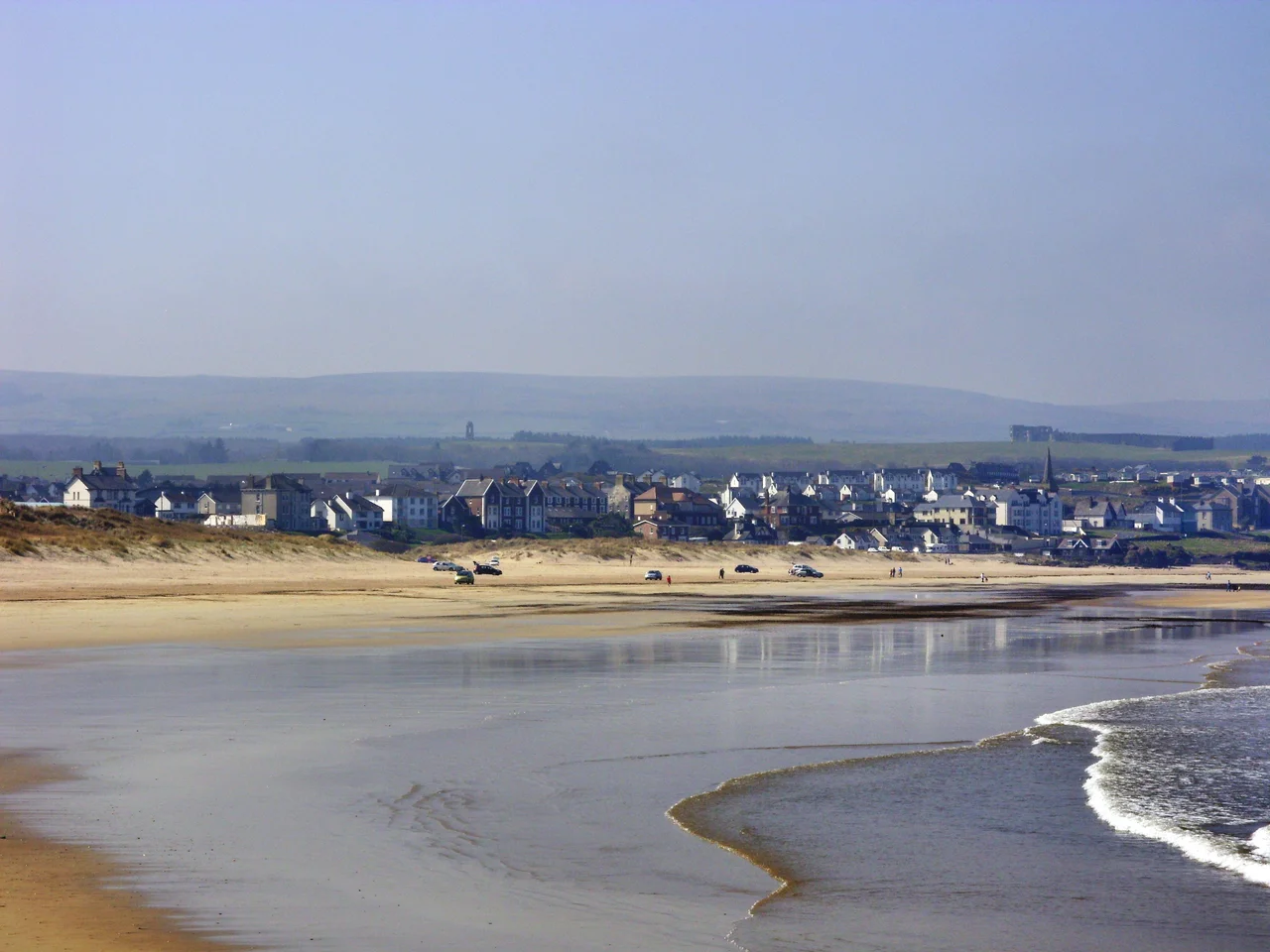
The Mussenden Temple stands on the cliff edge as if daring the Atlantic to come and take it. A small classical rotunda built in 1785 by the 4th Earl of Bristol - who was simultaneously the Anglican Bishop of Derry - it perches above a 120-foot basalt drop with the North Atlantic crashing white below. Erosion has been bringing the cliff closer to the temple for two centuries. The National Trust has stabilised it. The temple holds. Behind it sprawls the ruined Downhill House, another piece of episcopal extravagance from the same eccentric bishop. The village of Castlerock - 1,155 people at the last count, five miles west of Coleraine - sits below the cliff, where C.S. Lewis spent childhood holidays that may have helped shape the world he later called Narnia.
The Earl-Bishop's Folly
Frederick Hervey, 4th Earl of Bristol, was Bishop of Derry from 1768 until his death in 1803. He was also an obsessive traveller, an art collector, and an architect of impossible ambition. Hotels across Europe still bear his name. Downhill House was his Ulster project - a vast Italian-style palace built on the basalt cliffs in the 1770s, surrounded by gardens, terraces, follies, and the famously precarious Mussenden Temple, named for his niece Frideswide Mussenden. The bishop filled the house with paintings, sculpture, and a library that ranked among the finest in Ireland. A fire gutted the building in 1851; what remained was abandoned after the Second World War. The roofless shell is now owned by the National Trust. You can walk through where the drawing rooms used to be.
Hezlett House and the Crucks
Just outside the village, at a quiet crossroads, stands one of the oldest surviving thatched cottages in Northern Ireland. Hezlett House was built around 1691 - originally as a rectory or farmhouse - using a cruck-frame construction so traditional it was already considered old-fashioned by the late seventeenth century. Cruck pairs are matched curved timbers, like the ribs of a ship, that rise from the ground and meet at the roof apex. The technique reaches back to medieval building practice. Most cruck houses have collapsed or been demolished over the centuries. Hezlett House survived because the same family lived in it continuously for nearly three hundred years. The National Trust now keeps it as a museum of pre-industrial rural life.
Lewis and the Lion
C.S. Lewis was born in Belfast in 1898, and as a boy he spent summer holidays in Castlerock. The damp Edwardian seaside, the cliffs above the strand, the ruins of Downhill House visible from the beach - these were the landscapes of his childhood imagination. Lewis would later say that the bookcase wardrobe full of fur coats in his great-aunt's house gave him the idea for the entrance to Narnia. But he also acknowledged that the Antrim and Londonderry coasts shaped his sense of magical geography - the way an old ruin on a clifftop can feel like the threshold of another world. Some readers think the description of Cair Paravel, the seaside castle in The Lion, the Witch and the Wardrobe, owes something to Mussenden and Downhill. The connection is suggestive rather than proven. Lewis himself was characteristically cagey about specific sources.
The Trains and the Tourists
Castlerock railway station opened on 18 July 1853 as part of the Belfast-Derry coast line - one of the great Victorian railway journeys, hugging the cliffs above the Atlantic for miles. NI Railways still runs hourly trains in both directions, slowing the schedule slightly for Sunday. The village swells in summer. The two caravan parks fill up, the apartment blocks along the promenade fill up, the Castlerock Golf Club fills up. The 18-hole Mussenden championship links course is bounded by the beach, the River Bann, and the railway line - one of the most dramatic settings for golf anywhere in Ireland. The 9-hole Bann course offers a gentler alternative. Both have been here for over a century.
Quiet Shadow
Castlerock was largely untouched by the Troubles. Only one fatal incident occurred in or near the village in connection with the conflict - the 1993 Castlerock killings, when four workmen were shot in a van on Freehall Road by UDA gunmen using the Ulster Freedom Fighters cover-name. Coleraine man Torrens Knight was later convicted. The actor James Nesbitt lived in Castlerock as a teenager and learned his trade in school productions. The village does not advertise its dark moments. The cliffs and the strand and the trains do most of its talking. The basalt remembers everything; the basalt says nothing. People come here mostly to walk along the beach, look up at Mussenden, and let the salt air clear whatever they brought with them from inland.
From the Air
Located at 55.15°N, 6.78°W on the Antrim/Londonderry coast at the mouth of the River Bann. The basalt cliffs and Mussenden Temple are the most distinctive aerial landmarks - the temple perches on the cliff edge just east of the village. Nearest airports: City of Derry (EGAE) 18 nm west; Belfast International (EGAA) 35 nm east-south-east. The 18-hole Castlerock Golf Club links course is clearly visible from cruising altitude. The Belfast-Derry railway line traces the coast immediately below the cliffs, one of the most scenic train routes in the British Isles.
Nearby Stories
- Armoy 2.6 km away
- Buncrana 5.7 km away
- Strabane 5.8 km away
- Plantation of Ulster 14 km away
- HMS Audacious 19 km away
- Castle Upton 22 km away
- German submarine U-218 30 km away
- Port Ellen Distillery 30 km away