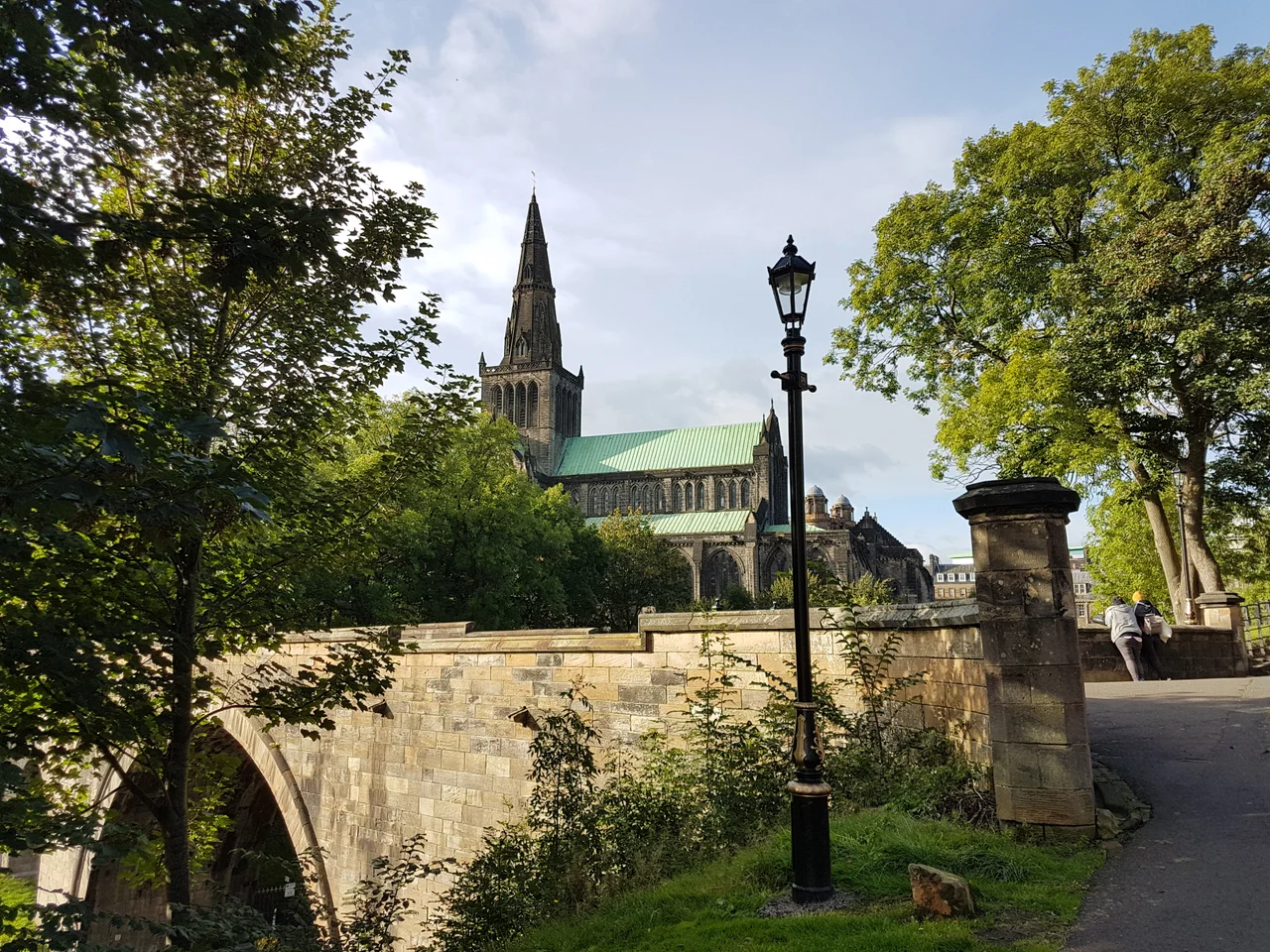

Cathedral Square, Glasgow
Before 1879, the ground in front of Glasgow Cathedral was a packed labyrinth of post-medieval houses and workshops, the kind of muddled half-derelict block that grew up on the rubble of a forgotten castle. Stalking through it on his way to the Royal Infirmary, an ordinary Glaswegian would have hardly seen the cathedral until he was on top of it. The City Improvement Trust, under the city's chief architect John Carrick, swept it all away that year, opening up Cathedral Square. The result is the rare Glasgow space that lets you stand and take in the full age of the city at once: the cathedral, the Necropolis on its hill, the medieval Provand's Lordship, and the great Victorian Royal Infirmary, all visible from the same patch of grass.
Clearing the Hovels
John Carrick had a job that would now be called master planning, but the language of the 1860s and 1870s was blunter: he was paid to clear hovels. The City Improvement Trust, established to remake the medieval core of Glasgow, demolished the slum tenements crowding up to the cathedral, pushed a new road called John Knox Street curving past the entrances of the Necropolis down toward Duke Street, and covered over the Molendinar Burn, the small stream that, six centuries before, had marked the spot where Saint Mungo settled. Cathedral Square Gardens opened in 1879, laid out by Carrick the same year as Glasgow Green. The space served, and still serves, two purposes at once. It is a quiet place to sit, with old trees and benches; it is also the natural backdrop for political gatherings, public mourning, and civic ceremony. In the late 1890s the sprawling Duke Street Prison tried to expand into the square. Indignation meetings were held. The campaign to save the green space succeeded; an anonymous poem in the Glasgow Evening Post defended the square: We love it, and who shall dare to chide us for loving Cathedral Square.
The Buildings That Frame the Sky
Glasgow Cathedral itself anchors the east side: the oldest building in Glasgow, first dedicated in 1136 and substantially rebuilt and reconsecrated in 1197, Category A listed, the only medieval Scottish cathedral on the mainland to come through the Reformation almost intact. North of it the Glasgow Necropolis rises sharply, a Victorian garden cemetery opened in 1833 above what had once been the Merchants' Park, its monuments standing like a stone forest on a hill. To the west the Glasgow Royal Infirmary, reconstructed from 1914 by architect James Miller on the site of a 1794 Robert Adam building, looms over the square. The 1880 Glasgow Evangelical Church, Category A listed, brings an elegant Italian facade designed by John Honeyman, a partner of Charles Rennie Mackintosh's later master. Sir John James Burnet's 1889 red sandstone Barony Hall stands across from it. In the centre of the Victorian square is the St Mungo Museum of Religious Life and Art, designed by Ian Begg and opened in 1993. Provand's Lordship, the oldest dwelling in Glasgow, sits opposite, on the corner of Castle Street, a small house that has watched the square's making and unmaking from the late fifteenth century onward.
Statues with Stories
Cathedral Square gathers statues the way a magnet gathers iron filings. Some came from elsewhere in the city when newer purposes needed their original sites. The equestrian statue of King William III, cast by Cant and Lindsay in 1735, stood at Glasgow Cross until 1923 before being moved here. David Livingstone, physician, missionary, and explorer, by sculptor John Mossman in 1879, stood at George Square until 1956. Queen Victoria, by Albert Hemstock Hodge in 1914, surveys the square; an 1881 bust by John Mossman commemorates Rev Dr Norman McLeod, the minister of the Barony Church. James Lumsden, a Lord Provost and Royal Infirmary treasurer, was memorialised in 1862 by Mossman. James Arthur, a clothing manufacturer and philanthropist, came in 1893; James White, a chemicals manufacturer, in 1890. On top of the Necropolis hill, predating the cemetery itself, stands the 1825 monument to the Reformer John Knox, designed by Thomas Hamilton and carved by Robert Forrest. Glasgow's history of religion, industry, and empire stands here in stone, looking out across the square at one another.
An Older Glasgow, Still Audible
What makes Cathedral Square uncanny, if you stop to feel it, is how close together the centuries are. Below your feet runs the covered Molendinar Burn, which the medieval city used as its water source and its drain, the same little stream by which Mungo set up his community some time around 600 CE. Above your head are the spires of the cathedral that was built over Mungo's grave starting in the late 1100s. Across the small green park rises the Royal Infirmary, where Joseph Lister introduced antiseptic surgery in the late nineteenth century. The Necropolis hill behind the cathedral holds tens of thousands of dead, their stones recording merchants, ministers, doctors, and, occasionally, the unknown poor. Cross the iron Bridge of Sighs from Cathedral Square to the Necropolis, and you are walking, in physical terms, from the city's first sacred ground to its great Victorian cemetery in about a hundred steps. Few cities let you do that without buying a ticket.
From the Air
Cathedral Square lies on the east side of central Glasgow at 55.8628 N, 4.2361 W, with Glasgow Cathedral as the most prominent landmark and the wooded slope of the Necropolis immediately east. The square is on High Street/Castle Street at John Knox Street. Glasgow International (EGPF) lies 6 nm west; Glasgow Prestwick (EGPK) 28 nm to the south-southwest. From 1,500 to 2,500 feet AGL the cathedral's slate roof and the Necropolis stones are an unmistakable landmark on the city's east side; the Royal Infirmary's pale frontage closes the square to the west. On clear days the Campsie Fells rise to the north and provide a useful navigational backdrop.
Nearby Stories
- Mauchline 3.6 km away
- Shotts 4.2 km away
- HMS Ulysses (1917) 7.7 km away
- Rothesay Castle 8.8 km away
- Inchcailloch 10 km away
- Strachur 14 km away
- Battle of Dollar 16 km away
- Crawford Castle 16 km away