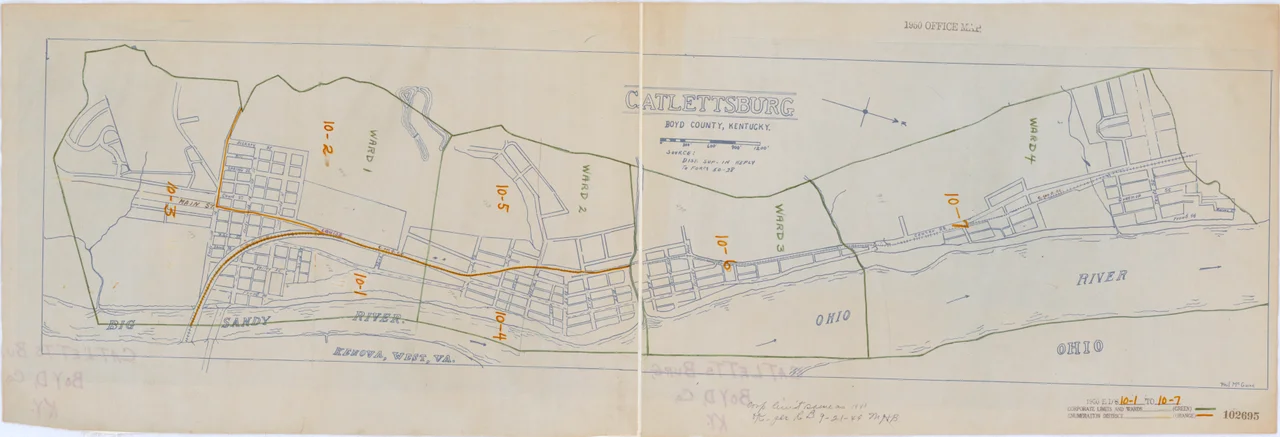

Catlettsburg, Kentucky
Between roughly 1890 and 1920, Catlettsburg, Kentucky, was the largest hardwood timber market in the world. Logs floated down the Big Sandy River from the deep eastern Kentucky forests, accumulated at the mouth where the Big Sandy meets the Ohio, and were sold by the millions of board feet to buyers from across the country. Virgin oak, walnut, hemlock, hickory - the great trees of the Appalachian forest came through Catlettsburg on their way to becoming furniture, flooring, ship timbers, and gun stocks. By the 1920s the boom was over because the trees were gone. Catlettsburg today is a town of 1,780 people, the Boyd County seat, the kind of small American river city whose past dwarfs its present by an order of magnitude.
The Catletts and Their Inn
Alexander Catlett arrived at this bend of the Ohio River in 1798. Before his arrival, the spot was known as the Mouth of Sandy. His son Horatio opened a post office on December 5, 1810, the first official use of the Catlett family name as the community's identity. Around 1811, the Catletts built a log structure from virgin Kentucky hemlock-maple and ran a tavern, post office, trading post, and inn from it. The location was perfect. Frontiersmen heading west on the Ohio stopped here. River traders unloaded and reloaded. The guest list over the early nineteenth century included Henry Clay, Felix Grundy, and the future president James Garfield. (Family tradition also includes Stonewall Jackson, though the dates make this harder to verify.) The Catlett House still stands - 200 years old in 2026, made of hemlock-maple walls 9 to 12 inches thick, supported by virgin timber columns 64 inches in diameter that run the full 42-foot width of the house. It is cited as the oldest known building within a 300-mile radius.
Hardwood King
Catlettsburg's hardwood market peaked in the decades around 1900. The Big Sandy River drained an enormous watershed of mature Appalachian forest, and the easiest way to get timber to market was to float it. Logs were branded by individual loggers, floated downstream, and sorted at Catlettsburg's booms. From there they shipped by Ohio River barge or by rail to buyers everywhere. The trade was tremendously profitable for a few decades. It also stripped the upstream forests with a thoroughness that is hard to fully picture today. Most of the desirable hardwoods within several miles of Catlettsburg were felled. A few survivors remain: a large oak in the Hampton City section dates to around 1760 and measures 246 inches in diameter - the oldest known living tree of any breed in or around the city. A nearby hemlock-maple measures over 350 inches, one of very few of that species left in North America.
The Railroad Bridge
Collis P. Huntington built the city of Huntington across the river specifically to be a railroad town for his Chesapeake and Ohio Railway. In 1885 the C&O began constructing the railroad bridge that crosses the Big Sandy at Catlettsburg, linking the Kentucky side to Kenova, West Virginia. The bridge opened with the line to Cincinnati in 1888 and is still in service - now operated by CSX Transportation, carrying an average of 80 freight trains daily. Amtrak's Cardinal also crosses it, three times a week in each direction, on its long run between Chicago and New York. The 1906 passenger depot at Catlettsburg operated for 52 years before service moved to Ashland in 1958, after which the C&O sold the building to the city for one dollar. Russell Compton funded a full restoration in 2006-2007, and the depot now serves as the Russell Compton Community Center.
Beechmoor and Mary Elliott Flanery
Beechmoor Place on Walnut Street incorporates the original Catlett House as its eastern wing - the building now used as the servants' quarters of the larger Georgian home built next to it. Colonel Laban T. Moore, a former U.S. House member, bought the estate in 1868 for $10,000 (about $171,000 in 2011 dollars). His granddaughter Rebecca Patton listed the property on the National Register in 1973 and lived in it until her death in 1986. It remains in the Moore family. Across town, Catlettsburg native Mary Elliott Flanery made history in 1921 as the first female state legislator elected in Kentucky and the first elected anywhere south of the Mason-Dixon line. The list of notable Catlettsburg figures is unusually deep for the city's size - including the blind fiddler Ed Haley, the novelist Billy C. Clark, and Michael Polakovs, a Latvian-born circus performer who retired here and who as Coco the Clown revamped the Ronald McDonald character that became one of the most recognized commercial icons in the world.
The Town from Above
From the air, Catlettsburg sits at the confluence of the Big Sandy and Ohio rivers, with the railroad bridge a thin straight line crossing the smaller Big Sandy and the Marathon Petroleum Catlettsburg Refinery looming as the largest industrial complex in the area. The downtown grid is compact - 1.6 square miles total, with 22 percent of that surface water. The First Presbyterian Church at 26th and Broadway, built in 1875 and used as a Union Army hospital during the Civil War, still anchors the historic core. The Boyd County Courthouse stands a few blocks away. The town reads visually as a small Ohio River port that once mattered more than its current size suggests - the layered remnant of an American economy built on rivers, railroads, and the great timber boom that exhausted itself a century ago.
From the Air
Located at 38.405 degrees north, 82.601 degrees west, at the confluence of the Big Sandy and Ohio Rivers in Boyd County, Kentucky. Recommended viewing altitude 3,500 to 5,500 feet AGL for clear views of the river junction. Nearest airport is Tri-State (KHTS) at Huntington, just across the Ohio River, about 4 nautical miles east. Ashland Regional (KDWU) is about 5 nautical miles west. The Catlettsburg Refinery is a major visual landmark just upstream on the Big Sandy.
Nearby Stories
- Battle of Scary Creek 6 km away
- Portsmouth 7.2 km away
- Fred M. Vinson Museum and Welcome Center 14 km away
- Staats Mill Covered Bridge 24 km away
- Lake Tight 25 km away
- Battle of Blair Mountain 32 km away
- Lower Shawneetown 35 km away
- The Kentucky Meat Shower: When Flesh Fell From a Clear Sky 68 km away