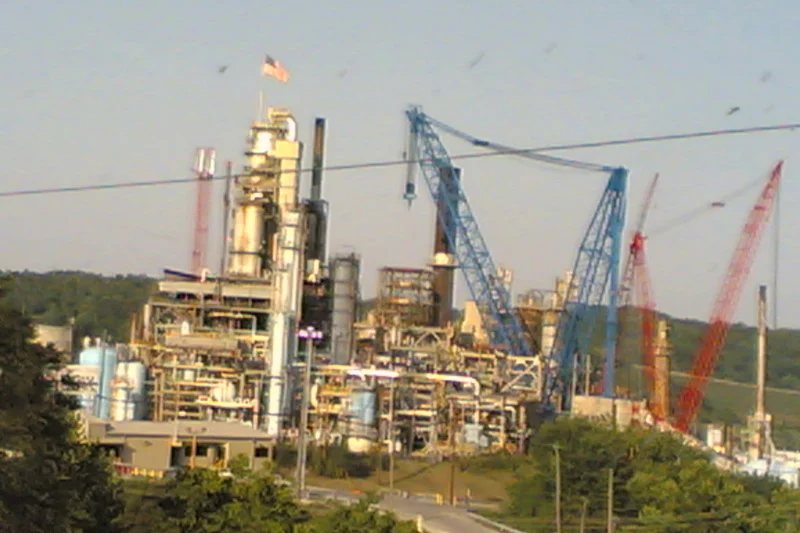

Catlettsburg Refinery
Two miles south of where the Big Sandy River empties into the Ohio, a forest of distillation towers, storage tanks, and stack flares occupies 650 acres of riverbank. The Catlettsburg Refinery processes more than 291,000 barrels of crude oil per day - one of the largest refineries in the central United States. The complex has been here since 1916, employs around 1,600 people, and ships its products by pipeline, by barge, and by truck out into the surrounding tri-state economy. From any vantage point in Ashland, Huntington, or Catlettsburg, the refinery is visible. From the air, it dominates a section of the Big Sandy valley with an industrial footprint that has no peer for fifty miles in any direction.
Built in 1916, Sold in 1924
The Great Eastern Refining Company built the original refinery on this site in 1916, in the early years of the American petroleum industry's expansion beyond the Pennsylvania oil fields. The location was strategic. Big Sandy River barges could move products downstream to the Ohio. Coal-fired power was abundant. Eastern Kentucky's small oil fields were nearby. And the growing industrial economy of the Huntington-Ashland corridor provided immediate local demand. In 1924, Ashland Refining Company purchased the facility - a transaction that would help launch what eventually became Ashland Inc., one of the major American oil and chemical companies of the twentieth century. The refinery has expanded continuously since then, growing in fits and starts as ownership and demand changed.
What 291,000 Barrels a Day Means
The refinery's nameplate capacity exceeds 291,000 barrels per day - over twelve million gallons of crude processed every twenty-four hours into gasoline, diesel, jet fuel, asphalt, petrochemicals, and other refined products. To put that in perspective, that volume could fuel roughly a million American cars a day. The Catlettsburg facility ranks among the larger inland refineries in the United States. The 650-acre site includes crude distillation units, cracking towers, hydrotreaters, sulfur recovery, blending tanks, and miles of pipework connecting it all. The visual scale from the ground is overwhelming. From the air, the orderly grids of tank farms and the silver complexity of the processing units read as a single integrated industrial organism.
Pipeline, Barge, and Truck
The refinery's location at the intersection of Interstate 64 and U.S. Route 23 gives it highway access for tanker trucks distributing finished products to regional terminals. The Big Sandy River frontage allows products to load onto barges for shipping down the Ohio - the Port of Huntington-Tristate, of which Catlettsburg is a component, regularly ranks among the busiest inland ports in the United States by tonnage. Pipelines connect the refinery to the broader American distribution network, including the major Mid-Continent pipelines that feed crude in and the product pipelines that move refined fuels out. The three-way transportation access - rail, water, and highway - is a significant competitive advantage that few American refineries can match.
Marathon Petroleum Era
Ashland Inc. spun off its refining business in 1998 and ultimately merged its remaining refining operations into Marathon Petroleum Corporation. The Catlettsburg Refinery now operates under Marathon's ownership. Marathon has continued to invest in the facility, modernizing equipment to meet evolving emissions standards and to improve efficiency. The refinery remains one of the largest private employers in the Huntington-Ashland metropolitan area, with around 1,600 employees and contractors on site. Its economic footprint extends beyond direct employment to the construction trades that maintain the facility, the truckers who haul products, the railroad workers who service the rail spurs, and the local businesses that serve all of them.
The Industrial Skyline
From the air, the Catlettsburg Refinery defines a long stretch of the Big Sandy River's west bank. Storage tank farms appear as orderly grids of white circles. The processing units cluster densely in the center of the complex, with the tall distillation columns rising as vertical accents. Flare stacks burn off excess gas, visible at night as small steady flames. The Ohio River runs north of the complex, the Big Sandy River runs east of it, and Interstate 64 cuts past the southern edge. This is the industrial face of Eastern Kentucky that coal and oil money built - smaller now than its 1970s peak, but still very much functioning. The refinery is not a tourist attraction. It is a working facility, and it has been working continuously for over a century.
From the Air
Located at 38.374 degrees north, 82.599 degrees west, on the west bank of the Big Sandy River in Catlettsburg, Kentucky. Recommended viewing altitude 4,500 to 7,500 feet AGL for clear views of the refinery's full footprint. The complex is also visible from much higher altitudes due to its size. Nearest airports are Tri-State (KHTS) at Huntington, about 4 nautical miles east, and Ashland Regional (KDWU), about 5 nautical miles north. The refinery's flares are visible at night for miles in any direction.
Nearby Stories
- Battle of Scary Creek 6 km away
- Portsmouth 7.2 km away
- Fred M. Vinson Museum and Welcome Center 14 km away
- Staats Mill Covered Bridge 24 km away
- Lake Tight 25 km away
- Battle of Blair Mountain 32 km away
- Lower Shawneetown 35 km away
- The Kentucky Meat Shower: When Flesh Fell From a Clear Sky 68 km away